The modern theater of war is undergoing an unprecedented transformation driven by the rapid evolution of unmanned technologies. While remotely piloted unmanned aerial vehicles (UAVs) and the first iterations of unmanned ground vehicles (UGVs) were the key factors influencing the battlefield during 2022–2024, the near future will be defined by the mass deployment of fully autonomous ground systems controlled by artificial intelligence (AI).
The Russian Federation’s full-scale aggression against Ukraine has turned the country into a global testing ground for military innovations, where Ukraine must not only adapt to new challenges, but also be the first in the world to develop and implement a comprehensive doctrine to counter autonomous UGVs.
The appearance on the battlefield of fully autonomous ground robotic complexes operating under AI control without constant communication with the operator requires a radical change in the concept of countermeasures.1Traditional defense architectures, which rely heavily on electronic warfare (EW) to suppress control and navigation channels (e.g., 2.4 GHz bands or GPS/GNSS signals), are rapidly losing their effectiveness. Autonomous UGVs rely on onboard computing power, inertial navigation systems, and computer vision algorithms to operate in complete electronic isolation.2
Realizing this fact requires a transition from electromagnetic warfare in the ether to a multi-level impact on the physical and cognitive logic of machine operation. Defeating such systems should be based on four fundamental pillars: destruction of sensory perception (optical-electronic suppression), disabling on-board computing power (microwave defeat), blocking mobility (specialized engineering barriers), and kinetic destruction of power sources and critical nodes.4Moreover, a method of countering algorithms — adversarial attacks — that can disorient enemy neural networks at the level of pattern recognition is becoming critically important.7
This study provides a comprehensive analysis of the timeline for the deployment of autonomous systems, details the architecture of countermeasures for different types of robotic platforms, and outlines the necessary steps to reform Ukraine’s organizational structure, strategy, and military-industrial complex to ensure effective defense and offensive capabilities in a new era of military technology.
Chronology and forecasting of the mass deployment of robotic complexes
To develop an effective and efficient countermeasure system, it is necessary to clearly calculate the time frame when autonomous assault UGVs will enter the battlefield en masse. Analysis of global markets, defense orders, and current military experiments allows for a highly accurate forecast.
The military UGV market is showing signs of exponential growth. According to global industry experts, the global military unmanned ground vehicle market, which was valued at approximately US$2.06 billion in 2025, is projected to grow to US$2.18 billion in 2026 and reach US$3.74 billion by 2034, at a compound annual growth rate (CAGR) of 7.1%.9At the same time, the broader market for military drones and countermeasures is growing even faster: the total military UAV market is expected to reach $22.81 billion by 2030 (up from $15.8 billion in 2025), and the market for unmanned warfare systems is expected to be approximately $42.1 billion.1
Ukraine and Russia are the only countries currently using armed ground robots in conditions of prolonged, high-intensity combat.10Ukraine’s experience is unprecedented: already in 2025, hundreds of models and thousands of systems were successfully deployed, including small tracked “mini-tanks”, remotely controlled platforms for logistics, demining, and medical evacuation.10There is a known case when, at the end of 2025, a remotely controlled ground robot (specifically, DevDroid TW 12.7) held a forward position for 45 days without the direct presence of manpower, undergoing maintenance every 48 hours.10
The transition point to mass deployment will be 2026. The Ministry of Defense of Ukraine announced a contract for the purchase of 25,000 unmanned ground vehicles in the first half of 2026 alone, which is more than double the figures for 2025.13
The goal of this initiative is to provide 100% of frontline logistics with robotic systems, taking this burden off the infantry.13Systems such as the Bizon-L (a robot with a payload of 300 kg and a range of 50 km), the TerMIT universal NRC, as well as combat platforms such as the Ironclad from Roboneers, capable of carrying M2 Sabre turrets and operating at speeds of up to 12 km/h, have already been codified and put into operation.13
Forecasting the emergence of fully autonomous assault systems (2027–2030+)
Despite the successes of remotely controlled systems, full-scale deploymentautonomous assaultplatforms faces certain technological barriers. The DARPA RACER (Robotic Autonomy in Complex Environments with Resiliency) program, which tests autonomous movement of combat vehicles (such as modified Textron Ripsaw M5) through difficult terrain, is showing significant progress. During experiments, the system was able to independently overcome rough terrain and apply a mine clearance system from a distance of 2.5 km.16
However, the program management recognizes that large-scale autonomous ground combat operations, where robots will act as independent strike units in difficult, unpredictable conditions without human intervention, will not become a reality until a decade later (approximately 2030-2035).16
Despite this, other countries are actively pushing forward with development. Iran has introduced the Aria combat robot with artificial intelligence, India is developing a heavy unmanned tank based on the Arjun platform with a 120 mm cannon, and European companies (for example, the Rheinmetall and DOK-ING partnership) plan to launch prototypes of modular robotic guided vehicles as early as 2025–2026.10
Based on these data, the Armed Forces of Ukraine should build their strategy based on the following deployment matrix:
| Development stage | Time frame | Level of system autonomy | Main tasks on the battlefield | Threat level and focus of countermeasures |
| Stage 1: Saturation | 2024–2026 | Remote control (RC), telemetry, basic waypoint navigation. | Logistics, mining/demining, evacuation, stationary turrets. | High dependence on communications. Countermeasures: classic electronic warfare, kinetic artillery damage, remote mining. |
| Stage 2: Hybrid autonomy | 2027–2029 | Semi-autonomous algorithms, AI assistants, optical capture and target recognition. | Fire support for infantry, assault on prepared positions, patrolling. | Reduction of EW effectiveness. Countermeasures: physical barriers, microwave weapons (HPM), adversarial patches (basic). |
| Stage 3: AI Swarms | 2030+ | Full autonomy, collective intelligence (Swarm AI), independent decision-making to defeat. | Deep defense breakthroughs, combat operations in highly urbanized areas, algorithmic target search. | Electronic warfare is ineffective. Countermeasures: total adversarial cloaking, laser blinding of sensors, specialized anti-robot munitions. |
Therefore, the critical period of preparation for the appearance of semi-autonomous enemy attack aircraft is2026–2027Right now, Ukraine must begin reforming its defense lines and developing specialized means, because from 2027, classic defense systems will not be able to stop massive attacks by robotic equipment.
Typology of platforms and their vulnerabilities
The development of specific countermeasures must be based on a deep understanding of the physical architecture, kinematics, and energy balance of enemy systems. Ground vehicles (unlike aircraft) interact rigidly with the terrain, are subject to the laws of friction, and have significant limitations in overcoming spatial obstacles. Each type of platform requires a specific approach to neutralization.
Tracked vehicles, ranging from small platforms like the Ukrainian Ratel S or THeMIS, to heavy strike complexes (such as the Russian “Uran-9” or the American RCV-Heavy weighing up to 30 tons with a 50 mm AI cannon), are designed to overcome difficult terrain, soft soils, mud, and snow.2
- Strengths:High resistance to overturning, ability to carry heavy weapons and powerful batteries, high level of passive armor protection, ability to overcome classic anti-tank ditches (depending on dimensions).
- Vulnerabilities:The crawler drive is critically vulnerable to roller jamming. Winding high-strength synthetic fibers (Kevlar, Dyneema) or steel wire leads to instant jamming of the transmission, causing catastrophic overload of the electric motor or hybrid power plant and its burnout.6Additionally, heavy batteries emit a significant thermal and magnetic signature, making them vulnerable to induction mines.
Wheeled robots (4×4, 6×6, 8×8 platforms) are optimized for fast movement on roads, relatively flat terrain and in urban areas. These systems are more economical to manufacture, have a longer range and are more often used for logistics or as mobile EW platforms and repeaters.6
- Strengths:Speed, ease of maintenance, lower cost of swarm deployment, ability to quickly change position after completing a fire mission.
- Vulnerabilities:Severe dependence on micro-relief. The wheelbase is easily stopped by narrow trenches, spikes, caltrops and concrete barriers.6Even a slight vertical drop in height, which a tank or a person can overcome without any problems, becomes an insurmountable wall for a small-wheeled UGV due to the small wheel diameter.6
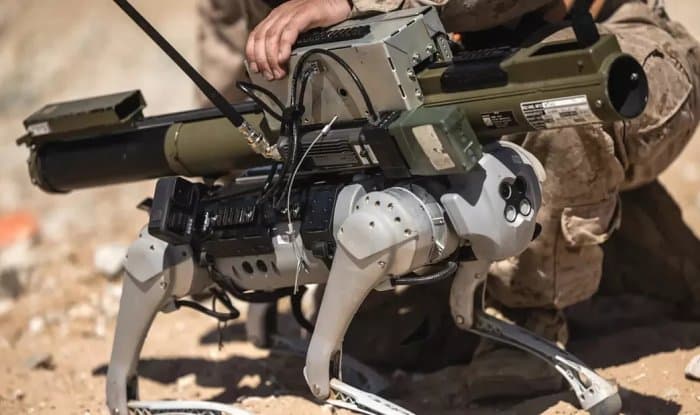
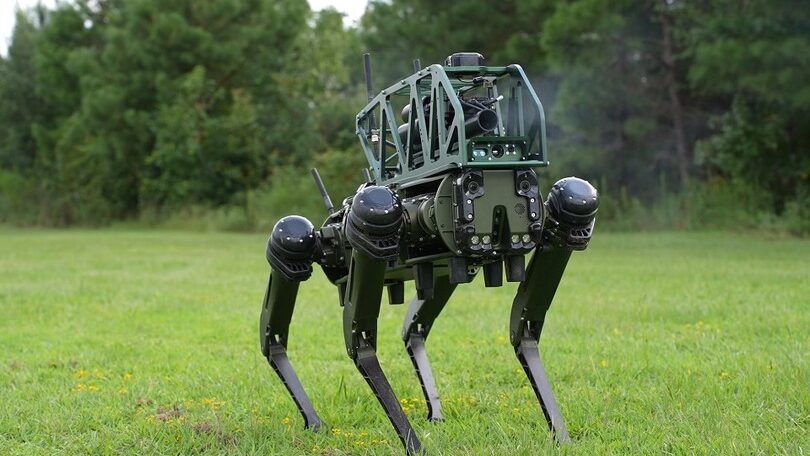
Walking robots (so-called “robodogs”, for example, the Ghost Robotics V60 or developments by Boston Dynamics) pose a particular threat in highly urbanized environments, high-rise buildings, forest plantations, and trench systems.6
- Strengths:Unprecedented adaptability. Dynamic balancing algorithms allow them to jump over obstacles, climb stairs, navigate over debris, and continue moving even after the loss of a limb or a significant kinetic impact.
- Vulnerabilities:Their strength is their weakness—their extremely complex joint kinematics and critical reliance on high-speed visual processing for balance. Hitting one servo in an FPV drone destroys the entire motion geometry.6Additionally, they are extremely vulnerable to spatial grids and confusion: if a wire gets caught between joints, the AI algorithm cannot calculate the correct force vector for release, resulting in a fall and shutdown.6
Adversarial attacks and AI deception
The most revolutionary and cost-effective way to combat autonomous AI systems is to interfere with their “cognitive domain.” Unlike a human who evaluates an object holistically (context, behavior, shape), AI relies on deep convolutional neural networks (CNNs, such as the YOLO, SSD, Faster R-CNN architectures) that analyze images as arrays of pixels, looking for specific edges, gradients, and patterns.8
When these algorithms encounter carefully calculated visual noise or altered geometry, they suffer critical failures, leading to misclassification or complete target ignoring.7
The ability to generate such “adversarial attacks” should become the basis for the camouflage of the Ukrainian Defense Forces.
The implementation of specialized adversarial patches is a necessity. Research shows that the creation of localized visual noise (e.g., the LaVAN framework) allows for the creation of patterns that are imperceptible to humans but catastrophic to AI.19
One of the newest solutions is the use of systems like TACO (Truck Adversarial Camouflage Optimization).20By using the Unreal Engine 5 engine and integrating differential rendering with the Convolutional Smooth Loss function, patterns are generated that are applied to 3D models of equipment (for example, tanks or logistics trucks).20Experiments show that the presence of such adversarial camouflage radically reduces the performance of the latest YOLOv8 detector, reducing the average accuracy rate (AP@0.5) to a critically low level (0.0099), which effectively makes the technique invisible to the robot.20
More importantly, these patterns have high transferability to other architectures, such as Faster R-CNN and older versions of YOLO.20
The effectiveness of an adversarial patch in military camouflage is measured by the following key metrics:
- Attack Success Rate (ASR): The percentage of trials in which the patch successfully achieves its goal (ignoring or false identification).
- Mean Average Precision (mAP) Drop: The level of decline in the recognition accuracy of the neural network.
- Detection Delay: The time the system delays before making a decision, which is critical to buying time to destroy the robot.
- Physical Test Success Rate (PTSR): Patch success rate in real-world lighting, dirt, and deformation conditions.8
Since military UGVs operate 24/7 and in difficult weather conditions, their sensor systems are not limited to the visible spectrum, but actively use long-wavelength (LWIR) and near-infrared (NIR) thermal imagers.21A computer vision model identifies objects (e.g., a soldier) in the thermal range by detecting contrasting outer and inner edges of heat.21
To counter this, the Armed Forces of Ukraine should develop dual-purpose camouflage. European developments, in particular within the framework of the DFR_ARC project (Belgium), are already investigating the creation of patterns that deceive AI in different spectra.22Deterioration of thermal edge definition (through the use of thermoregulating fabrics or special panels that dissipate thermal radiation) destroys the ability of the YOLO model in the LWIR spectrum to distinguish an object from the background, nullifying the effectiveness of the robot’s aiming system.21
Additionally, the use of QR-like adversarial patches in the form of small shields or stickers scattered around positions will create phantom targets.19An enemy autonomous complex will classify a piece of plywood with a patch as an ATGM crew or an infantry group, wasting expensive ammunition on it, while the real firing points will remain unnoticed.
Optoelectronic and sensor suppression
When adversarial cloaking is not possible (for example, during active vehicle movement) or the enemy system has approached a critical distance, it is necessary to use direct physical blocking of the robot’s sensor systems. An autonomous system, deprived of vision and lidar data, loses the ability to balance, navigate, and fire, turning into a static target.
- Multispectral smoke and aerosol screens: Classic smoke blocks only visible light. Against autonomous UGVs, it is necessary to use specialized aerosols containing metallized microparticles and graphite dust. Such curtains are able to simultaneously absorb infrared radiation (blinding thermal imagers) and scatter laser beams of lidar, destroying the three-dimensional cartography of the terrain that the robot builds in real time.
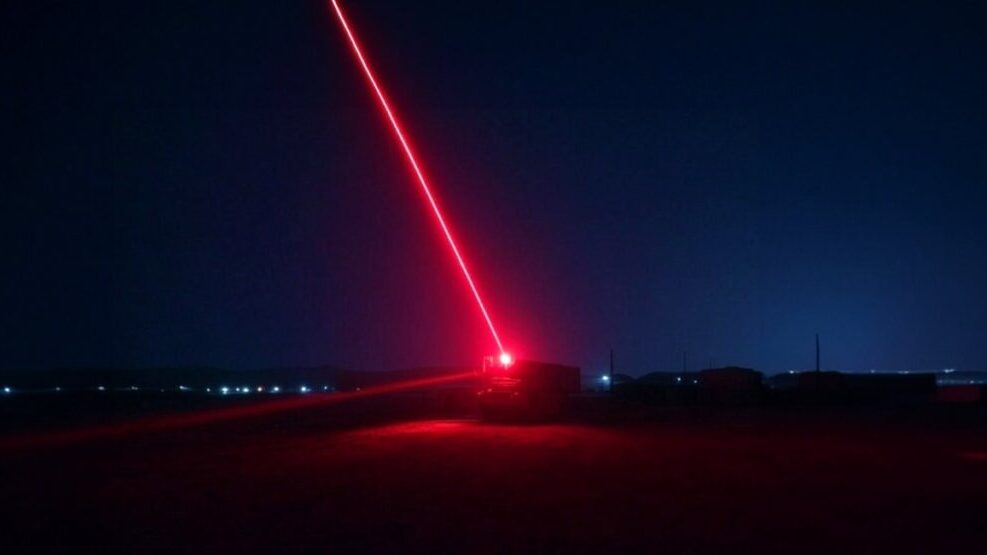
- Laser Dazzling: Using automated stations with low- and medium-power lasers, also controlled by artificial intelligence. These stations (similar to futuristic DEW systems) quickly scan the space, find the reflections of enemy robot optics, and direct a concentrated beam of light there.4This causes oversaturation of the camera matrix (CMOS/CCD) or irreversible thermal damage to the matrix, which ultimately renders the optical channel inoperable.
- Contaminant kinetic traps: Placing sprayers with fast-setting, sticky or opaque chemicals (such as construction foam or epoxy resins) along the likely robot movement routes. When a breach is attempted, the trap mechanically covers the camera lenses, lidar sensors and UGV radars with a thick opaque layer that cannot be cleaned in the field without operator intervention.
Electromagnetic and cybernetic damage to electronics
Due to their autonomy, UGVs do not require instructions from an operator via radio. Therefore, attempts to jam communications using traditional electronic warfare (EW) means become ineffective, especially considering that robots can use low-frequency bands (below 1 GHz) to penetrate obstacles or even operate in radio silence based on inertial navigation.2The impact vector must shift from the data channel to the hardware part of the on-board computer itself.
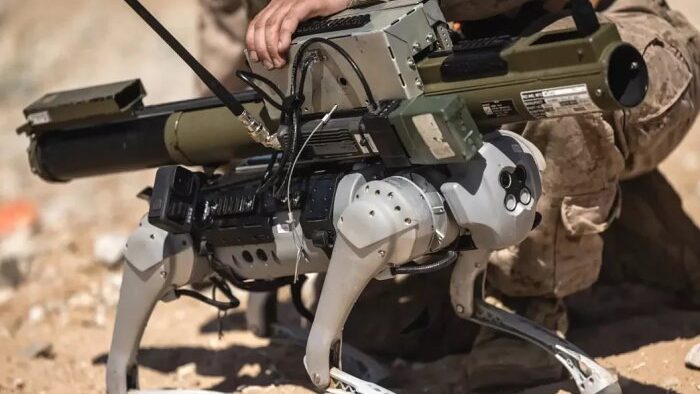
The use of directed energy weapons, in particular high-power microwave systems (High-Power Microwave), is one of the most promising areas of combating robot swarms.4
Systems, similar in concept to the American Leonidas complex from Epirus, generate a powerful directional electromagnetic pulse.25This pulse induces excessive voltage in the robot’s internal unarmored circuits – on the motherboards, graphics processing units (GPUs) and neural processing units (NPUs). This results in a “burnout” effect or critical overload of logic, which instantly disables the AI algorithms and stops the system without harming the surrounding infrastructure. Microwave weapons are scalable: they are capable of hitting both single targets and wide sectors, neutralizing the enemy’s advantage in the number of machines.4
Although new robots can be equipped with Faraday cages to protect electronics (Hardening)5, high-intensity microwave systems will remain a key soft-kill at medium ranges.
Autonomous ground systems, regardless of their size, require powerful power sources — large-capacity lithium-ion batteries or electric motors that generate a specific magnetic and electromagnetic signature. Modifying traditional anti-tank or anti-personnel mines with inductive sensors will allow them to respond exclusively to the passage of robotic equipment, ignoring wild animals or light infantry.2Detonating such mines under the bottom of the robot guarantees the detonation of lithium-ion batteries, leading to an uncontrolled fire and complete destruction of the complex.
Mechanical obstacles and engineering barriers of a new format
Unlike UAVs, ground-based UGVs move in two-dimensional space and are rigidly attached to the surface. This brings back the high relevance of engineering fortification, but its standards must be radically changed. Means effective against heavy tanks or manpower are often ineffective against small, maneuverable robot dogs or wheeled drones. And vice versa: cheap, quickly constructed barriers can completely paralyze a high-tech machine.
Below is a comprehensive architecture of anti-robotic engineering barriers:
| Obstacle type | Specification and materials | Effectiveness and method of application | Against what type of UGV |
| Anti-robot nets and tangles | High-strength barbed wire (8 kg/100 m), Egoza tape (Concertina tape), Dannert Concertinas (14 kg/roll), MZP (Inconspicuous wire barrier).6 | High.The robots don’t feel pain from the spikes, so the barrier acts as a transmission trap. The wire wraps around the rollers and hinges, blocking movement. The MZP is extremely effective against caterpillars.6 | Crawler, walking (all sizes). |
| Micro-relief traps (Anti-UGV Ditches) | Trenches 0.5 m wide and up to 1 m deep (created quickly using excavator cutters such as the MH100 Trencher).6 | High.A classic anti-tank ditch requires a width of over 3 meters and heavy equipment (Trojan, Caterpillar D5N).6A micro-trench is impassable for small-radius wheels and is created ten times faster.6 | Wheeled (small and medium radius). |
| Urban quick-installation barriers | Steel cables are stretched through anchors (Gripple Apex, Spirafix) in the doorways in combination with plastic garden netting (10 mm).6 | Critically high.Assembles in minutes with powder-actuated tools. Absorbs energy from a walking robot’s jump. AI balancing algorithm gets tangled in the flexible mesh, causing it to fall.6 | Walking (working dogs), small wheeled. |
| Static concrete and metal blocks | Interlocking Concrete Blocks, Jersey Barriers, Tetrapods (Dolos), Dragon Teeth (connected by steel cable through lugs).6 | Medium/High.Used for spatial channeling of UGV swarms. Creates insurmountable walls that force autonomous systems to seek detours directly into prepared destruction zones.6 | Tracked (medium and heavy), wheeled. |
| Caltrops and thorns | MEXE kits, small caltrops dropped from drones.6 | Average.Effective only against pneumatic tires of wheeled UGVs, does not affect tracked vehicles. Often used for remote mining of roads by drones.6 | Wheeled (pneumatic). |
A separate advantage of modern fortifications is their modularity and speed of deployment. For example, rapid deployment systems (Atkore Hatbox) allow you to lay a 15-meter barrier in the corridors of urban development in a matter of seconds, creating instant protection from an advancing swarm of assault robots.6The engineering troops of the Armed Forces of Ukraine already have successful experience in using remote mining and installing obstacles using robotic complexes.
In April 2026, thanks to engineering barriers in the Lymansky direction, more than 660 occupiers were eliminated and 140 pieces of equipment were destroyed, and all facts of defeat were recorded in the Delta situational awareness system.27This approach should be extrapolated to fighting exclusively against machines.
Kinetic and point damage
In close combat, when electronic countermeasures and cognitive cloaking systems have exhausted their capabilities, the last line of defense remains kinetic destruction of autonomous systems. It is important to note that standard infantry ammunition (e.g., 5.45 or 5.56 mm caliber) is extremely ineffective against protected robotic platforms.5Bullets can penetrate thin exterior panels, but often ricochet off internal components or pass through without causing critical damage, leaving the robot in combat condition.5
To successfully conduct close combat, infantry must receive the latest tools of destruction:
- Specialized anti-robot grenades (ARCA): 40-mm ammunition (Anti-Robot Munitions) are under development, designed specifically for combating mechanisms.5For example, Anti-Robot Corrosive Acid (ARCA) grenades spray chemicals when detonated that destroy wiring insulation, corrode camera lenses, and block external sensors. A blind robot loses its ability to navigate and coordinate with the swarm.5
- Internal Penetration Explosive Ordnance (AREP): Anti-Robot Explosive Penetrators. These are harpoon-shaped or special shaped charge shells designed to be fixed in the robot’s body and detonated inside (in compartments with computing units or batteries), tearing it apart from the inside.5
- Specialized FPV drones: Controlling kamikaze drones requires a new doctrine of targeting. Operators must aim the drone not at the center of mass or the thickest armor of the hull, but at critical and most vulnerable nodes: motor-wheels of wheeled systems, open joints of walking platforms, antenna blocks and masts with optics.6The implementation of computer vision systems (auto-target acquisition) on FPV drones themselves will allow them to automatically identify these vulnerable points and carry out an unerring strike on a moving target.
- Automatic counter-robotic turrets: Stationary turrets with 12.7 mm or larger machine guns, controlled by their own AI modules, are installed on key defense lines. They are optimized for recognizing and conducting high-speed, dense fire on small ground targets moving at high speed and with different vectors.
Reforming the Armed Forces of Ukraine and military production
The emergence of autonomous systems and their countermeasures is not just a technological challenge; it is deconstructing traditional military doctrines. Infantry units cannot fight swarms of AI robots using tactics and strategies from the last century. Ukraine has an advantage: it has already begun this process, creating the Unmanned Systems Forces (USF) as a separate branch of the military in February 2024.28Currently, the SBS has more than 12 units, including the Deep Strike Center, 14 separate brigades and regiments (for example, the 414th OBBS “Ptakhi Magyara”, the 412th OBBS “NEMESIS”, the 419th Unmanned Systems Battalion).28
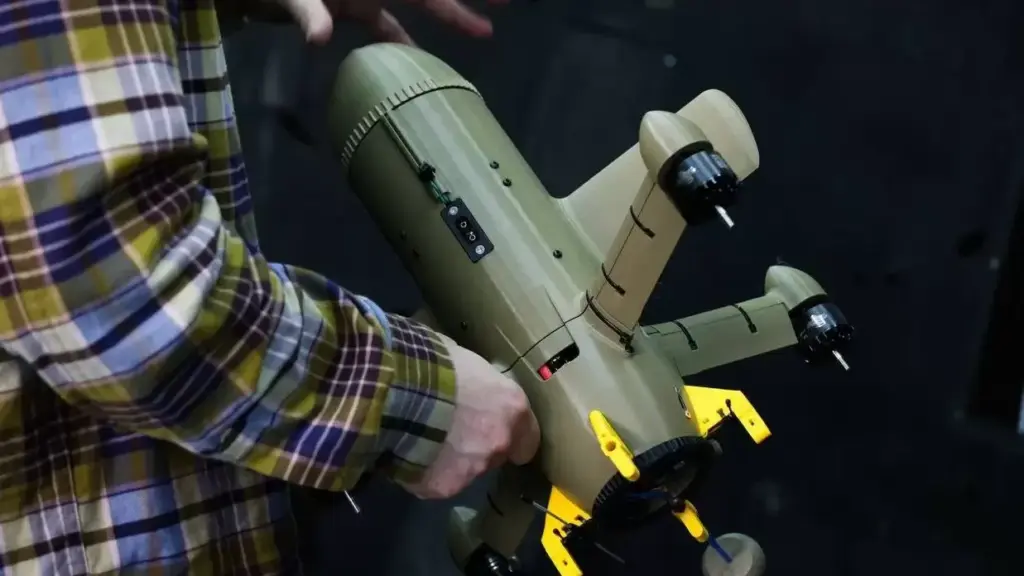
However, to prepare for 2026–2030 (the period of mass deployment of autonomous assault UGVs), the Armed Forces of Ukraine need in-depth system formatting at the level of the entire army.
The integration of robotic systems must move from the “special unit” format to the combined-arms level of each battalion.
- Scaling SBS at the brigade level: As the command notes, each linear battalion already has an unmanned systems company, and each brigade has a battalion.32However, the focus urgently needs to be expanded from aerial drones (UAVs) to ground-based UGVs. The structure of a UGV company should include:
- Assault and fire UGV platoon (control and support of Ironclad platforms).
- Ground logistics, mine clearance and medical evacuation platoon (Bizon-L, TerMIT platforms).13
- Counter-UGV Platoon: A new specialized unit focused exclusively on fighting enemy vehicles.
- New military specialties (VOS): The Armed Forces of Ukraine should introduce new professions:
- Adversarial Camouflage Specialists— officers of the engineering troops or electronic warfare, who are responsible for calculating and applying adversarial patches, and installing false thermal targets on positions.8
- Microwave Weapons Operators (HPM Operators)— specialists in the deployment of directed energy weapons.
- Decryption engineers and computer vision analysts.30
- Robotization of engineering troops of the Armed Forces Support Forces: The profession of a human sapper must become a thing of the past. The replacement of dangerous manual labor with robotic remote mining/demining systems must be scaled up to 100%.27In addition, engineering troops should be equipped with equipment for the rapid creation of anti-robot barriers (micro-trencher cutters, MZP tensioning tools and Gripple cables in urban combat).6
Western maintenance doctrine, which relies on large rear-end factories to repair complex equipment, is ineffective in high-intensity warfare, where logistical routes are constantly under attack from drones.
- Mobile support infrastructure: As the experience of operating UGVs in Ukraine shows, the key to success is integrated communication systems and local logistics.33The Armed Forces of Ukraine should implement a decentralized model: built-in mobile workshops with 3D printers for manufacturing spare parts at the battalion level. Moreover, battalion commanders should be given decentralized authority to modify UGV software (rapidly updating algorithms for circumventing enemy electronic warfare or computer vision).33This will transform machines from “disposable” tools into powerful reusable assets.33
- Defense Innovation Funding (Brave1): Developing countermeasures against AI robots requires huge investments in science. The Ukrainian defense-tech cluster Brave1 has already launched new grants (from 4 to 8 million UAH) for developers of ground robotic complexes, electronic warfare systems, cyber warfare, and weapons based on unconventional principles of action.17The selection and financing of projects to improve fire-fighting UAVs and ground robots is carried out jointly with the State Emergency Service.35However, the state should immediately create a separate, priority track within Brave1, dedicated exclusively to “Anti-UGV” technologies and the development of “Adversarial Camouflage” (including the development of AI patch generators like SAP-DIFF).15
- Training cycles: Training for SBS operators currently takes about 42 days of professional training and 14 days of coordination.30But basic training with “Counter-UGV” must be completedevery infantrymanTraining programs should include tactics for evading thermal imagers using the YOLO algorithm, methods for creating micro-relief obstacles from improvised materials in the city (blocking doors with nets and cables), and skills for hitting robot dogs with specialized grenades in the joints.5
New strategy
The integration of autonomous complexes creates a new dimension of combat operations – a war of attrition of machines, where the main goal is not the destruction of enemy personnel, but the economic and technological depletion of its robotic swarms while preserving its own.10With this in mind, the doctrine of combat requires adaptation.
For Defense:
- Deeply echeloned physical-optical blockade: Classic minefields are supplemented by a network of “confusions” (MZP) and micro-trenches invisible to computer vision at a distance of 1-2 km from positions.6
- Algorithmic exclusion zone: Behind physical barriers, a network of false targets (phantom targets with adversarial patches) is deployed, which disorient the enemy’s YOLOv8 detection algorithms.19Ukrainian Armed Forces tanks and shelters are camouflaged with dual-purpose thermo-regulating patches22, which destroy their contours in the infrared and LWIR ranges.21Enemy assault robots will waste ammunition into the void.
- Microwave Dome (HPM): Electromagnetic emitters are installed directly in front of the positions, which “burn out” the neuroprocessors of those machines that managed to break through the physical traps. The rest are taken out by operators with ARGs (acid grenades).5and FPV drones into vulnerable kinematic nodes.
For the Offensive:
- “Zero echelon” of robots: In accordance with the goals of the Ministry of Defense, replace 100% of front-line logistics with robots13, offensive operations no longer begin with the deployment of manpower. The first to enter the battle is the “zero echelon” – a swarm of inexpensive UGVs that detonate minefields, stretch enemy barriers, and take the first (most dense) blow from enemy artillery and FPV drones.10Robots don’t bleed.11
- Multi-domain coordination in electronic warfare environments: Ground and air systems must be combined into a single secure network (based on the “Delta” system).27If the enemy uses powerful electronic warfare (e.g., AD COUNTER FPV type electronic warfare) that disrupts the communication of aerial drones15, offensive ground platforms (Ironclad, etc.) must instantly switch to autonomous mode. Guided by their own onboard lidars and algorithms, they continue to storm enemy positions in complete radio silence, destroying the enemy who raised a cardboard sign “we surrender” (as has already happened in the Kharkiv region).13
- Preventive blinding of the enemy: Before the breakthrough of its own robotic swarm, the Ukrainian Armed Forces artillery creates multispectral aerosol curtains over enemy positions to blind its optical detection systems, neutralizing any attempts to use AI turrets for defense.
Conclusions
The global technology landscape suggests that the transition to fully autonomous, machine-centric warfare is irreversible. Given the exponential growth of the UGV market (to nearly $4 billion) and intensive testing programs such as DARPA RACER, the critical point of saturation of the battlefield with semi-autonomous and fully autonomous assault robots will fall between 2026 and 2030.9
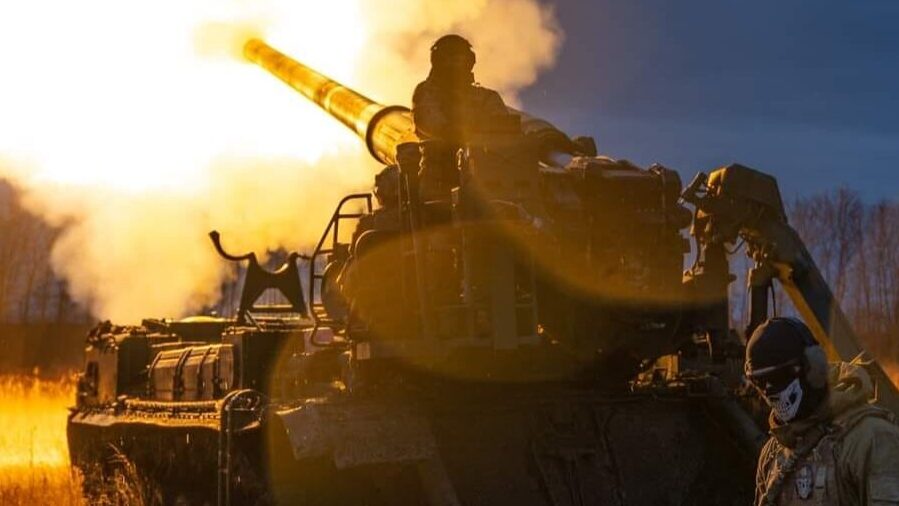
Ukraine, by contracting tens of thousands of logistics vehicles right now, is itself accelerating this process, which makes the development of a comprehensive system for countering issues of national survival.13
Classic electronic warfare methods are defenseless against artificial intelligence, which does not require communication with an operator.2Protecting the future must be built on a multi-level concept:
- Intervention in cognitive space: Creating adversarial patches and false targets that disorient computer vision neural networks (YOLOv8) in the optical and thermal spectra.20
- Hardware destruction: Using high-power microwave weapons (HPM) to burn neuroprocessors25and induction mines against rechargeable batteries.5
- Physical blocking: Abandoning standard anti-tank ditches in favor of a network of micro-trenches, “tangles” of high-strength wire, and rapid urban barriers that physically paralyze the undercarriage of tracked, wheeled, and walking platforms.6
- Specialized kinetic lesion: Providing infantry with anti-robotic chemical and expansive grenades for pinpoint strikes on sensors and joints of vehicles in close combat.5
To meet this challenge, the Armed Forces of Ukraine must complete their institutional transformation. The creation of the Unmanned Systems Forces (USF) is the right foundation28, but the next step should be the integration of specialized “Counter-UGV” platoons, HPM operators, and algorithmic cloaking specialists into each combat brigade.32At the same time, innovative grant platforms such as Brave1 should redirect the focus of funding towards developing tools to counter artificial intelligence.15
Only by acting proactively, transforming its own troops into a high-tech machine-centric army and building an impenetrable shield against enemy autonomous systems will Ukraine be able to maintain its strategic advantage and protect its personnel in new generation wars.
Institute for Social Dynamics and Security KRONOS
Sources:
- Autonomous Warfare Takes Flight: Military Drone Market Set for Explosive Growth Through 2030 | Morningstar, https://www.morningstar.com/news/pr-newswire/20260319ln14501/autonomous-warfare-takes-flight-military-drone-market-set-for-explosive-growth-through-2030
- Here are 4 ways to defend against unmanned ground vehicles – C4ISRNet, https://www.c4isrnet.com/opinion/2024/04/25/unmanned-ground-vehicles-rapidly-finding-their-place-on-battlefields/
- QUALIFICATION WORK Explanatory note – KhNURE,https://openarchive.nure.ua/bitstreams/d4ce34b0-b6de-4506-902f-77c218e33e00/download
- Future Weapons: Exploring Military Tech Of Tomorrow – Covid, https://covid.fabriciano.mg.gov.br/official-origin/future-weapons-exploring-military-tech-of-tomorrow-1767648972
- Grapeshot and Grenadiers: Winning the Counter-Robot Battle | Australian Army Research Centre (AARC), https://researchcentre.army.gov.au/library/land-power-forum/grapeshot-and-grenadiers-winning-counter-robot-battle
- Counter UGV Barriers – Think Defence, https://www.thinkdefence.co.uk/2025/01/counter-ugv-barriers/
- Operational Feasibility of Adversarial Attacks Against Artificial Intelligence – RAND, https://www.rand.org/content/dam/rand/pubs/research_reports/RRA800/RRA866-1/RAND_RRA866-1.pdf
- Generating adversarial patches for physical camouflage: methods, challenges, and constraints – SPIE Digital Library, https://www.spiedigitallibrary.org/conference-proceedings-of-spie/13673/1367304/Generating-adversarial-patches-for-physical-camouflage–methods-challenges-and/10.1117/12.3070077.full
- Unmanned Ground Vehicle UGV Market Outlook 2026-2034, https://www.intelmarketresearch.com/unmanned-ground-vehicle-market-44805
- The Status of Robot Tanks in March 2026: An Unbundling | Educational Technology and Change Journal, https://etcjournal.com/2026/03/20/the-status-of-robot-tanks-in-march-2026-an-unbundling/
- Ukraine’s robot army will be crucial in 2026 but drones can’t replace infantry, https://www.atlanticcouncil.org/blogs/ukrainealert/ukraines-robot-army-will-be-crucial-in-2026-but-drones-cant-replace-infantry/
- In the Lymansky direction, the Armed Forces of Ukraine use robotic complexes for logistics and evacuation – Zoria.info,https://zoria.info/lymanshchyna/na-lymanskomu-napryamku-zsu-vykorystovuyut-robotyzovani-kompleksy-dlya-logistyky-ta-evakuacziyi/
- Ukraine to field 25,000 ground robots in push to replace soldiers for …, https://www.defensenews.com/unmanned/2026/04/24/ukraine-to-field-25000-ground-robots-in-push-to-replace-soldiers-for-frontline-logistics/
- Evacuation, logistics, fire damage. Universal NRC “TerMIT – Brave1 Market,https://market-brave1.delta.mil.gov.ua/evakuatsiia-lohistyka-vohneve-urazhennia.-universalnyi-nrk-termit/
- Over 1,600 developments have already been registered on the Brave1 platform – Ministry of Digital Affairs – Ukrinform,https://www.ukrinform.ua/rubric-economy/3865840-na-platformi-brave1-zareestrovano-vze-ponad-1600-rozrobok-mincifri.html
- Army Still Years Away From Large-Scale Autonomous Ground …, https://www.nationaldefensemagazine.org/articles/2026/2/12/army-still-years-away-from-large-scale–autonomous-ground-vehicle-ops
- Brave1 increases grants for Ukrainian developers of defense innovations to UAH 8 million,https://thedigital.gov.ua/news/army/brave1-zbilshue-granti-dlya-ukrainskikh-rozrobnikiv-oboronnikh-innovatsiy-do-8-mln-grn
- Adversarial Camouflage – arXiv, https://arxiv.org/html/2603.21867v1
- 1 Review of recent papers on adversarial patch attack generation and detection algorithms along with defense against natural noises. – arXiv, https://arxiv.org/html/2604.26317v1
- TACO: Adversarial Camouflage Optimization on Trucks to Fool Object Detectors – arXiv, https://arxiv.org/html/2410.21443v1
- Transforming the Multidomain Battlefield with AI: Object Detection, Predictive Analysis, and Autonomous Systems – Army University Press, https://www.armyupress.army.mil/Journals/Military-Review/Online-Exclusive/2024-OLE/Multidomain-Battlefield-AI/
- AI – Resistant Camouflage – Robotics & Autonomous Systems, https://mecatron.rma.ac.be/index.php/projects/arc/
- AI-Driven Adaptive Camouflage Pattern Generation for Helicopter Detection Evasion in Aerial Sensor Imagery Using Fine-Tuned YOLOv8 and Stable Diffusion – PMC, https://pmc.ncbi.nlm.nih.gov/articles/PMC13029914/
- (PDF) Adversarial Camouflage – ResearchGate, https://www.researchgate.net/publication/403072774_Adversarial_Camouflage
- High Power Microwave Weapons – YouTube, https://www.youtube.com/watch?v=MRI7fYRMI9E
- Future warfare | Mongoose Publishing, https://forum.mongoosepublishing.com/threads/future-warfare.125988/
- The defense forces eliminated hundreds of occupiers at engineering barriers in a month,https://wz.lviv.ua/news/552426-syly-oborony-za-misiats-likviduvaly-sotni-okupantiv-na-inzhenernykh-zahorodzhenniakh
- Unmanned Systems Forces of the Armed Forces of Ukraine – Wikipedia,https://uk.wikipedia.org/wiki/%D0%A1%D0%B8%D0%BB%D0%B8_%D0%B1%D0%B5%D0%B7%D0%BF%D1%96%D0%BB%D0%BE%D1%82%D0%BD%D0%B8%D1%85_%D1%81%D0%B8%D1%81%D1%82%D0%B5%D0%BC_%D0%97%D0%B1%D1%80%D0%BE%D0%B9%D0%BD%D0%B8%D1%85_%D1%81%D0%B8%D0%BB_%D0%A3%D0%BA%D1%80%D0%B0%D1%97%D0%BD%D0%B8
- Unmanned Systems Forces of the Armed Forces of Ukraine – Ministry of Defense of Ukraine,https://mod.gov.ua/pro-nas/sili-bezpilotnih-sistem
- 12 units that are changing the course of war: how the Unmanned Systems Forces work,https://www.armyfm.com.ua/-pidrozdiliv-shcho-zminiuiut-khid-viiny-iak-pratsiuiut-syly-bezpilotnykh-system/
- 419th Unmanned Systems Battalion – MilitaryLand.net,https://militaryland.net/ua/ukraine/unmanned-systems-forces/419th-battalion-of-unmanned-systems/
- Syrsky named the length of the line of active fighting on the front – Word and Deed,https://www.slovoidilo.ua/2026/02/06/novyna/bezpeka/syrskyj-nazvav-dovzhynu-liniyi-aktyvnyx-bojovyx-dij-fronti
- Networked for War: Lessons from Ukraine’s Ground Robots – Modern War Institute, https://mwi.westpoint.edu/networked-for-war-lessons-from-ukraines-ground-robots/
- Brave1 increases grants for defense startups. Developers can receive from 4 to 8 million UAH | DOU,https://dou.ua/lenta/news/brave1-grants/
- Grant of up to 8 million UAH for innovative fire-fighting solutions for developers of aviation and ground robotic complexes – Grant market,https://grant.market/opp/firefighting-drones-usf