This analytical report is devoted to a comprehensive study of the dynamics of socio-political attitudes, logistical vulnerabilities, and the overall moral and psychological state (MPS) of the population in the Autonomous Republic of Crimea.
The study is based on verified daily analytical reports of the “ROY” system for the period from 1 June to 14 July 2026. This system, developed by the Kronos Institute (Kyiv), has been operating for six months and makes it possible, on the basis of open sources (OSINT), to obtain sociological data whose relevance fully matches or even exceeds the results of traditional surveys, which are currently impossible to conduct due to strict military censorship and criminal prosecution for discrediting the occupation authorities in the Russian Federation.
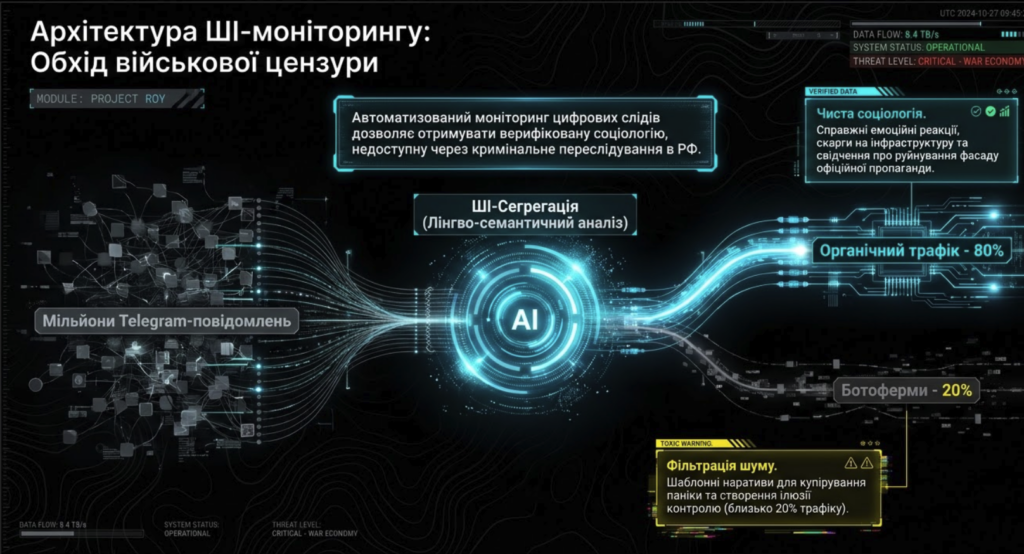
The methodological basis of the project lies in automated monitoring and linguo-semantic analysis of millions of messages per week generated in Telegram channels of Sevastopol, Simferopol, Kerch, Yevpatoria, Saky, and other key settlements on the peninsula. The system’s artificial intelligence performs traffic segregation, clearly distinguishing the activity of official bot farms aimed at suppressing panic and creating reassuring narratives from the organic behavior of real users. The latter leave digital traces in the form of comments, emotional reactions, and complaints about the actual state of infrastructure, which makes it possible to look behind the façade of official propaganda.
The particular value of the analyzed period lies in the ability to trace the direct impact of the increasing intensity of kinetic actions by the Armed Forces of Ukraine (UAV attacks, missile strikes on logistical hubs) on internal processes in occupied Crimea. Using the sociological PANAS scales (positive and negative affect), Panina’s social tension scale, and the Spielberger situational anxiety level, we analyzed how the logistics crisis, fuel shortages, and threats to life transform the population’s loyalty to the occupation regime.
SECURITY DEGRADATION AND INFRASTRUCTURAL COLLAPSE
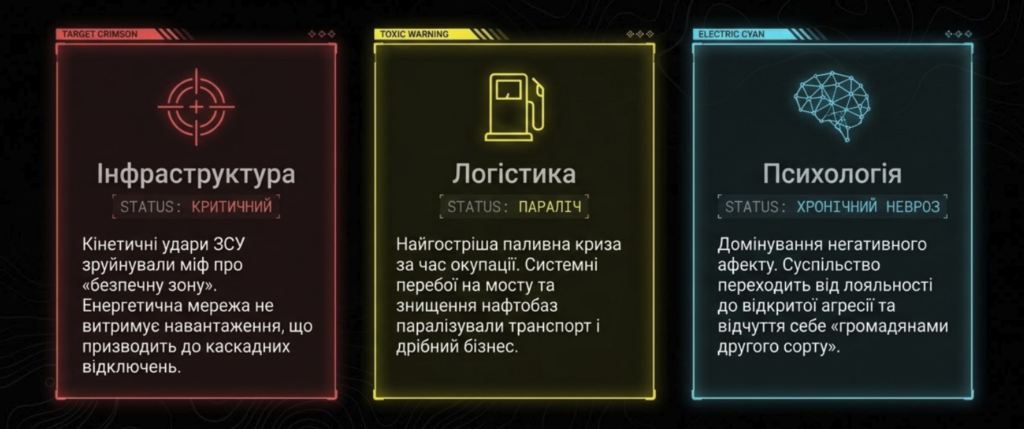
During June–July 2026, the security situation on the Crimean peninsula was characterized by a critical increase in instability. Military activity by the Armed Forces of Ukraine, aimed at destroying the occupiers’ logistical potential, turned Crimea into a zone of constant combat engagement, destroying the propaganda myth of a “safe zone” and a “protected outpost.” The key incidents that shaped the information dynamics of the period were regular night and day UAV and cruise missile attacks on energy facilities, air defense assets, and military infrastructure.
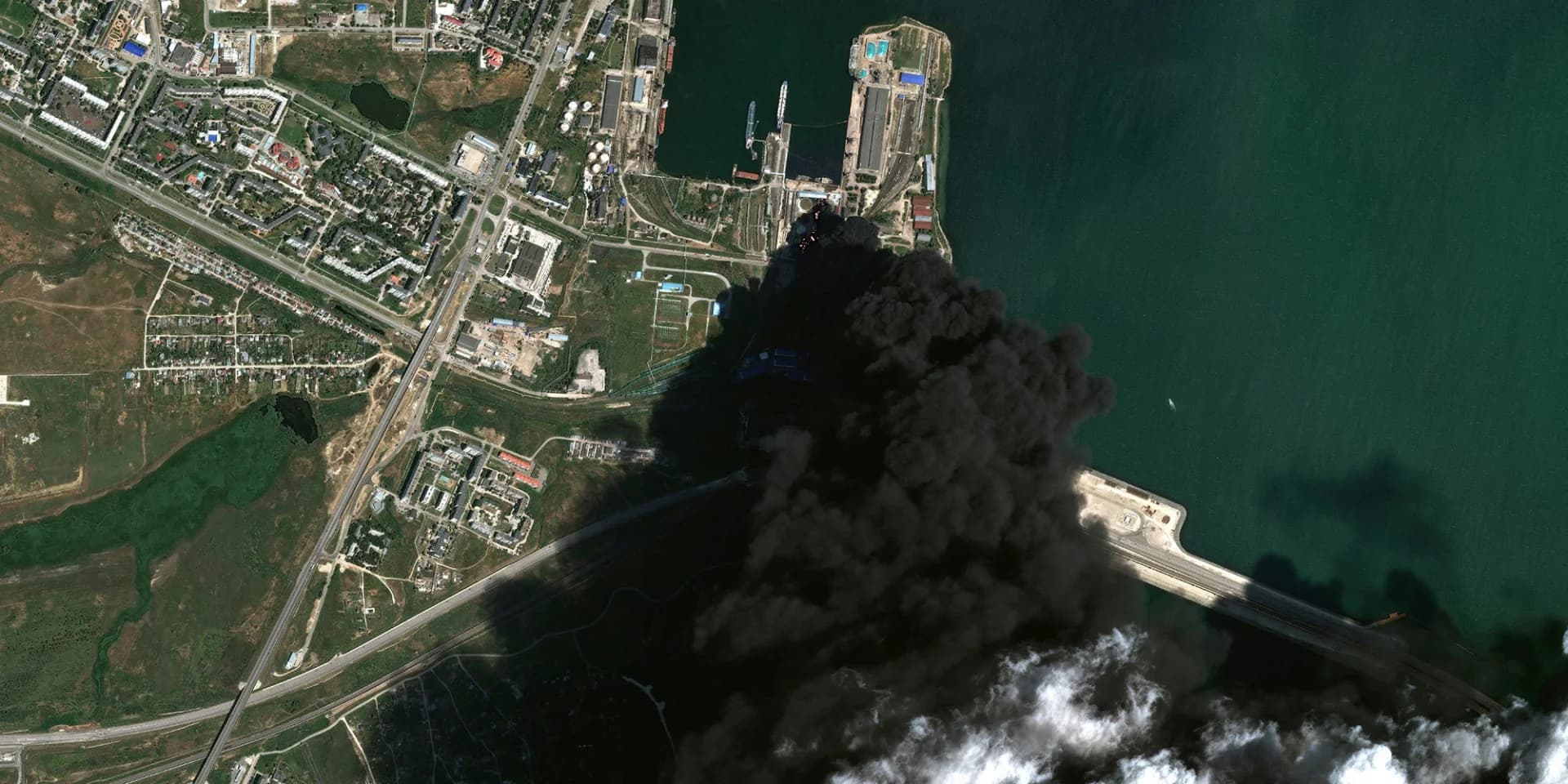
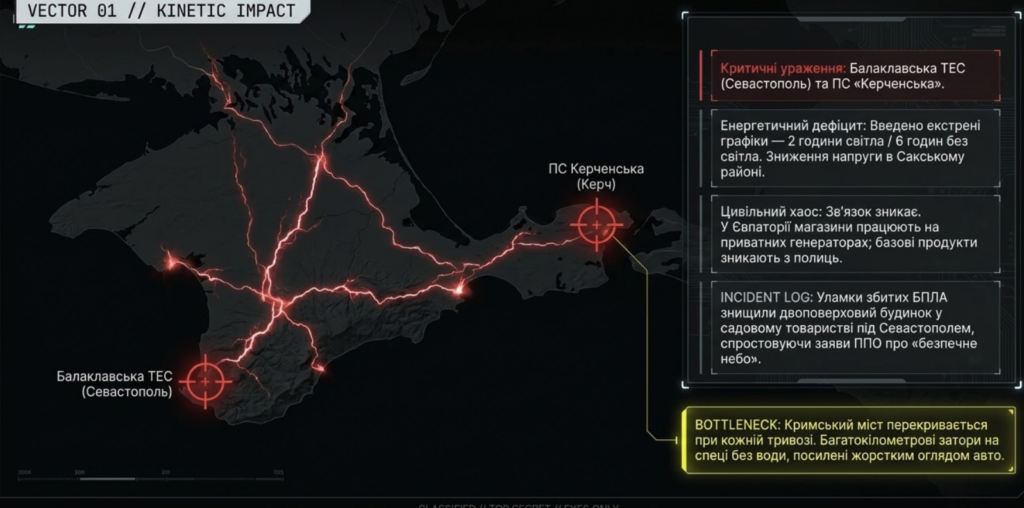
The most resonant strike was the attack on the Balaklava thermal power plant in Sevastopol and the Kerch substation. These attacks led not only to the destruction of the occupiers’ military facilities, but also to the immediate collapse of the civilian power grid. The introduction of emergency blackout schedules (in the format of “2 hours of electricity / 6 hours without electricity”), as well as voltage reductions in the networks of the Saky and Saky coastal districts, triggered a wave of public outrage. Daily life was completely disorganized: communications disappeared, and in Yevpatoria shops were forced to operate on private generators, causing essential goods to quickly vanish from the shelves.
The impotence of the occupation air defense triggered a wave of sarcasm. Official reports about the “successful downing of all aerial targets” were repeatedly contradicted by actual fires and the absence of electricity. For example, when a private two-story house in a gardening cooperative near Sevastopol burned down due to debris from downed UAVs, local residents began openly discussing the ineffectiveness of the military command. Crimeans see the obvious discrepancy between television reports of “100% protection” and the real sky burning above their heads.
An additional factor of logistical pressure was the systematic closure of traffic across the Crimean Bridge. Traffic was halted during every air raid alert, creating multi-kilometer traffic jams on both sides. When the authorities tried to justify the queues as “security measures” and strict inspections of personal belongings and vehicles (including restrictions on carrying liquids and gasoline canisters), this provoked fury among drivers forced to stand for hours in the heat without water or basic conditions. This was perceived especially sharply by the “tourists” who had dared to come to Crimea.
LOGISTICAL AND FUEL CRISIS
In parallel with the security challenges, June and July 2026 brought Crimea the most acute fuel crisis since the beginning of the occupation. Disruptions in petroleum product supplies via railway lines and regular attacks on fuel depots in neighboring regions of the Russian Federation led to shortages of gasoline of all grades. Initially, the occupation administration tried to suppress the problem, urging citizens “not to create artificial panic” and to refuel only when necessary. However, the situation soon spiraled out of control, forcing the authorities to introduce ration coupons for private vehicles.
Restrictions on fuel sales led to enormous queues at gas stations. AI-100 gasoline became a scarce commodity, with prices among resellers rising to astronomical 350–500 rubles per liter. Official gas stations imposed limits — no more than 20 liters “per person” and exclusively into a vehicle’s tank, with a categorical ban on filling canisters. This completely paralyzed the work of small entrepreneurs, farmers, and transport operators who depended on mobile fuel reserves. The situation was further worsened by the behavior of speculators who somehow obtained gasoline outside the queues and resold it at exorbitant prices прямо on the roadside.
The economic collapse also affected the utilities sector. Due to electricity shortages and the rising cost of alternative sources, the price of bottled gas (used by a significant share of Crimea’s private sector) rose to 6,000 rubles per cylinder. The attempt by “governor” Aksyonov to smooth things over by announcing the “free” distribution of 4,000 gas cylinders to eligible categories provoked only skepticism and bitter irony in society. People understood that this one-off action did not solve the systemic problem of the high cost of living.
The situation was complicated by natural disasters. Heavy rains in Sevastopol in July led to large-scale street flooding, landslides (including the collapse of a large retaining wall), and a complete halt of public transport (trolleybuses). This exposed the chronic neglect of urban utilities and the occupation administration’s inability to respond to emergencies. Against the backdrop of a lack of electricity, water, and fuel, Crimea’s urban infrastructure began to deteriorate rapidly, turning the peninsula into a zone of humanitarian discomfort.
INFORMATION CONFRONTATION AND NARRATIVE MANIPULATION
Crimea’s information space in June–July turned into an arena of fierce confrontation between the occupiers’ propaganda machine and the population’s organic discontent. Semantic analysis of the project database shows that the share of organic (live) behavior in discussions of critical security and infrastructure topics remained steadily at 70–80%. This indicates that real people no longer believe official spokespeople and seek an outlet for their emotions in the public sphere.
To maintain control over narratives, the occupation authorities actively used controlled bot farms and administrative resources (their share in discussions of the fuel crisis and UAV attacks was about 15–20%). The bots’ main task was to spread calls for calm, inform the public about the “temporary nature of the difficulties,” and accuse any critics of working for Ukrainian intelligence services. However, the effectiveness of these efforts proved extremely low. Every formulaic bot comment that “the situation is under control” triggered a barrage of irritated responses from real residents pointing to empty gas stations and the dark windows of their homes.
A separate line of propaganda work involved attempts to create the illusion of a “symmetrical response.” During large-scale blackouts in Crimea, pro-Russian channels and bots began actively circulating news about Russian missile strikes on the ports of Odesa or the energy infrastructure of mainland Ukraine. The purpose of these manipulations was to distract Crimeans from their own problems and evoke a sense of schadenfreude that would overshadow everyday hardships. However, as the system’s data show, this effect was short-lived: after the television screen went dark, people once again faced an empty refrigerator and a lack of water.
At the same time, the occupation administration launched a campaign against “AI-generated fakes.” They frightened the population by claiming that Ukrainian intelligence services were releasing artificially generated videos and audio about famine in Crimea, evacuation, and deaths from heat due to the absence of air conditioning in hospitals. This indicates the authorities’ deep fear that any alternative information could become the spark for mass protests. Any manifestation of organic discontent was labeled as “hostile information-psychological operations,” which only further irritated citizens.
PERCEPTION OF THE OCCUPATION AUTHORITIES AND THE REPRESSIVE APPARATUS
Social tension was directly projected onto perceptions of local and central authorities. “Governor” of Sevastopol Mikhail Razvozhayev and “head” of Crimea Sergey Aksyonov became the main targets of public criticism. If propaganda had previously managed to channel anger toward the middle layer of officials, now complaints were directed straight at the peninsula’s top figures.
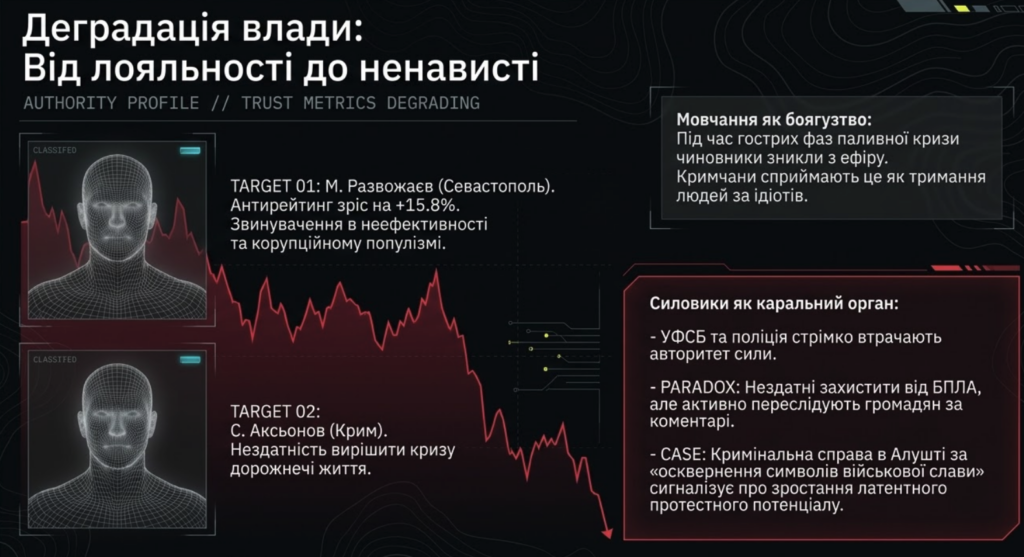
Particular irritation was caused by the authorities’ prolonged silence during the acute phases of the crises. For example, when the fuel shortage began, officials did not comment on the situation at all for several days, hoping it would resolve itself. This silence was perceived by Crimeans as cowardice and as treating people like idiots. “Governor” Razvozhayev was openly accused of ineffectiveness, and his promises of “free” gas for eligible recipients triggered a storm of accusations of corruption and populism. His anti-rating rose by a record 15.8% in June–July.
Law enforcement agencies (police, FSB) also began to lose their authority as a force. Their weekly reports about the “successful detention of Ukrainian spies” and the exposure of fraud networks were received by society with mixed feelings of skepticism. People see that the силовики are unable to protect them from UAV strikes, but actively persecute ordinary citizens for comments on social media. The repressive apparatus is perceived by the population not as a shield of security, but as a punitive organ that protects exclusively the interests of the Kremlin elite.
An example of intensified repression was the criminal case opened in Alushta for “desecration of symbols of military glory.” This was the authorities’ response to attempts by local residents to protest against the occupiers’ symbolism. The overall result of the sociological assessment of the security bloc’s activities demonstrates a growing latent protest potential: people are beginning to conceal their true thoughts, but the level of hatred toward law enforcement is steadily increasing, creating the preconditions for a sharp explosion if central control weakens.
ANALYSIS OF THE POPULATION’S MORAL AND PSYCHOLOGICAL STATE
The moral and psychological state (MPS) of Crimea’s population in June–July 2026 was characterized as extremely destructive. Using scientific assessment scales, the system’s analysts recorded persistent negative trends across all spheres of society’s mental health.
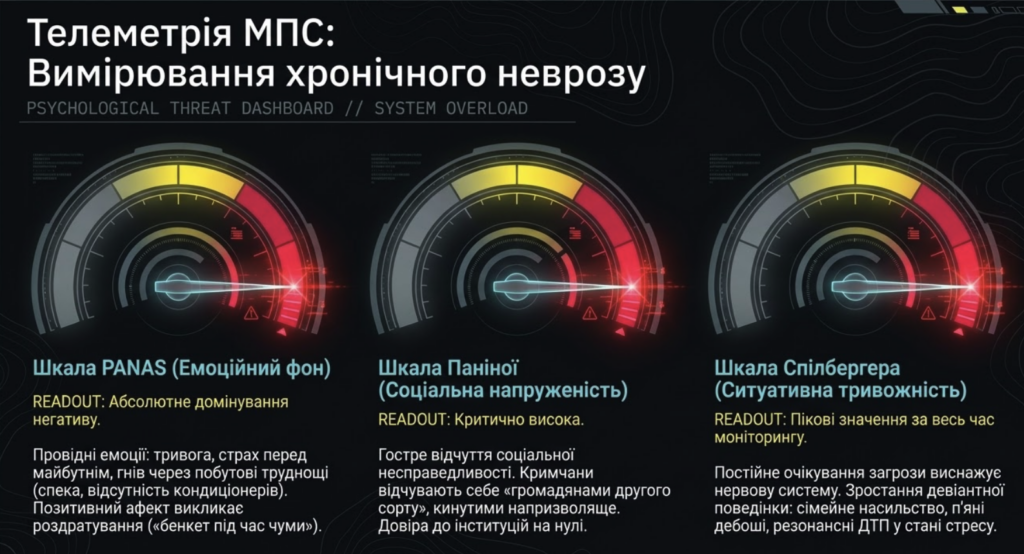
The emotional background according to the PANAS scale demonstrates the absolute dominance of negative affect. The leading emotions are deep anxiety, fear of the future, and anger. Fear is fueled by the daily sounds of explosions and air defense activity, while anger is caused by purely everyday hardships: lack of electricity, air conditioners in the summer heat, and fuel shortages. Positive affect is practically absent — isolated news about cultural or sporting events irritates people, as it is perceived as “a feast during the plague.”
The level of social tension according to Panina’s scale is classified as critically high. The main marker is an acute sense of social injustice. Crimeans compare their standard of living and security with regions of mainland Russia, feeling like “second-class citizens” who have been abandoned to their fate. Trust in state institutions has fallen to minimal levels. Aggressive frustration spills over into harsh online discussions, where pro-Ukrainian and pro-Russian residents move on to open insults and threats of physical violence.
Situational anxiety according to the Spielberger scale has reached the highest levels for the entire monitoring period. Constant anticipation of threat (air raid alerts, bridge closures, UAV reports) exhausts citizens’ nervous systems. This leads to increased personal anxiety and deviant behavior in everyday life. Cases of inappropriate reactions, domestic violence, drunken disturbances, and high-profile traffic accidents committed under severe psychological stress are being recorded.
Crimean society is in a state of chronic neurosis.
CHRONICLE OF DEGRADATION
To demonstrate the depth of the social split and the real psychological state of citizens, authentic excerpts from the system database are provided below. These comments from real people are the best proof of the failure of occupation policy and the growth of panic and protest sentiments on the peninsula.
Case 1. Fuel collapse and criticism of the authorities’ silence (June 2026)
When the authorities tried to conceal the scale of the fuel crisis, real users reacted extremely harshly. A user under the nickname Drive wrote in a local Sevastopol chat: “Мне интересно почему все Крымские высокопоставленные лица молчат из за чего кризис топливный, это же и так все знают, вы этим еще хуже делаете, людей за идиотов держите… у вас все хорошо и лучше вообще промолчать, так это не работает!!!”. This comment reflects a deep crisis of communication between the occupiers and society, which no longer wishes to tolerate lies.
Similarly, a user named Svetlana expressed outrage at speculation amid official helplessness: “З-за чого бензовозы не едут в достаточном количестве, думаю всё понимают. А вот как накажут спекулянтов? И почему у них топливо есть для перепродажи и они его в открытую предлогают втридорога?”. This indicates an acute sense of injustice and suspicion that corruption schemes are being covered up by the “authorities” themselves.
Case 2. Threat to economic survival and transport deadlock
The introduction of restrictions and ration coupons caused panic among tourists and local businesses. User @advokat_labygin reacted with a radical demand: “Підвищення цін на пальне в такій ситуації треба прирівняти до держзради перед Кримським мостом стоять сотні залізничних цистерн кілометрів на 10, вживіть заходів до негідників, що наживаються на відсутності палива”. This comment shows how quickly everyday problems transform into political accusations. Even loyal citizens demand repressive measures against oligarchic structures profiting from the war.
The “tourist” sector, which is the foundation of Crimea’s economy, also suffered collapse. User @OrdineComposito asked in confusion: “Добрий день. Я турист і щорічно приїжджаю до Криму на відпочинок, на автомобілі. Як бути? Де дістати талони?”. Such comments vividly show the destruction of Crimea’s image as a tourist region. Instead of rest, people face fuel queues and the threat of being stranded on the peninsula without gasoline.
Case 3. Military escalation and aggressive polarization of society
After the Armed Forces of Ukraine struck military facilities in Crimea and neighboring areas, the occupiers tried to mobilize hatred toward Ukraine. User Anna emotionally wrote: “Мало мстим за наших детей, особенно Порошенко и Зеленскому”. She was supported by Ekaterina, who called for genocide: “Эту заразу у нас под боком можно только выжечь, чтобы просто некому было ничего запускать… Только тогда мы будем жить нормально”. However, this rage quickly runs into the skepticism and irony of the sober-minded part of society. User @Naglaya_Aglaya sarcastically replied: “да чо вы мелочитесь-то? Весь мир выжечь. Оставить Россию и Уганду, ага. А то чо они…”. This dialogue vividly illustrates the deep mental split in society, where aggressive militarism is increasingly marginalized under the pressure of the obvious absurdity of war.
Case 4. Awareness of betrayal and geopolitical defeat
The ongoing prolongation of the war and uncertainty about the future cause deep depression and disappointment among Crimeans with the Kremlin’s geopolitical course. A user named Ivan wrote in the governor’s comments: “Странная война, гибнут наши граждане, нам во все уши втирают, что мы воюем с НАТО, а сегодня утром в Киев безнаказанно приехал глава НАТО Рютте”. People see the inaction and inability of the Russian leadership to respond to real challenges, which leads to the destruction of the patriotic consensus.
All these cases demonstrate that beneath the thin film of administrative control in Crimea there is a deep social crisis. War fatigue, everyday disorder, fear for life, and a sense of absolute hopelessness are gradually eroding the occupation system from within, making the peninsula extremely vulnerable.
FORECASTS FOR THE DEVELOPMENT OF THE SITUATION
First, the infrastructural collapse will deepen. Any new kinetic strikes on the peninsula’s energy and transport systems will lead to the immediate paralysis of utilities, which, against the backdrop of the summer season and heat, will provoke new waves of panic and aggression. The supply of drinking water and the operation of Sevastopol’s sewage systems will become especially critical.
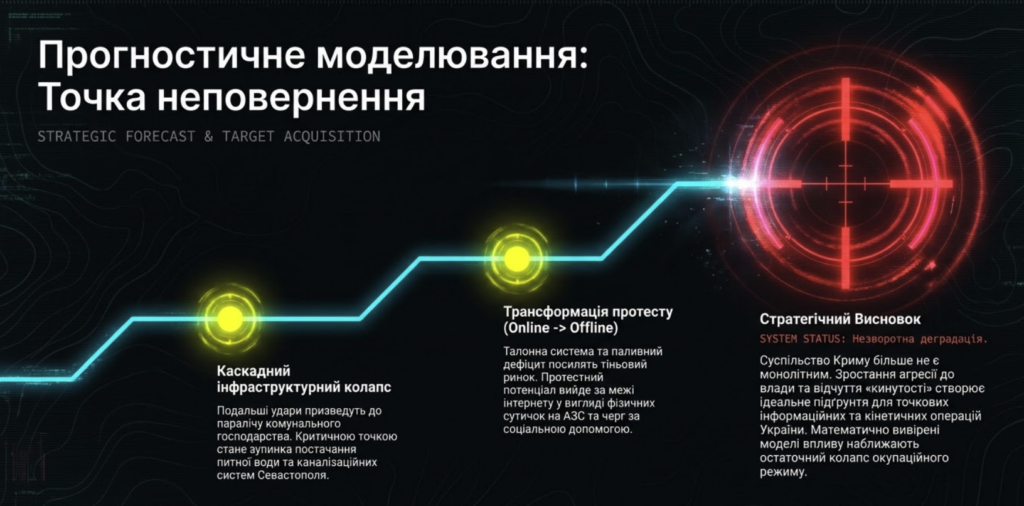
Second, the fuel shortage will continue to be the main social trigger. The introduction of ration coupons and limits will only intensify the shadow market, speculation, and corruption among local officials, leading to new outbursts of public outrage. Protest potential will gradually move beyond the internet space into the form of local clashes at gas stations and queues for social assistance.
CONCLUSIONS
Summarizing the results of the month-long monitoring, one can draw an unequivocal conclusion: the occupation system on the peninsula has entered a phase of irreversible degradation. All attempts by the propaganda machine to preserve the illusion of stability are completely nullified by the daily experience of citizens who face missile strikes, lack of electricity, and the fuel crisis.
Crimean society is no longer monolithic in its support for the war. On the contrary, there is a deep fatigue, fear for the future, and a growing aggression that is increasingly directed at the occupation governors Razvozhayev and Aksyonov. The growth of social injustice and the feeling of being “abandoned” create favorable ground for conducting our information operations.
The ROY project has proven its strategic effectiveness. Obtaining objective sociological data on the basis of digital traces allows us to build precise, mathematically calibrated models of influence on the hostile society, bringing our victory on the information and kinetic fronts closer.
Institute of Social Dynamics and Security KRONOS
The investigation actively used OSINT tools and artificial intelligence, in particular the Gemini and Grok models. OSINT methods made it possible to collect and analyze open data from various sources, including social networks, public databases, and web resources. Gemini provided in-depth analysis of textual data, pattern detection, and forecasting, while Grok, created by xAI, was used to process complex queries and generate accurate conclusions based on large volumes of information. The combination of these technologies significantly accelerated the investigation process, increased the accuracy of the results obtained, and revealed connections that might have remained unnoticed by traditional methods.