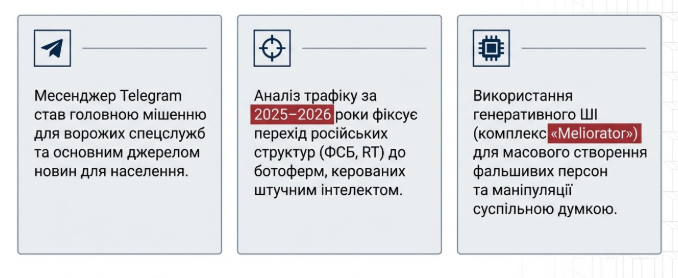
The key battlefield for the consciousness of the population of the Russian Federation and residents of the temporarily occupied territories remains the Telegram messenger. It is the main source of news for the majority of the population, which makes it the primary target of hostile intelligence services. Traffic analysis for 2025–2026 clearly indicates the large-scale use of bot farms, controlled by artificial intelligence, to simulate public support while simultaneously harshly suppressing organic dissent.7
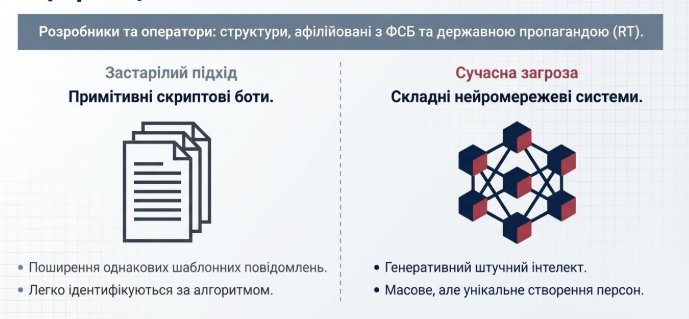
Russian information troops (in particular, structures affiliated with the FSB and state propaganda, such as RT) have made a qualitative technological leap. There has been a transition from primitive script-based bots that distributed identical template messages to sophisticated neural-network systems. The main instrument of this new era has become the software complex “Meliorator” — a generative AI-based tool designed for the mass creation of fake social personas.9
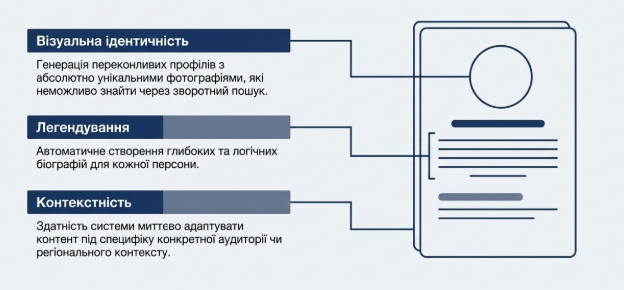
The “Meliorator” operating in the Russian Federation (the real name is unknown) is capable not only of generating convincing profiles with unique photographs and biographies, but also of adapting content to specific audiences, imitating the communication style of real users, and creating emotionally charged messages.9 This technology enables the enemy to respond rapidly to any event by generating thousands of comments that justify the actions of the Russian leadership or incite hostility toward Ukraine and Western countries.8
In the temporarily occupied territories of Ukraine, the situation has taken on the character of total digital occupation. A coordinated network of more than 3,600 bots has been identified, operating deliberately in local chats and Telegram channels.7 Their goal is to create the illusion of mass gratitude among the local population toward Russia. Indicative is the operating pattern of the account with the identifier @nieucqanдoberr, which in just one day (11 May) left 1,391 comments in 65 different channels.7 Bots of this type promote narratives about the “strongest leader in the world” (Putin), blame NATO for escalation, and simulate grassroots interest in Russian state programs, adapting their responses to the context of conversations with real people.7
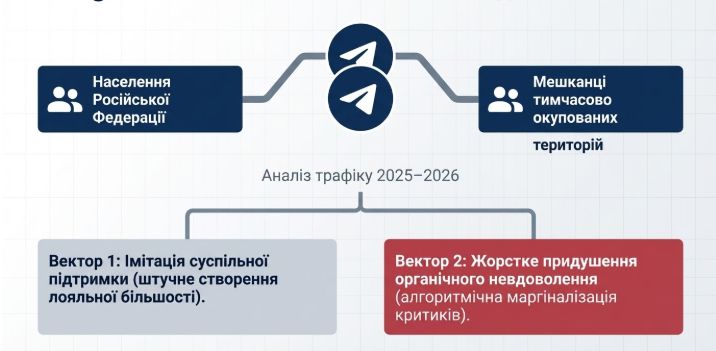
At the same time as the airwaves are saturated with artificial content, the Russian authorities have launched an unprecedented campaign to algorithmically cleanse organic traffic. Analysis of the collected data clearly demonstrates the difference between the artificially generated information field and the real reactions of living people.
In large Telegram channels (for example, among military bloggers such as Boris Rozhin), automated systems of strict moderation have been introduced, such as the specialized bot @bot_clean_bot (ID: 5313552179).13 The rules of these communities explicitly prohibit any expression of dissent. Subject to censorship are messages that administrators classify as “panic,” “IPSO,” “discrediting the SMO,” or discussion of real military losses.13
Analysis of view and comment statistics exposes the artificial nature of the Russian information space:
- Officialdom and propaganda (the anomaly of zero reaction): Posts about international politics (for example, Putin’s guarantees to Hungary or the situation in the Middle East) receive between 15,000 and 36,000 views, but have zero comments.13 This indicates a complete absence of organic interest in the official agenda and the preventive closure of discussions by administrators out of fear of uncontrolled crowd reaction.
- Local tragedies and organic response: By contrast, posts about local emergencies (for example, a major fire in a high-rise building in Moscow) elicit a live organic response from real users. People with IDs 8697378578 and 1106465683 express fear for their own safety, criticize construction quality (“this will be in all the human anthills across the country”), and demonstrate a high level of anxiety.13 It is here that the true face of Russian society emerges — atomized and frightened.
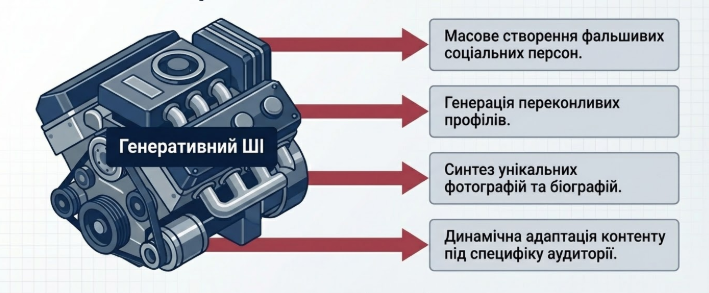
Artificial intelligence (in particular, text-generation systems such as Meliorator) massively creates the illusion of total public support for the authorities’ actions, while algorithms of strict censorship and automated moderation (for example, @bot_clean_bot) instantly remove any organic resistance or manifestations of dissent. This dual-track mechanism traps the average user in a closed loop of cognitive distortion, inevitably leading to rising anxiety, loss of orientation, and deep political apathy.
Cognitive Distortions and the Degradation of Social Psyche
Prolonged immersion of the population in such a highly toxic and artificial information environment leads to irreversible psychological consequences and mass cognitive distortions. Sociological and medical studies indicate a direct link between algorithmic news feeds saturated with propaganda and the rapid growth of political polarization, clinical depression, and anxiety in society.14
As a result of the use of IPSO and bot farms in Russia, the phenomenon of the “liar’s dividend” has emerged. Aware that the internet is saturated with bots and deepfakes, Russians cease to believe any information at all, even objective and truthful data.10 This leads to a state of learned helplessness.
In the semantics of ordinary Russians’ comments, classic patterns of cognitive distortion are clearly visible: black-and-white thinking (all-or-nothing), catastrophizing of any event, overgeneralization, and discounting the positive.16 This is not merely the result of a bad mood — it is a defensive psychological mechanism of a society that has completely lost control over its own life, understands that the state treats it as expendable material, but has no legal channels to express frustration or influence policy.
| FSB influence mechanism | Technological support | Psychological consequence for the population of the Russian Federation |
| Simulation of mass support | AI “Meliorator,” generation of 1,000+ comments per day from a single account | Minority syndrome (fear of expressing an opinion different from the “majority”) |
| Algorithmic censorship | Moderation bots such as @bot_clean_bot, auto-deletion by keywords | Learned helplessness, political apathy, social atomization |
| Discrediting truth | Mass use of deepfakes and emotionally manipulative videos (TikTok, Telegram) | “Liar’s dividend,” total distrust, cynicism, paranoia |
The “MAX” Project as the Architecture of a Digital Concentration Camp
Recognizing that, despite an army of bots, organic public discontent continues to break through, the Russian authorities in 2025–2026 moved to a radical stage of information isolation. They are accelerating the creation of a fully sovereign digital infrastructure, which has received the unofficial name “Digital Gulag” among experts and the opposition.1 The central element of this repressive system is the national messenger MAX (developed by structures affiliated with VK).4
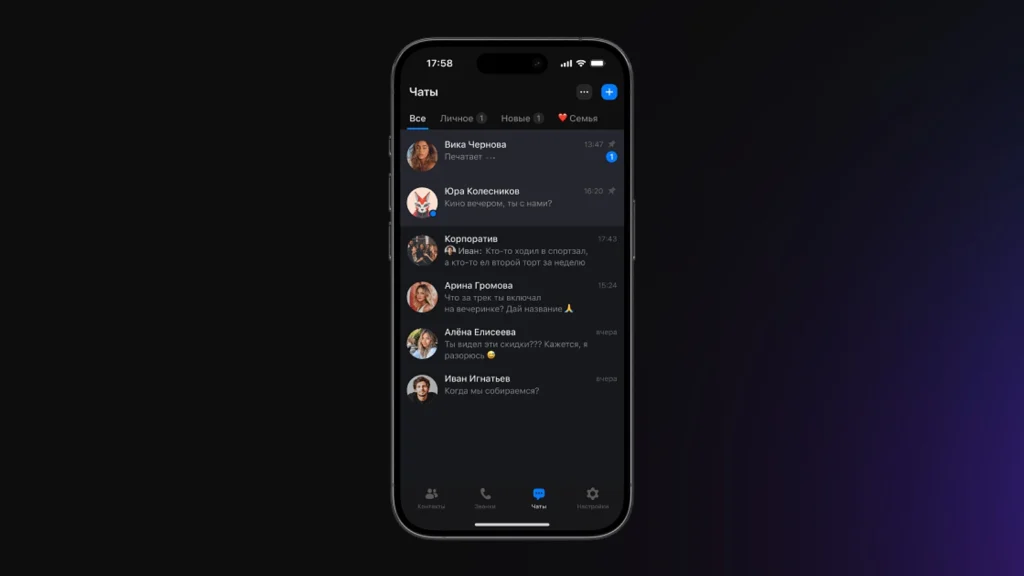
Official propaganda presents MAX as a “fast, secure, and domestic alternative” to Telegram and WhatsApp, allegedly providing high-quality communication and service integration.17 However, the real functionality of this ecosystem is aimed exclusively at establishing unprecedented control over every citizen.
The messenger is tightly integrated with the state system “Gosuslugi.” A key requirement of the platform is mandatory user verification through a “Digital ID.”17 This means complete de-anonymization online. Independent code audits of the application have confirmed that MAX is a tool for total data collection, granting the FSB direct and unhindered access to private correspondence, group chats, geolocation, and contact lists.20
The state uses overt administrative terror to force the platform’s adoption:
- From 1 September 2025, MAX is forcibly installed on all new smartphones sold in the Russian Federation and in the temporarily occupied territories.4
- From 1 September 2026, all stores and services will be required to accept identity verification, benefits, and loyalty cards exclusively through the digital ID in MAX.21
- Authorities are blackmailing public-sector employees: teachers, civil servants, and military personnel are being mass-transferred to MAX under threat of dismissal or criminal prosecution.4
- Enormous funds — more than 2.27 billion rubles — have been allocated to the development of AI-based traffic censorship systems (against the backdrop of cuts to public-sector wages).3
Despite colossal pressure, administrative threats, and an aggressive advertising campaign to discredit foreign messengers (the Russian authorities constantly claim that Telegram and WhatsApp are used by Ukrainian intelligence 4), Russian society is mounting strong passive resistance to the institutionalization of the digital Gulag.
Sociological surveys and analysis of user reactions across all regions of the Russian Federation and in the temporarily occupied territories 23 demonstrate a catastrophic level of distrust toward the state product. The population perceives MAX solely as a surveillance tool.
The main reasons for this mass rejection are:
- Total distrust: Citizens openly admit that the application is “spyware.” Users note in comments that MAX is being created solely to imprison people for “discrediting the army” on the basis of private conversations.20
- Rejection of propaganda: Aggressive imposition of the app produces the opposite effect. The Kremlin’s statement at the end of 2025 that the introduction of the messenger had failed and that “someone will be held responsible for this” 24 confirms the systemic collapse of the initiative.
- Technical sabotage: Citizens openly discuss plans for mass use of VPNs to bypass Telegram blocks 3, leaving MAX only on “clean” phones without confidential information, solely for display to inspection authorities.20
Instead of consolidating society around a state resource, the imposition of “MAX” has led to even greater alienation of citizens from the state, turning the installation of Telegram into an act of silent but mass civic resistance.
The Socio-Political Climate in the Russian Federation
Within the territory of the Russian Federation itself, the socio-political climate has reached a critical level of tension. Accumulated fatigue from a protracted war that, according to propaganda, was supposed to last “three days” 25, the deepening economic crisis, and the destruction of basic security have radically altered the unwritten social contract.
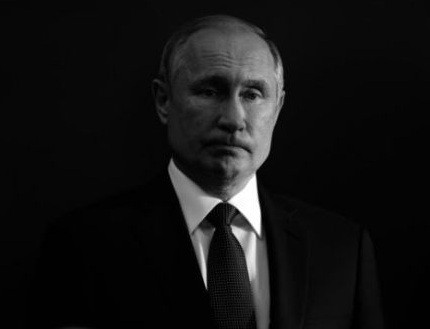
The most symptomatic indicator of the shift in mood is the unprecedented decline in respect for V. Putin, not only among the liberal opposition (which has long been destroyed or pushed out), but specifically among the radical-patriotic, so-called “Z-electorate.”
In the eyes of the population, the Russian dictator has lost the aura of a “strong leader.” Analysis of raw communication data (RAW DATA) records the mass use of extremely derogatory epithets toward the president of the Russian Federation. Due to the absence of harsh and effective responses to the systematic strikes by Ukrainian UAVs on Russian territory and on Russian facilities abroad (in particular, the Ukrainian drone attack on the Russian gas carrier “Arctic Metagaz” in the Mediterranean Sea off the coast of Libya), Putin is openly called a “bald dwarf,” “old man,” “pushover,” and “cuckold” in comments.13
Here are typical reactions of deep Russian society to official statements:
- Users openly mock the Kremlin’s endless and ineffective threats: “we won’t be drawing red lines anymore, the paint has run out, we’ll use green”.25
- Recognition of their own weakness compared with the actions of allies: commenters enviously discuss the United States’ harsh actions against Iran (strikes on 2,000 targets 13) and the effectiveness of the Israeli army, contrasting them with the inaction of the Russian leadership, which can do nothing but “express deep concern.”25
- Citizens state the complete impotence of the state in defending its own territories: drones attack the Saratov, Bryansk, Rostov, and Belgorod regions, oil depots, and defense-industrial enterprises every day by the dozens.13 Comments express muted rage that “Leopold (Putin) is still chewing his snot” while Russian factories burn.
Economic problems have moved from the level of abstract macroeconomic indicators to the level of basic physical survival for Russian citizens.
- Inflation: Users complain about the catastrophic rise in prices for basic goods. For example, it is discussed that the price of bread has increased by 31% (from 61 to 80 rubles).25 The cost of imported goods, electronics, and auto parts has risen by 15–30%.26
- Devaluation and panic: Citizens tremble for their savings, feeling the instability of the banking system. Panic messages about account freezes and fraud are spreading online. Russians ironically and contemptuously call the national currency “fubliki.”28
- Industrial crisis: The growing crisis in heavy industry and logistics is being masked by new initiatives. The proposal by Rostec head S. Chemezov to introduce a “trade-in” mechanism for freight railcars directly indicates a sales crisis, the Central Bank’s high key rate, and a general decline in economic activity (reduced load on Russian Railways networks).13 The personnel shortage has reached catastrophic proportions: nearly 30% of currently employed electricians and technical specialists are people aged 50 to 70.27
The divide between the ruling elites and ordinary people is deepening. Society clearly sees the injustice: the children of officials continue to live abroad, while ordinary Russians are forcibly sent to “meat assaults” in Donbas. Corruption scandals (for example, the arrest of the founder of the propaganda outlet Readovka for embezzling 1 billion rubles in Defense Ministry contracts 25) finally закрепляют in mass consciousness the thesis that the war is an instrument of enrichment for the top, not an ideological struggle.
A particularly powerful social trigger (pain point) is migration policy. Against the backdrop of enormous losses at the front and a demographic hole, the authorities are massively bringing in labor migrants from Central Asia. This provokes open aggression from the indigenous population. Statements by Interior Minister Kolokoltsev regarding migration problems are received hostilely. Russians are outraged by the formation of internal criminal enclaves (“kishlaks”), rampant crime, and openly call the Kremlin’s policy a “deliberate disposal of the local population” for the benefit of oligarchs.25
| Sphere | Transmitted Russian propaganda | Reality (according to intercepts and comments from 2026) | Level of social frustration |
| Leadership | Putin is a strong strategist challenging the United States | Putin is called weak (“pushover”), and his promises are mocked | Critical (collapse of the foundational myth) |
| Economy | The world’s 4th-largest economy (according to M. Reshetnikov) | Bread inflation at 31%, fear for deposits, personnel shortages | High (struggle for survival) |
| Security | “Air defense is working reliably, everything is being shot down” | Daily drone strikes on the rear (Bryansk, Saratov), destruction of refineries | High (panic, awareness of vulnerability) |
| Society | National unity around the SMO | Hatred of elites stealing billions; aggression toward migrants | Critical (polarization and atomization) |
The Socio-Psychological State in the Temporarily Occupied Territories
Analysis of local chats and regional resources in the temporarily occupied territories (Crimea, Donetsk, and Luhansk regions) reveals an even deeper level of disappointment than in the Russian Federation itself. The illusions of “integration” and “prosperity” actively inflated by the occupiers have collided with the harsh reality of corruption, poverty, and infrastructural degradation. The population has shifted into a mode of cynical survival.5
Autonomous Republic of Crimea
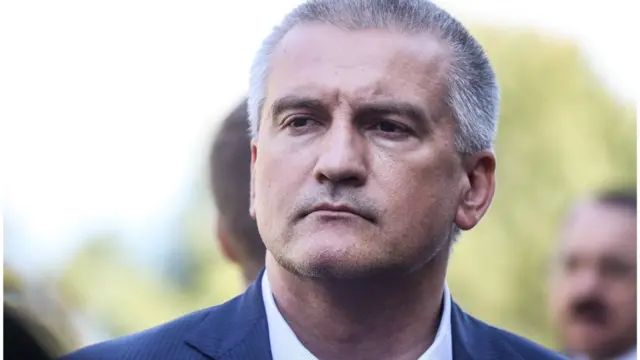
In Crimea, there is acute irritation with the incompetence of the local collaborationist administrations. The authorities try to gloss over the situation with abstract forums and grand promises (for example, the announcement of a glass factory in Feodosia with 180 jobs 6), but the population responds with open sarcasm.
- Distance from the authorities: Trips by officials (including the mayor of Yalta) to Moscow for municipal forums are perceived as window dressing. Comments call for the dismissal of the leadership: “it’s time to think about retirement and train the youth as replacements”, “well then.. now we’ll live well…”.6
- Infrastructure crisis: At the everyday level, the critical point of tension is the state of utilities. In Kerch, large-scale work on laying engineering networks has turned the streets into “a muddy mess.” Residents are in a state of “anxiety,” fearing they will be left without even basic access to their homes. Despite complaints and official orders, contractors ignore people’s problems, proving the absolute inability of the occupation authorities to control the situation on the ground.6
- Corruption in healthcare: A high-profile scandal involving the Crimean “Ministry of Health” purchasing low-quality ultrasound machines for 45 million rubles, which caused patients to be misdiagnosed for years in Kerch, Alushta, and Yevpatoria, triggered a wave of outrage.6
It is also worth noting the moral degradation of the radicalized part of the population (the so-called “Crimean SMERSH” of O. Talipov). Russian drone strikes on foreign civilian vessels in Odesa provoke schadenfreude, accompanied by hypocritical deflection of responsibility (“We know nothing, it’s all the Ukrainians”).6
Donetsk Region
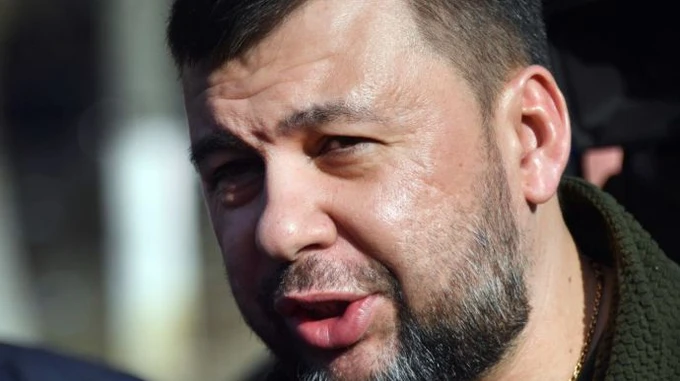
In Donetsk and the surrounding occupied cities, the key topic of discussion is the catastrophic demographic and economic situation.
- The myth of “maternal capital”: Russian state propaganda actively promotes maternal capital programs as a panacea for depopulation. However, in local chats residents sharply dismantle these narratives. Donetsk residents name hopeless poverty and low wages as the main reason for the total unwillingness to have children.26 Women in comments express outrage at gender inequality in pay and note that one man’s income today is categorically insufficient even for basic family support, let alone two or three children.26
- Utilities paralysis: The basic life-support infrastructure in Donetsk remains destroyed. Massive advertising for household water storage tanks (“Stop living without water! Water should always be available… Install a tank and forget about interruptions!”) is direct evidence that centralized water supply in the occupied regional center is effectively not functioning properly even in 2026.26
Luhansk Region
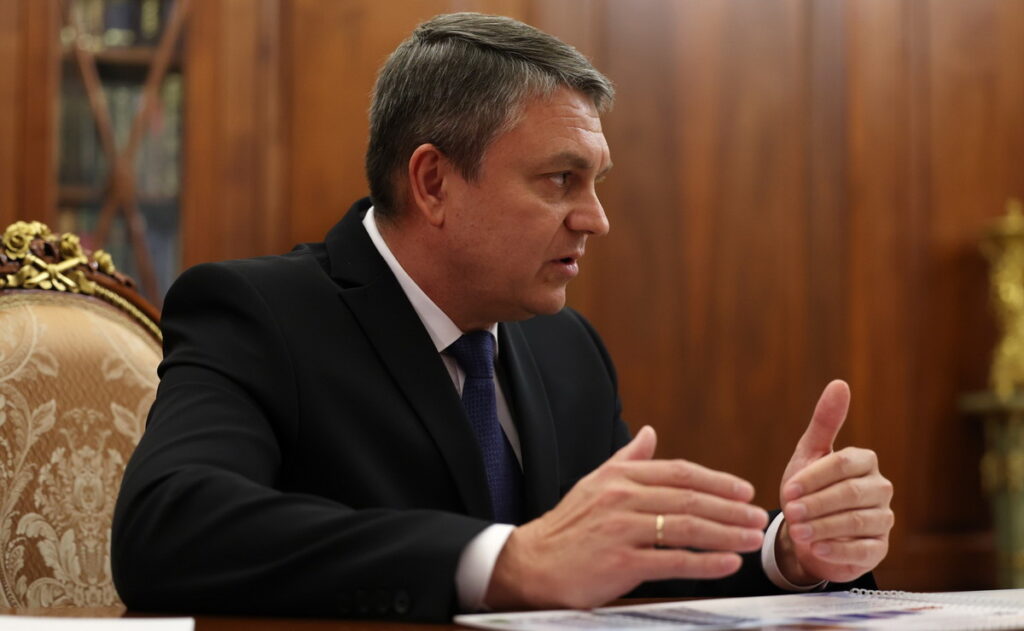
In Luhansk, residents’ discontent focuses on embezzlement and total devastation.
- Roads and mud: Local residents openly mock the so-called “pothole repair.” Videos of horrific mud on the streets of Luhansk and Pervomaisk provoke anger. Commenters directly accuse the occupation authorities of stealing budgets (“money, you love money”), complaining that after winter it is “simply impossible” to wash the mud off their shoes.5
- Fear of digital control: As in the Russian Federation itself, there is strong resistance in Luhansk to forced digitalization. The requirement to use the Russian “Gosuslugi” portal to access school electronic diaries provokes paranoia. Residents sarcastically note that “soon refrigerators and elevators will open through Gosuslugi,” rightly fearing total surveillance and a system of social fines.5
- The survival anomaly: Against this depressive backdrop, the reported 6% increase in marriages in the LNR in 2025 (more than 7,000 couples) appears as a statistical anomaly.5 From the perspective of military sociology, this is not a sign of “improved living standards,” but a typical social reaction to existential threat and mass mobilization — people rush to formalize relationships under conditions of high risk of death at the front.
Strategic Forecast
Analysis of the collected sociological and operational data allows for clear forecasts regarding the further development of the situation in the Russian Empire and in the temporarily occupied territories. We are observing an irreversible process of institutional atrophy and a transition to open technological totalitarianism.
Totalitarian Encapsulation
- Militarization and economic degradation: The trajectory of the Russian Federation is aimed at extracting the maximum internal resources from the civilian sector. The economy is being transformed into a Soviet-style model of stagnation with elements of wild capitalism. Initiatives such as introducing a “trade-in” mechanism for worn freight wagons 13 are a symptom of a systemic crisis in heavy industry and logistics. The catastrophic shortage of labor (fitters, electricians, builders) due to losses at the front and migration will lead to further growth in utility accidents and the shutdown of enterprises.27
- Digital isolation: The authorities will rely on the automation of repression. The MAX messenger project and AI censorship systems (cheburnet) will be driven through to completion by force.4 However, as resistance statistics show, this will not solve the problem of social consolidation, but will only drive discontent deeper underground, forcing the population to use VPNs and shadow communication channels on a mass scale.
- Deepening internal fractures: The dissonance between the television image of “geopolitical greatness” (where the Russian Federation is supposedly confronting all of NATO) and the reality of an empty refrigerator and oil depots burning from drone strikes will widen the gap between the federal center and the regions. Attitudes toward Putin will continue to become more marginal.
Prospects for the Temporarily Occupied Territories (TOT)
For Crimea, Donetsk, and Luhansk, Russian policy offers no “bright future.” Russia views these territories solely as a military buffer, a logistics hub, and a resource base (demographic and territorial).
- Entrenchment as depressed ghettos: Economic stagnation will continue. Wages will remain at the level of physical survival, which will stimulate further outflow of skilled and employable people to the Russian Federation.26 Individual showcase infrastructure projects will be used by local collaborators solely to siphon off federal subsidies, leaving the cities in ruins and filth.5
- Intensification of terror and assimilation: Under conditions of growing disappointment among the local population, the occupation administrations will move from attempts to “buy” loyalty to open terror. Forced passportization and integration into the digital registry (through the MAX messenger and “Gosuslugi”) will be intensified in order to control every step of residents and ensure an uninterrupted process of mobilization into the ranks of the Russian Armed Forces.4
Conclusion
The study of the enemy’s information and socio-political space as of 2026 states a deep systemic crisis of governance in the Russian Federation. State propaganda has lost its mobilization effectiveness and is sustained solely by the crutches of artificial intelligence (bot farms) and algorithmic terror. Russian society is in a state of acute cognitive dissonance.
Although no open armed uprising is currently recorded on the territory of the Russian Federation due to fear of repression, passive resistance (refusal of digital control systems, sabotage of birth rates, evasion of mobilization, hatred of migrants) has reached unprecedented proportions. The authorities in the Kremlin are perceived as weak and corrupt.
The Russian Empire is overstretched, and any strong external military or internal economic shock could turn this latent frustration into an uncontrollable social explosion.
KRONOS Institute for Social Dynamics and Security
The investigation actively used OSINT tools and artificial intelligence, in particular the Gemini and Grok models. OSINT methods made it possible to collect and analyze open data from various sources, including social networks, public databases, and web resources. Gemini provided in-depth analysis of textual data, pattern detection, and forecasting, while Grok, created by xAI, was used to process complex queries and generate precise conclusions based on large volumes of information. The combination of these technologies made it possible to significantly accelerate the investigation process, improve the accuracy of the results obtained, and identify connections that might have remained unnoticed by traditional methods.
KRONOS TRACER SYSTEM
Sources:
- Russia’s Digital Repression Landscape: Unraveling the Kremlin’s Digital Repression Tactics | illiberalism.org, https://www.illiberalism.org/russias-digital-repression-landscape-unraveling-the-kremlins-digital-repression-tactics/
- Total War, the Culmination of Putinism – russian desk, https://desk-russie.info/2025/12/17/total-war-the-culmination-of-putinism.html
- Russia to Launch AI-Powered Internet Censorship System in 2026 to Strengthen Information Control – UNITED24 Media, https://united24media.com/latest-news/russia-to-launch-ai-powered-internet-censorship-system-in-2026-to-strengthen-information-control-15178
- Digital Gulag: Russia Forces Its Spy App on Every New Phone – UNITED24 Media, https://united24media.com/anti-fake/digital-gulag-russia-forces-its-spy-app-on-every-new-phone-10792
- RAW_DATA_LNR_2026-03-04_06-09.docx
- RAW_DATA_CRIMEA_2026-03-05_09-25.docx
- Digital Occupation: Pro-Russian Bot Networks Target Ukraine’s Occupied Territories on Telegram – OpenMinds, https://www.openminds.ltd/reports/digital-occupation-pro-russian-bot-networks-target-ukraines-occupied-territories-on-telegram
- A Russian Bot Farm Used AI to Lie to Americans. What Now? – CSIS, https://www.csis.org/analysis/russian-bot-farm-used-ai-lie-americans-what-now
- FBI Shuts Down Russian AI-Enhanced Bot Farm – AIwire, https://www.hpcwire.com/aiwire/2024/07/10/fbi-shuts-down-russian-ai-enhanced-bot-farm/
- The architecture of lies: Bot farms are running the disinformation war | Arkose Labs, https://www.arkoselabs.com/latest-news/bot-farms-disinformation-war
- Manufacturing “realities”. The impact of AI in the age of disinformation – Érudit, https://www.erudit.org/en/journals/riatps/2025-n28-riatps010574/1123286ar.pdf
- Digital occupation: Pro-Russian bot networks target Ukraine’s occupied territories on Telegram – Atlantic Council, https://www.atlanticcouncil.org/in-depth-research-reports/report/report-russian-bot-networks-occupied-ukraine/
- RAW_DATA_RU_2026-03-05_08-27.docx
- Cognitive distortions are associated with increasing political polarization – PMC – NIH, https://pmc.ncbi.nlm.nih.gov/articles/PMC12263434/
- Social Drivers and Algorithmic Mechanisms on Digital Media – PMC – NIH, https://pmc.ncbi.nlm.nih.gov/articles/PMC11373151/
- Validating the architecture of cognitive distortions in Russian discourse using artificial intelligence and bootstrap analysis – Frontiers, https://www.frontiersin.org/articles/10.3389/fpsyg.2026.1740864/full
- How to install MAX: step-by-step instructions in 2026, https://www.glavbukh.ru/art/393218-kak-ustanovit-max-poshagovaya-instruktsiya-v-2026-godu-news
- Russia’s “Secure” Max App Flagged as Security Risk, Troops in Ukraine Told to Stop Using It – UNITED24, https://united24media.com/latest-news/russias-secure-max-app-flagged-as-security-risk-troops-in-ukraine-told-to-stop-using-it-16194
- MAX – a fast and easy app for communication and everyday tasks, https://max.ru/
- Russia’s State-Backed Messaging App Is a Blatant Attempt at Control – The Moscow Times, https://www.themoscowtimes.com/2025/08/27/russias-state-backed-messaging-app-is-a-blatant-attempt-at-control-a90362
- Age verification through Max — everywhere: from 1 September 2026, all stores in Russia are required to accept identity, benefits, and loyalty card confirmations through the Max messenger – iXBT.com, https://www.ixbt.com/news/2026/02/21/max-1-2026-max.html
- Russia probes Telegram founder in bid to subjugate the app – TVP World, https://tvpworld.com/91760737/russia-probes-telegram-founder-pavel-durov-in-bid-to-subjugate-the-app
- RAW_DATA_LNR_2026-03-05_08-56.docx
- Max (messenger) – Wikipedia, https://ru.wikipedia.org/wiki/Max_(%D0%BC%D0%B5%D1%81%D1%81%D0%B5%D0%BD%D0%B4%D0%B6%D0%B5%D1%80)
- Russia moves forward with a nationwide plan for generative AI | Digital Watch Observatory, https://dig.watch/updates/russia-moves-forward-with-a-nationwide-plan-for-generative-ai