An analysis of the state of Ukraine’s energy sector reveals a profound structural transformation unfolding under the pressure of unprecedented military, economic, and technological challenges. Behind the façade of official reports on infrastructure recovery and the heroic efforts of energy workers lies a complex landscape in which large-scale corruption schemes, deep technological dependence on foreign monopolists, and the threat of an irreversible environmental catastrophe intersect. Research based on the aggregation of customs databases, materials from criminal proceedings of anti-corruption bodies, reports of national regulators, and scientific publications makes it possible to reconstruct a three-dimensional picture of this transformation.
Section 1: “Green Tariff” — From Political Monopolies to Criminal Schemes
Legislative incentives for the development of renewable energy sources (RES) in Ukraine through the mechanism of the so-called “green tariff” were initially presented as a key instrument of European integration, decarbonization of the economy, and the attainment of energy independence. The state assumed unprecedented financial obligations to purchase electricity generated from alternative sources at tariffs more than ten times higher than the cost of generation at conventional nuclear power plants, guaranteeing the stability of these payments until 2030.1 However, an analysis of law-enforcement practice and financial flows indicates that this financial incentive quickly mutated, becoming a powerful magnet for systemic fraud both at the level of industrial consortia and in the segment of private households.
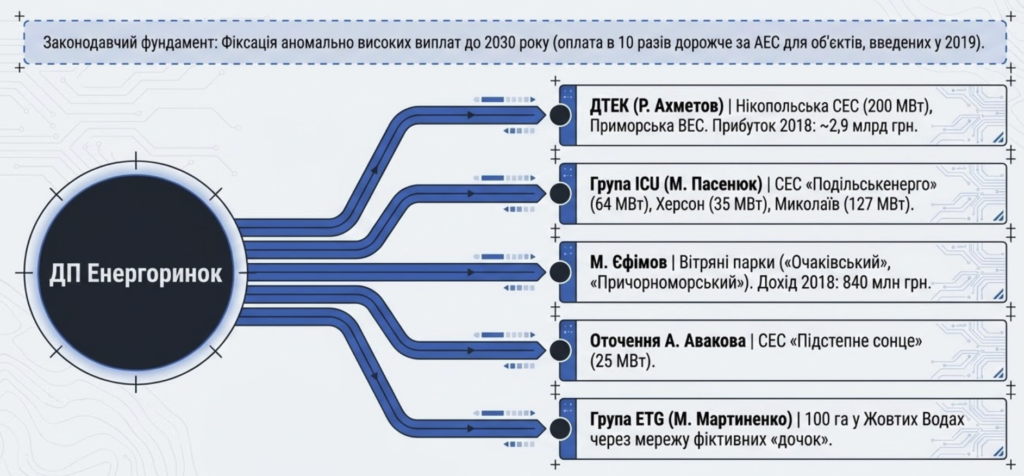
1.1. Elite Boom: The Legislative Foundation of Superprofits
To understand the current corruption mechanisms, it is necessary to turn to the 2018–2019 period, which laid the foundation for the architecture of superprofits in the renewable energy sector. The legislative framework was shaped in such a way that parliament preserved an anomalously high special payment rate for alternative energy facilities that managed to be commissioned precisely in 2019.1 This tariff window triggered an unprecedented investment boom among representatives of the country’s political and business elite. The source of these multi-billion payments was the state-owned enterprise “Energorynok,” which accumulated funds from end consumers of electricity.1
An analysis of public registries and journalistic investigations from that period clearly identifies the main beneficiaries of this legislative construct. The largest player in this field was the DTEK energy holding, owned by Rinat Akhmetov. In 2019 alone, the company launched the giant Nikopol Solar Power Plant with a capacity of 200 MW and the Prymorska Wind Power Plant, with a strategic plan to increase total capacity fivefold — to 1,000 MW.1 Financial reports indicate that by the end of 2018, the projects of this holding had generated approximately UAH 2.9 billion in profit.1
However, the monopoly did not belong exclusively to one oligarch. Structures directly linked to the country’s political leadership were also actively involved. The ICU investment group, co-owned by the financial adviser to Ukraine’s fifth president, Makар Paseniuk, launched large-scale construction, commissioning the Podilskenergo solar power plant with a capacity of 64 MW, as well as initiating the construction of a 35 MW plant in Kherson Oblast and, at that time, the largest facility, with a capacity of 127 MW, in Mykolaiv Oblast.1 Other political figures acted in parallel: Member of Parliament Maksym Yefimov, through his wind farms (“Ochakivskyi,” “Prychornomorskyi,” “Blahodatnyi”), secured income of UAH 840 million in 2018.1 At the same time, structures linked to the inner circle of then-Minister of Internal Affairs Arsen Avakov (through his wife Inna Avakova and Member of Parliament Ihor Kotvytskyi) were developing the Pidstepne Sontse solar power plant with a capacity of 25 MW in Kherson Oblast.1 The ETG group, which investigators say is linked to Mykola Martynenko, through a complex network of subsidiaries accumulated about 100 hectares of land in Zhovti Vody for development with solar panels.1 This system of corporate ties and subsidiaries became a classic instrument for concealing real beneficiaries and maximizing the area available for development.
1.2. Occupation-Based Generation: A Scheme for Stealing State Funds
If on the territory of Ukraine under government control the extraction of superprofits balanced on the edge of legal legislative lobbying, the situation in the temporarily occupied territories turned into outright criminal enterprise. The most масштабный example of exploitation of the “green tariff” mechanism was an unprecedented scheme of misappropriating state funds, uncovered and documented by the National Anti-Corruption Bureau of Ukraine (NABU) and the Specialized Anti-Corruption Prosecutor’s Office (SAPO).3 The total amount of losses confirmed by the investigation in this proceeding is UAH 141.3 million.3
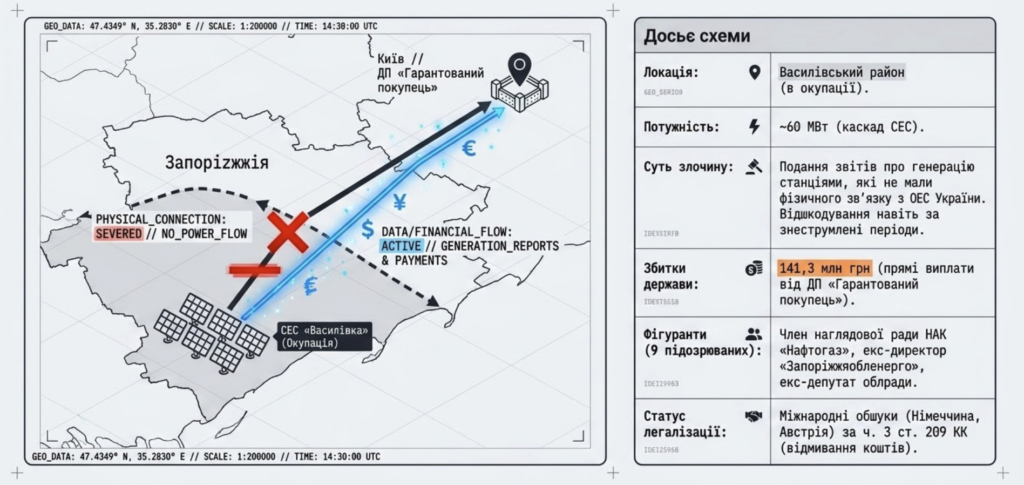
The architecture of this crime began to take shape in 2019–2020. According to the materials of the pre-trial investigation initiated after an exposé by the Bihus.Info project, a former deputy of the Donetsk Regional Council, together with his brother, concentrated covert control over a number of commercial power-generating enterprises.3 The geographical center of the scheme was Vasylivka District in Zaporizhzhia Oblast, where a cascade of solar power plants with a total generating capacity of about 60 MW was built.3 To legalize future financial flows, long-term electricity sale agreements were concluded between these enterprises and the state-owned enterprise “Guaranteed Buyer” exclusively under the special “green” tariff.3
The turning point that transformed ordinary business into a large-scale fraud was the full-scale invasion of the Russian Federation and the subsequent military occupation of part of Zaporizhzhia Oblast. As a result of the hostilities, these solar power plants suffered physical destruction, qualified personnel were forced to evacuate, and, most importantly, the plants completely and irreversibly lost their physical and technical connection to Ukraine’s Unified Energy System (UES).3 The elementary physics of electricity transmission made it absolutely impossible for the generated kilowatts to flow into networks controlled by the Ukrainian government.
Despite this objective fact, the companies controlled by the group launched a mechanism of systematic falsification of documentation. Declarations of allegedly stable electricity production continued to be submitted to the state regulator.3 NABU investigators established that knowingly false data regarding generation volumes and the overall technical readiness of the plants were deliberately entered into the reporting documentation. Moreover, reports of successful generation were submitted even during periods when the plants were completely de-energized due to damage to transmission lines.3
On the basis of this fabricated reporting, the state enterprise “Guaranteed Buyer,” acting formally within the framework of the concluded contracts, made multi-million payments.3 The funds obtained through criminal means were subsequently withdrawn and laundered through an extensive network of affiliated Ukrainian and foreign companies, which made it possible to qualify the actions of those involved not only under the article on misappropriation of property (Part 5 of Article 191 of the Criminal Code of Ukraine), but also under the article on money laundering (Part 3 of Article 209 of the Criminal Code of Ukraine).3 Law enforcement officers notified nine individuals of suspicion. Among them, the key figure providing administrative and political cover for the scheme was a member of the supervisory board of Naftogaz of Ukraine.3 The group also included the former commercial director of Zaporizhzhiaoblenergo JSC, trusted intermediaries, and managers of shell companies.3 The transnational nature of the laundering of stolen funds forced NABU detectives to initiate international legal assistance mechanisms, within which searches were conducted at the residences of suspects in Germany and Austria.3
1.3. Retail Fraud: The Architecture of the “Garland” Scheme
While industrial giants and individuals close to the corridors of power maximized their profits, the state, under pressure from budget shortages, attempted to limit the financial burden created by private owners of small household solar power plants. The legislation regulating this market segment established a strict cap on the maximum permissible capacity for private households at 30 kW.2 However, the commercial sector demonstrated extraordinary flexibility, quickly adapting to the new restrictions and generating a series of micro-schemes, the most well-known of which became the techno-legal construct known as the “garland.”
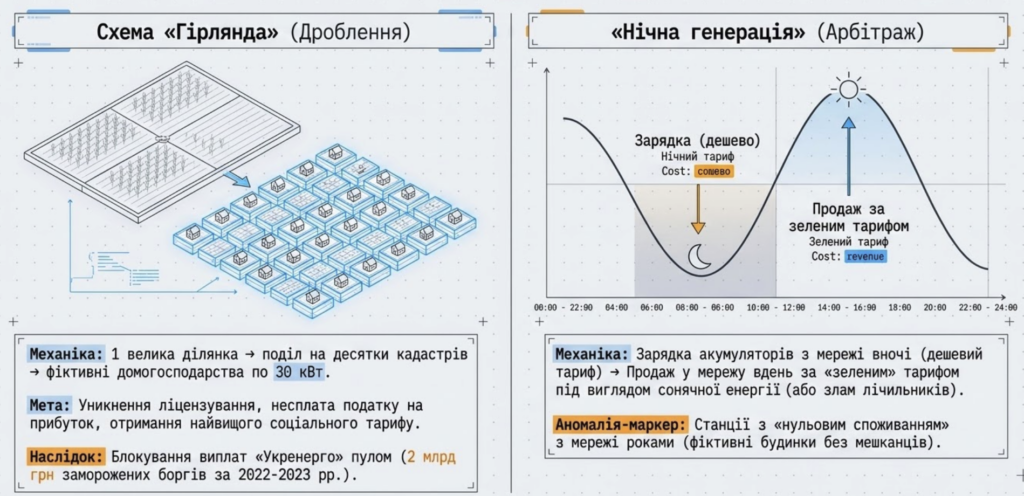
The mechanism of the “garland” is a classic example of artificial business fragmentation to circumvent regulatory restrictions and minimize the tax burden. Instead of going through the complex, bureaucratized, and expensive procedure of obtaining a license to build a single large industrial power plant, shadow investors buy or lease large tracts of land.1 Subsequently, this large territory is artificially divided into dozens, and sometimes hundreds, of small cadastral units. On each such micro-plot, a fictitious “private household” is legally registered, which applies to the local distribution system operator (oblenergo) for a separate connection to the electricity grid with the maximum permitted capacity for households of 30 kW.4
Technically, all these panels and inverters are located in one field and operate as a single, synchronized industrial facility. However, legally they are registered as separate private individuals. This manipulation allows investors to achieve several goals at once: they avoid the need to obtain a license for electricity generation, do not pay corporate income tax, and, most importantly, gain the right to sell electricity to the state at the highest retail tariff, which was designed solely as a social incentive for ordinary citizens.4
The scale of this problem forced the transmission system operator to take radical measures. Beginning in June 2023, NPC Ukrenergo significantly upgraded its analytics protocols and obtained additional software tools for monitoring data received from universal service providers (USPs).4 This toolkit made it possible to automatically compare the declared volumes of energy generated and fed into the grid with the actual physical capacity of the equipment installed in the household. According to the applicable regulations (in particular, Resolution No. 641 of the National Commission for State Regulation of Energy and Public Utilities), Ukrenergo is obliged to approve purchase and sale acts as a single pool for the entire monthly volume of electricity from all households within a specific region.4 The algorithm operates ruthlessly: if a violation, documentation mismatch, or excess of the 30 kW limit is detected even at one micro-plant in the overall settlement pool, the company has no legal right to sign the entire regional act. The result of this fight against “garlands” was the mass blocking of payments, causing the state’s total debt to suppliers for 2022–2023 to rise sharply to UAH 2.7 billion, of which about UAH 2 billion were frozen precisely because of the detected fraud.4
1.4. Energy Arbitrage: The Phenomenon of “Nighttime Generation”
In addition to the direct exceeding of installed capacity, enhanced monitoring revealed even more brazen technological manipulations that openly contradict the laws of physics. The documentation records numerous cases of so-called “nighttime generation.” Smart meters of certain fictitious households regularly recorded and transmitted data on the delivery of solar electricity to the grid during the period from 23:00 to 04:00.4
This phenomenon is purely criminal in nature and constitutes energy arbitrage. The scheme works as follows: equipment owners install hidden energy storage systems or bidirectional inverters with modified software. At night, when the minimum nighttime tariff for electricity consumption from the grid applies, they actively consume electricity, storing it in batteries. During the day, or even directly at night through tampered meters, this same electricity (previously purchased for a pittance) is fed back into the grid, but now under the guise of expensive, “clean” solar energy for which the state is obliged to pay the high “green” tariff. In addition, the analytics revealed a significant number of plants with absolutely “zero consumption” of electricity from the grid over extended periods (months or years).4 This is irrefutable evidence that there is no real residential house or household at the specified address, and that the facility functions exclusively as an industrial commercial site for parasitizing the state budget.
Section 2: Survival Strategy — Decentralization and the Architecture of Energy Storage Systems (BESS)
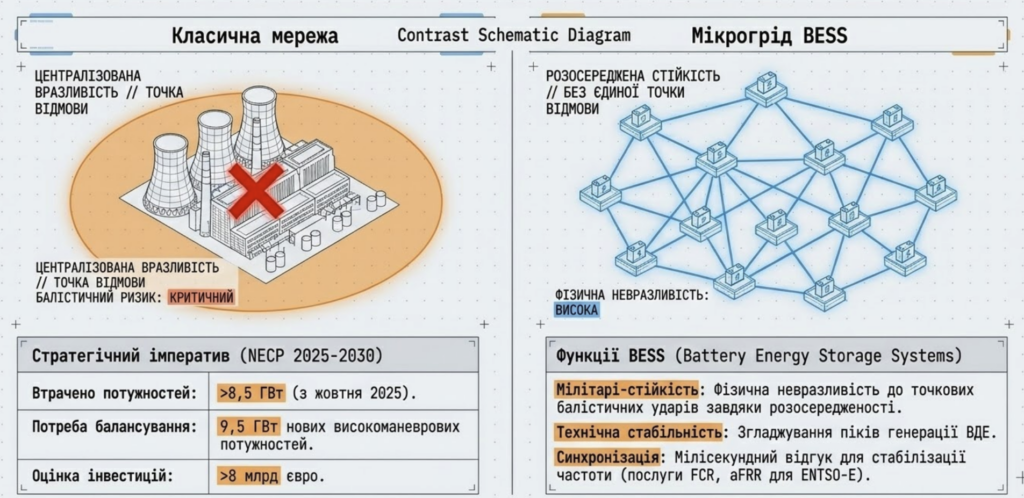
Recognizing the total vulnerability of the classic centralized generation system — both to targeted Russian missile strikes and to internal corruption risks and the manipulations of major players — the Ukrainian government began an accelerated and non-alternative transition to a decentralized energy model. The modern paradigm of energy resilience is based not merely on the chaotic expansion of new renewable energy sources, but on the mass deployment of industrial energy storage systems (Battery Energy Storage Systems — BESS).
2.1. Doctrine of Distributed Generation and Balancing
An analysis of strategic documents, in particular the National Energy and Climate Plan for 2025–2030 (NECP), shows that Ukraine’s energy system has entered the most extensive transformation phase of the past fifty years. According to experts and the leadership of NPC Ukrenergo, to compensate for destroyed capacity (more than 8.5 GW lost since October 2025 alone) and ensure balance in the national grid, the state urgently needs to commission about 9.5 GW of new, highly maneuverable balancing capacity.5 The financial estimate for implementing this ambitious program exceeds €8 billion in direct investment.5
The specific nature of the Ukrainian energy sector today lies in the fact that decentralization has shifted from an environmental trend to a fundamental issue of national survival. Unlike giant thermal or hydroelectric power plants, which are easy targets for ballistic weapons, small RES facilities dispersed across the country and technologically integrated with battery storage systems are practically impossible to destroy even with massive precision strikes.7 BESS serve as the strategic “glue” of the energy system. They are capable of smoothing peak loads, storing surplus wind and solar energy, and, most importantly, providing millisecond response times, which are critically important for stabilizing grid frequency (providing Frequency Containment Reserves — FCR, and automatic frequency restoration reserve — aFRR) and synchronizing with the European ENTSO-E grid.8
2.2. Formation of a New Market: Ukrenergo Auctions and Multi-Billion Obligations
To stimulate private investment in this entirely new market for Ukraine, NPC Ukrenergo developed and implemented an innovative financial and legal mechanism. During 2024–2025, the national operator organized and successfully conducted four unprecedented specialized auctions for the procurement of long-term ancillary services.9 The architecture of these auctions was built in such a way (two took place in August 2024, one in December 2024, and one in May 2025) that the winning companies received rigidly guaranteed, euro-denominated five-year contracts from the state.7 This step was revolutionary for the Ukrainian market, as the availability of a five-year state contract gave investors the long-awaited opportunity to attract affordable project financing from international institutions (such as the EBRD, EIB, and EU structures) at acceptable interest rates.7
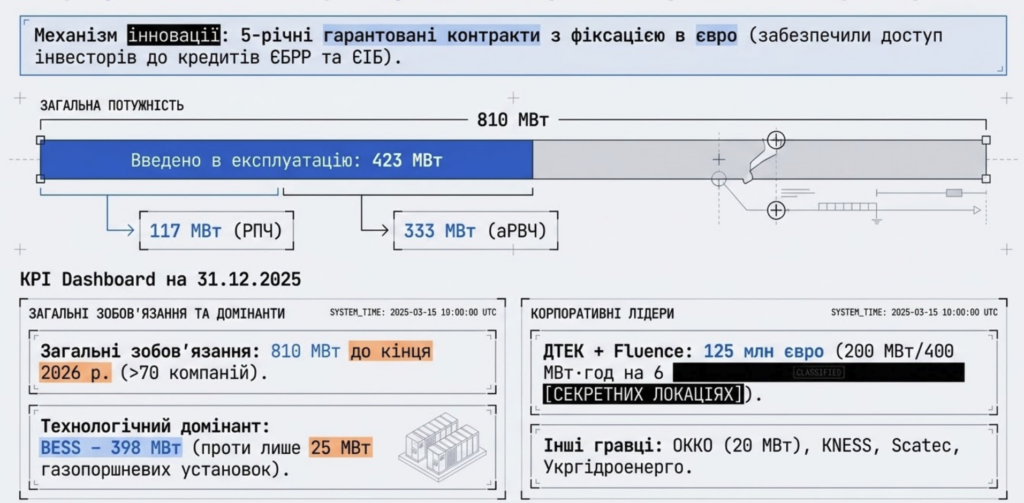
The results of this policy proved highly successful. Following the four auctions, more than 70 companies of various profiles assumed unequivocal legal obligations to build and commission up to 810 MW of entirely new generation and balancing capacity by the end of November 2026.9
The implementation dynamics of these obligations indicate strong business interest. As of 31 December 2025, the regulator had already officially recorded and certified the commissioning of 423 MW of new capacity.9 Of this volume, 117 MW provide frequency containment reserve (FCR) services, and 333 MW provide automatic frequency restoration reserve (aFRR) services.9 The technological analysis of the commissioned facilities demonstrates the total dominance of battery technologies.
As the data show, the lion’s share of new balancing capacity consists of energy storage systems (ESS/BESS) — 398 MW, while gas piston units were able to provide only 25 MW.9
2.3. Regional Integration and Corporate Leaders
Although the detailed topographic map of the location of all new facilities remains classified for reasons of national security and protection against enemy strikes, the overall development strategy clearly points to deep regional customization. According to Ukrenergo’s leadership, each oblast must form its own unique energy mix, taking into account geographical features and the capacity of local networks.5 Particular attention is paid to the most affected regions. In particular, for Kharkiv and Odesa, which systematically suffer the harshest blackouts and missile attacks, individual projects are being developed with an emphasis on local microgrid systems and decentralized generation integrated into 110 kV networks.5
The leader and main driver of BESS market development was, as expected, the DTEK Group. In partnership with the global technology leader Fluence, the holding invested an unprecedented €140 million for wartime conditions (the actual cost of the implemented project amounted to €125 million) in the construction of a powerful complex.8 This complex has a total capacity of 200 MW and a massive storage capacity of 400 MWh.8 To minimize military risks, the infrastructure was geographically dispersed: the units are physically located at six strategic sites in different regions of Ukraine.8 The capacity of this complex is sufficient, in the event of a blackout, to provide uninterrupted power to about 600,000 households (equivalent to half of Kyiv’s housing stock) for two hours.8 This project, completed in less than a year and ahead of schedule, became the first major infrastructure facility under the US–Ukraine Economic Partnership Agreement.8
However, there is no monopoly in this market. Large retail business and other corporations have also become actively involved. For example, the fuel giant — the OKKO gas station network — successfully commissioned its own 20 MW energy storage system, significantly ahead of the deadlines set by Ukrenergo.9 Other active auction winners and developers include the Ukrainian technology company KNESS, Norway’s Scatec, wind farm operators (including “Tylihulska WPP-2”), and the state-owned enterprise PJSC Ukrhydroenergo.9
Section 3: Technological Expansion — An Analysis of Chinese Technological Dominance in the Ukrainian Market
The destruction of domestic flexible generation and transformer nodes forced the Ukrainian population and business community to invest billions of dollars from their own savings in securing individual energy independence at the micro level. This process immediately triggered explosive growth in imports of complex energy equipment, a market in Ukraine that turned out to be almost totally monopolized and controlled by manufacturers from the People’s Republic of China. This dependence creates new, hidden vectors of geopolitical and technological vulnerability for the state.
3.1. Import Macroeconomics: Billion-Dollar Dependence on the PRC
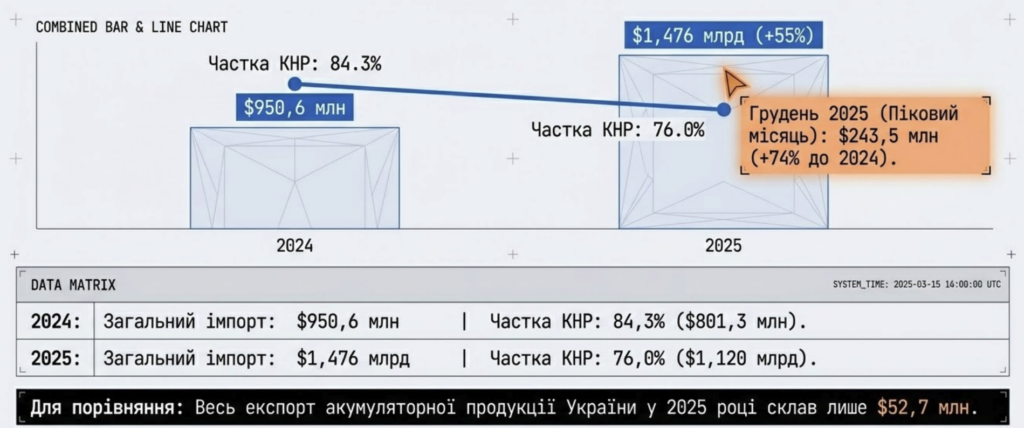
An analysis of aggregated databases of the State Customs Service of Ukraine for the period 2023–2025 makes it possible to trace the unprecedented dynamics of saturation of the domestic market with foreign equipment. If in 2023 import volumes were relatively moderate, during 2024 an initial rapid increase was recorded, when the value of imported equipment more than doubled, reaching USD 950.6 million.17 The following year, 2025, demonstrated exponential acceleration of this process. The total annual volume of imports of electric accumulators and separators for them increased by another 55%, reaching a phenomenal, record level for the industry of USD 1.476 billion.17 The peak month was December 2025, when imports rose by 74% compared with the same period of the previous year, amounting to USD 243.5 million.17
In this multi-billion-dollar trade ecosystem, China acts as an absolute and undisputed hegemon.
| Indicator | 2024 | 2025 |
| Total battery import volume | $950.6 million | $1.476 billion |
| Year-on-year growth | >100% | +55% |
| Share of imports from China | 84.3% | 76.0% |
| Value of imports from China | $801.3 million (est.) | $1.120 billion |
| Main competitors (share) | Czech Republic (2.6%), Bulgaria (2.5%) | Vietnam (6.6%), Taiwan (3.7%) |
The data in the table 17 vividly illustrate that despite some diversification of logistics chains and the emergence of new Asian players such as Vietnam and Taiwan in 2025, China’s share remains critically dominant.
The catalyst and main driver of this import boom were unprecedented regulatory steps by the Ukrainian government. At the end of July 2024, amid the threat of winter blackouts, the Cabinet of Ministers of Ukraine decided to temporarily, until 1 January 2029, fully exempt imports of power-generating equipment, inverters, and battery storage systems from customs duties and value-added tax (VAT).7 On the one hand, this decision was critically important for the physical survival of hundreds of thousands of households and for preserving the operability of small and medium-sized businesses under conditions of constant outages. On the other hand, from a macroeconomic perspective, it led to a massive, uncontrolled outflow of foreign currency liquidity from the country and effectively cemented 100% technological dependence of the energy micro-level on a single geopolitical actor.
In parallel with imports, Ukraine also attempted to develop exports of battery products (mainly to Poland, Germany, and France), but their volumes remain negligible compared with imports: USD 41.6 million in 2024 and USD 52.7 million in 2025.17
3.2. Inverter Systems: The Technological Rivalry Between Deye and Huawei
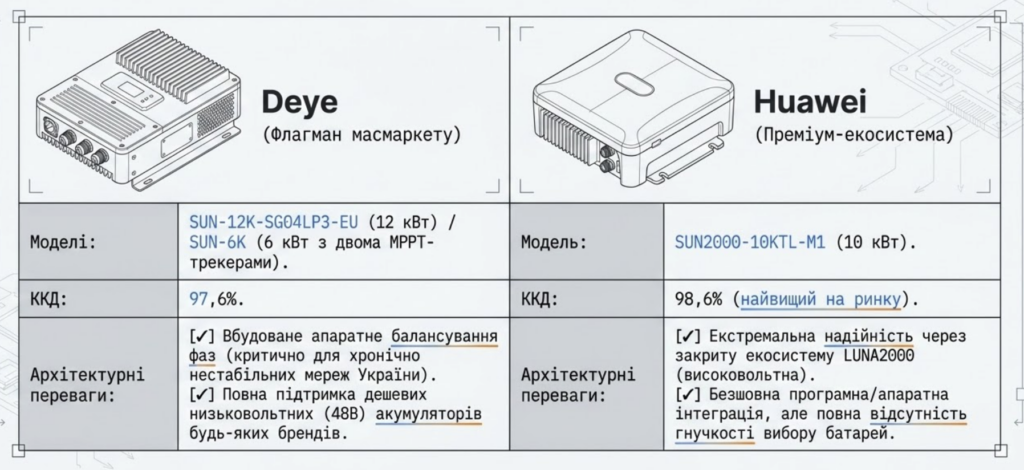
The heart and brain of any modern household or commercial solar energy storage system is the inverter. This complex electronic device not only converts direct current from solar panels or batteries into alternating current for powering the home grid, but also manages energy flows, determining charging and supply priorities. An analysis of the inverter market in Ukraine shows that, like the battery market, it is fully controlled by Asian manufacturers. As of 2025, according to aggregated data from integrators and expert feedback, the most popular and technologically advanced brands are Deye and Huawei.19
Research into technical solutions and consumer preferences shows a sustained shift in demand toward multifunctional hybrid models. The absence of competitive European or American analogues in this price range makes Chinese brands the only viable choice for the mass domestic consumer.
Deye’s strategy and technological advantages: The Deye brand has captured the Ukrainian market thanks to the unprecedented versatility of its architectural solutions. The flagship three-phase model Deye SUN-12K-SG04LP3-EU (12 kW capacity and a stated efficiency of 97.6%) has effectively become the unofficial industry standard for large private households and small businesses.19 Engineers and installers highlight two critical advantages. The first is the built-in hardware function for intelligent phase balancing. In the conditions of chronically unstable Ukrainian power grids, where voltage imbalance is a daily reality, this function allows the inverter to automatically, in real time, distribute power evenly across the household phases, preventing emergency shutdowns. The second strategic advantage is full hardware support for low-voltage (48V) battery systems.19 Unlike high-voltage systems, low-voltage assemblies are significantly cheaper on the market, which substantially reduces the overall system construction budget for the end user.
For smaller facilities with single-phase networks, the de facto standard has become the Deye SUN-6K-SG03LP1 model (6 kW capacity and 97.5% efficiency). Its engineering feature lies in the presence of two independent MPPT trackers (Maximum Power Point Tracking).19 This technology allows two separate arrays of solar panels (for example, placed on different roof slopes with different angles of illumination) to be connected to one inverter, optimizing total energy generation even under dynamic, partial shading of the panels during the day.19
Huawei’s strategy and technological advantages: Huawei, with its vast experience in the telecommunications sector, positions its inverters in the higher, premium segment of the market, relying on extreme efficiency and a closed ecosystem. Its flagship three-phase hybrid model Huawei SUN2000-10KTL-M1 (10 kW capacity) demonstrates the highest efficiency rating on the market — 98.6%.19 Huawei’s main technological doctrine is deep, seamless software and hardware integration of the inverter with its own proprietary high-voltage battery systems from the Huawei LUNA2000 line.19 This approach (similar to Apple’s ecosystem in the smartphone world) minimizes equipment conflicts and guarantees maximum reliability, but deprives consumers of flexibility in choosing cheaper batteries from third-party manufacturers.
3.3. Operational Vulnerabilities of the Systems: The Illusion of Total Safety and Temperature Traps
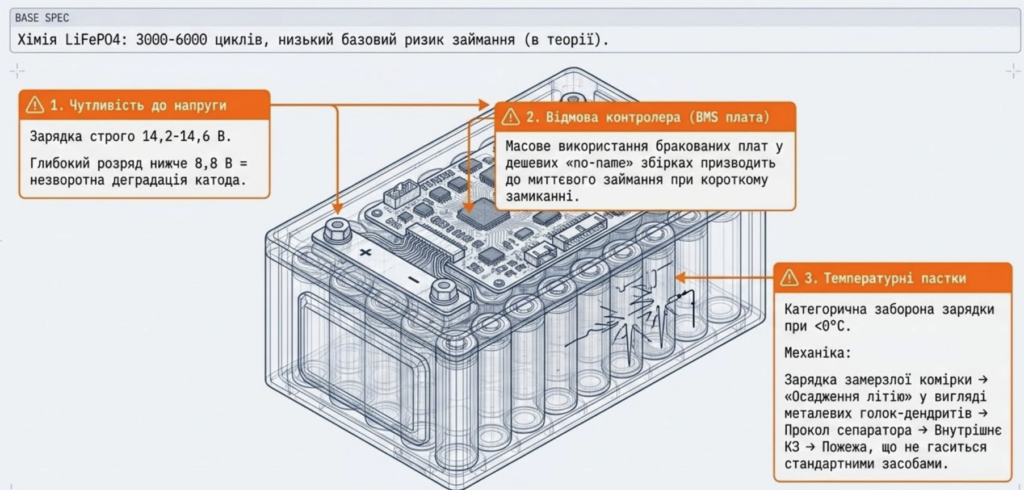
The foundation on which the energy resilience of Ukrainian apartments and houses rests has become lithium iron phosphate batteries (LiFePO4). In a short period, they have almost completely displaced outdated lead-acid and gel batteries, as well as classic lithium-ion NMC (nickel-manganese-cobalt) assemblies. The reason for this unequivocal success is the unique chemistry of LiFePO4: these cells have a significantly lower risk of thermal runaway and self-ignition in the event of damage, withstand a colossal number of deep charge-discharge cycles (from 3,000 to 6,000 cycles without significant degradation), and at the same time provide acceptable energy density.21
However, the illusion of absolute safety and low maintenance has led to widespread disregard for operating rules. The installation of these powerful chemical current sources by unqualified users in cramped apartments, on glazed balconies, and in unheated garages creates systemic risks on a national scale. Industry experts and technical specialists from official distributors (for example, Pulsar Limited LLC, which represents the LiTime brand) emphasize the existence of strict, non-negotiable safe operating parameters.21
Critical sensitivity to voltage parameters: The charging process for LiFePO4 batteries requires surgical precision. For standard 12V systems, the charging current must be supplied within a strict range of 14.2 to 14.6 V.21 Even more dangerous is the discharge process. The chemistry of these batteries is extremely sensitive to over-discharge: a drop in terminal voltage below the critical threshold of 8.8 V triggers irreversible chemical processes of degradation of the cathode crystal lattice, after which it becomes physically impossible to restore the battery’s capacity.21
The BMS system as the only line of defense: Given the high sensitivity of the cells, the key, life-critical component of any assembly is the built-in electronic control board — the Battery Management System (BMS). It is the BMS microprocessor that performs the functions of a safety controller, automatically and instantly disconnecting power in the event of a short circuit, dangerous overcurrent, an attempt to overcharge beyond 14.6 V, or a drop in voltage to critical limits.21 The main problem of the modern Ukrainian market is that cheap Chinese “no-name” assemblies massively use defective, low-quality, or improperly calibrated BMS boards. Failure of this penny electronic component during overload instantly turns the battery into a powerful fire hazard right in the consumer’s living room.
Winter temperature traps: The most underestimated threat, which manifests massively during winter power outages in Ukraine, is strict temperature limitations. According to technical manuals, LiFePO4 batteries are strictly prohibited from being charged at ambient temperatures below 0°C (the optimal charging temperature is 0–45°C, and for long-term storage — 10–35°C at a state of charge of about 50%).21
The mechanics of this vulnerability are as follows: attempting to pass charging current through a frozen cell (which often happens when people install batteries on cold balconies or in garages, or bring them in from the frost and immediately plug them in) leads to the phenomenon of so-called “lithium plating.” Instead of intercalating into the anode structure, lithium ions deposit on its surface in the form of metallic protrusions — dendrites. These microscopic needles can puncture the cell’s internal separator, inevitably causing an internal short circuit, rapid heating, and, at best, complete loss of functionality of the device, and at worst, a fire that is extremely difficult to extinguish with standard firefighting equipment.21
Section 4: Deferred Catastrophe — The Environmental Crisis and the Economics of Lithium-Ion Battery Disposal
Millions of battery units imported into Ukraine in a panic-driven effort to escape blackouts have a strictly limited service life, which in the realities of intensive deep discharges ranges from 5 to 10 years. The mathematics is inexorable: once this resource is exhausted, the state will simultaneously face an environmental problem of unprecedented, catastrophic scale, for which neither the legislative framework nor the country’s infrastructure is currently prepared. What is today a lifeline will tomorrow turn into millions of tons of highly toxic waste.
4.1. Waste Collapse and the Paralysis of Recycling Infrastructure
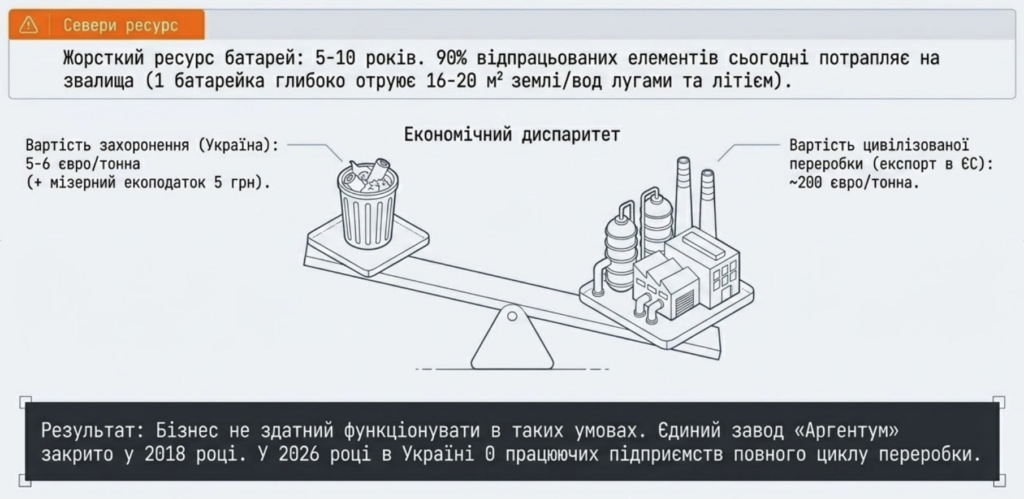
The current state of handling chemical power sources in Ukraine can be characterized as deeply crisis-ridden. According to environmental experts, more than 90% of all spent cells are simply thrown into ordinary containers and eventually end up in informal or municipal landfills.22 The chemical cocktail contained inside their casings (including heavy metals such as cadmium, antimony, alkalis, highly toxic electrolytes, and active lithium), after the inevitable corrosion of the metal shell under the influence of rain, is freely released into the open environment. The consequences are devastating: research shows that just one discarded battery can deeply and for decades poison 16 to 20 square meters of land and groundwater.22
The system of civilized industrial recycling in the country is de facto absent. As far back as 2011, an optimistic attempt was made on the basis of the Lviv state plant “Argentum” to launch the country’s first industrial battery recycling line. However, this initiative encountered harsh reality: due to the lack of modern, energy-efficient technologies and the tiny, unstable volumes of centralized collection of raw materials from the population, the plant operated at a loss, and in 2018 this line was finally shut down and dismantled.22 As of 2025–2026, there is not a single operating enterprise in Ukraine that carries out a full industrial recycling cycle for lithium-ion batteries with the extraction of pure raw materials.
The main and fundamental reason for this infrastructure paralysis is the catastrophic economic unprofitability of the recycling process under the existing legislative realities. In Ukraine, the cost of landfilling waste at a regular landfill is absurdly and artificially low — about €5–6 per ton (plus an environmental tax of only UAH 5 per ton).22 By contrast, the real costs for a certified operator for safe sorting, neutralization, packaging, and export of toxic waste for processing at European plants reach about €200 per ton.22 Business cannot function under such a cost disparity. Experts unanimously emphasize that without the immediate introduction at the highest legislative level of the European principle of extended producer responsibility (EPR) — which would oblige importers to include the fixed cost of future disposal directly in the retail price of the product at its first sale — the creation of a viable domestic recycling industry will remain an unattainable dream.22
4.2. Export Logistics: Civil Initiatives as a Temporary Barrier
In the absence of a state system and domestic plants, the entire burden of managing toxic waste has fallen exclusively on the public sector, volunteers, and a small percentage of socially responsible corporate business. The largest and most effective structure in this field has been the civic movement “Batteries, Surrender!” Thanks to voluntary financial contributions from citizens and the systematic support of more than 240 partner companies (including major retail chains such as Novus, Silpo, Epicentr, the banking sector, IT companies, and condominium associations), activists have managed to build a national network of 1,602 certified collection points across free Ukraine.22
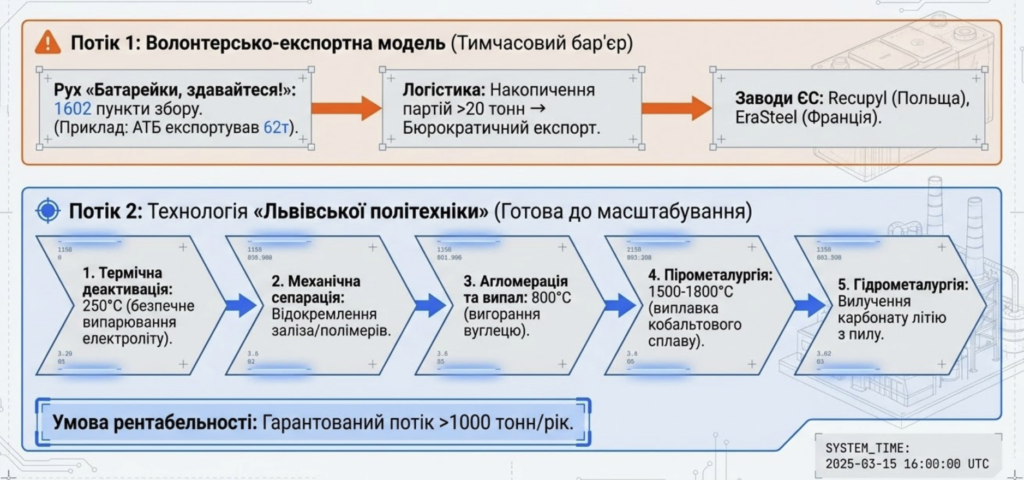
However, the activity of this organization is limited exclusively to the safe collection of waste, its classification, accumulation in specialized protected warehouses in Ukraine, and subsequent complex export to European Union countries. The logistics of cross-border movement of hazardous waste are extremely bureaucratic and expensive: for a shipment to be even minimally economically justified, organizers must accumulate at least 20 tons of scrap over several months in storage, which corresponds to the volume of one full truckload.22 The loads collected by Ukrainians travel thousands of kilometers and are sent for recycling to plants in Poland (notably Recupyl), France (EraSteel), and Romania.22 An illustration of the scale of the problem is the fact that only one major supermarket chain, ATB, since the beginning of 2025 has been forced to collect and, at its own expense, send more than 62 tons of used batteries for disposal in the EU.23 This volunteer-export model is the only functioning temporary barrier between toxic scrap and Ukraine’s groundwater, but it is physically incapable of coping with the millions of kilograms of batteries from UPS units and inverters that will fail in the coming years.
4.3. Ukraine’s Scientific and Industrial Potential: Recovery of Non-Ferrous Metals
The paradox of the Ukrainian situation is that, despite the complete absence of operating plants, domestic academic science is not standing still and is actively developing modern, industrially scalable recycling technologies. The global economy views spent batteries not as waste, but as an extremely rich artificial deposit of critically important raw materials. It is known that in classic lithium-ion batteries, the positive electrode material is the most valuable component, accounting for about 40% of the total cost of the entire device.24 Battery scrap contains strategic non-ferrous and rare-earth metals: lithium, cobalt (the most expensive component), nickel, manganese, copper, and high-quality aluminum.22
Research groups, including scientists from the leading National University “Lviv Polytechnic,” have developed, patented, and thoroughly scientifically substantiated a comprehensive, multi-stage technology for the disposal of lithium power sources. This innovative technology is based on a complex combination of mechanical, pyrometallurgical (thermal), and hydrometallurgical (chemical) processes.24 The process, designed for industrial-scale implementation, consists of the following clearly regulated stages:
- Thermal deactivation and evaporation: Battery scrap is heated in special chambers to 250°C. This stage is critically necessary for the controlled evaporation and safe condensation of volatile, highly toxic, and flammable organic electrolyte (mainly based on ethyl methyl carbonate and ethylene carbonate).24
- Mechanical separation and crushing: The neutralized material passes through powerful mills and disintegrators. After crushing, the mass is passed through a cascade of magnetic and air separators. This makes it possible to mechanically separate the iron components of the casing, copper contacts, pieces of aluminum foil, and polymer plastic residues.22
- Agglomeration and high-temperature firing: The finest particles remaining after separation and containing the most valuable metals (cobalt, lithium) together with graphite residues are mixed with a special binding agent (for example, ordinary molasses). This mixture is formed into dense pellets (granules), which are then fired in a rotary kiln at about 800°C to maximize the burnout of carbon residues.24
- Pyrometallurgical smelting: The most energy-intensive stage. The purified granules are melted in high-temperature furnaces at ultra-high temperatures in the range of 1500 to 1800°C. Due to differences in melting points and density, at this stage an extremely valuable heavy cobalt alloy is successfully separated from the melt, ready for sale on metallurgical exchanges.24
- Hydrometallurgical extraction of lithium: Since lithium is an extremely light and volatile metal, during smelting (at stage 4) a significant portion of it (up to 20%) simply evaporates and goes up the chimney together with flue gases (only about 1.4% lithium remains in the slag). Therefore, industrial chimneys must be equipped with special powerful filters that capture lithium-containing dust. This dust, together with the remaining concentrate, is dissolved in strong sulfuric acid. After the dissolution reaction is complete, a solution of ordinary soda (sodium carbonate) is added to the resulting liquid, causing the pure final product — lithium carbonate — to precipitate as a white sediment at the bottom of the tanks, and it can again be used to produce new batteries.24
According to financial models built on the basis of these scientific studies, the break-even point (economic viability) for launching such a high-tech plant in Ukraine would begin only if guaranteed and stable recycling volumes of at least 1,000 tons of battery scrap per year were secured.24 At the same time, the financial success of the entire enterprise would depend directly and rigidly on current global quotations for cobalt and lithium on the London Metal Exchange.
4.4. Global Innovations: Hydrometallurgy and Glycine Revolutions
While Ukraine is forced to remain at the initial stage of laboratory development, waste accumulation, and volunteer export of waste, the global recycling industry is moving forward by leaps and bounds, focusing on reducing costs and radically improving environmental performance. Classic thermal (pyrometallurgical) methods, similar to those being developed in Ukraine, although extremely effective, have two significant drawbacks: they require colossal amounts of electricity (to heat to 1800°C) and inevitably lead to the complete combustion and loss of graphite, accompanied by significant volumes of harmful carbon dioxide emissions into the atmosphere.
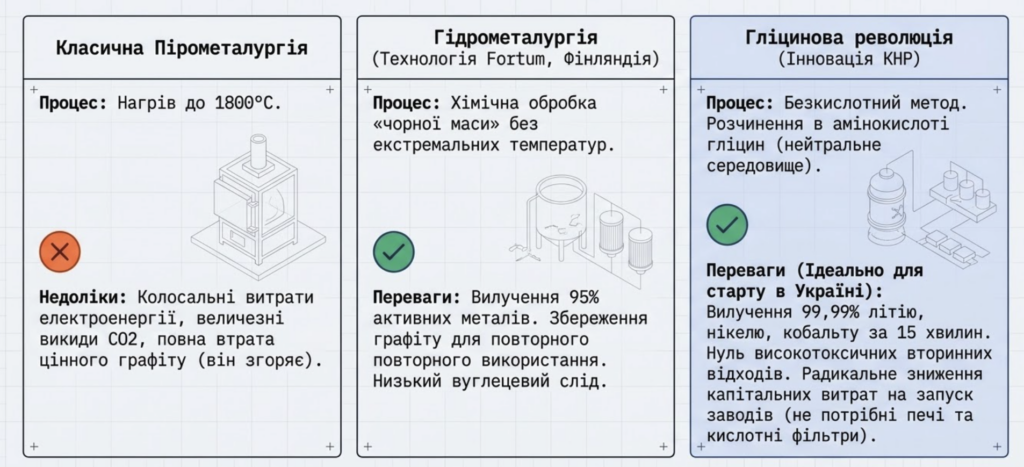
Therefore, the global alternative is the so-called clean hydrometallurgical processes. A vivid example is the innovative technology patented by the Finnish energy giant Fortum. Their method is optimized for large industrial batteries from electric vehicles and energy storage systems. The process begins with the safe crushing of discharged cells in special machines into a powder that engineers call “black mass.” This powder undergoes chemical (hydrometallurgical) treatment, which makes it possible, without the use of extreme temperatures, to extract up to 95% of active metals (cobalt, manganese, nickel, lithium), and, most importantly, to preserve graphite intact for its subsequent reuse in production cycles.25 By eliminating firing, this method radically reduces CO2 emissions.
An even more revolutionary and promising approach in the field of lithium-ion battery recycling was recently presented by scientists from China. Instead of using aggressive and dangerous sulfuric or hydrochloric acids, which generate huge volumes of secondary highly toxic waste (which themselves require complex disposal), Chinese chemists developed an entirely environmentally friendly method. The key component of their technology was a simple amino acid — glycine.26 This organic substance has a unique ability to effectively bind ions of target metals directly in a neutral, rather than acidic, medium. According to the developers, when battery “black mass” interacts with a solution of glycine, iron salts, and sodium oxalate, the material rapidly breaks down, preventing the formation of harmful by-products. The research results are impressive: the new technology makes it possible to extract a fantastic 99.99% of lithium, as well as the vast majority of nickel, cobalt, and manganese, in just 15 minutes of reaction time.26
The introduction of such “green,” low-temperature, and acid-free technologies in Ukraine could fundamentally change the rules of the game. It would make it possible to drastically reduce the initial capital costs of building and launching domestic recycling facilities, since investors would no longer need to spend millions on constructing ultra-powerful high-temperature furnaces (as in the processes of “Lviv Polytechnic”) and highly complex systems for filtering acid vapors and flue gases.
Strategic Conclusions for National Security
An analysis of all three examined directions makes it possible to assert that Ukraine’s energy sector is undergoing the most dramatic phase of its development in all years of independence. This transition is driven by the existential challenges of an ongoing war, yet its final architecture is being shaped under the significant influence of internal regulatory gaps, lobbying pressures, and the dictates of global technology markets.
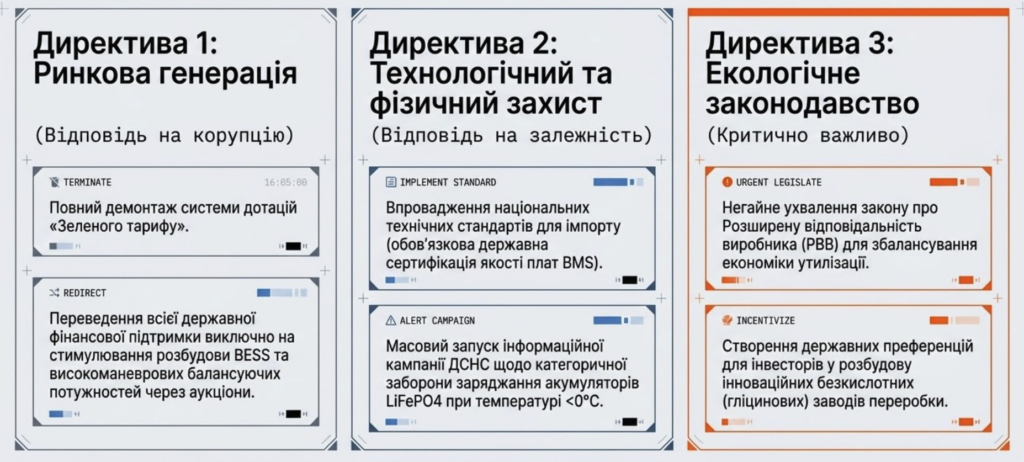
First, the history of abuses of the “green tariff” mechanism — from the direct criminal theft of state funds amounting to millions of hryvnias through fictitious plants in the occupied zone to mass systemic manipulation of capacity limits and tampered meters in the private sector (artificial “nighttime generation”) — unequivocally proves the need for a complete and final dismantling of the system of artificial subsidies and a transition to exclusively market-based pricing mechanisms. The shift in focus of the national regulator, NPC Ukrenergo, toward stimulating the development of decentralized energy storage systems (BESS) and launching transparent long-term auctions for ancillary services is a strategically correct, albeit belated, step. Decentralized battery and balancing capacities, the development of which has already been officially contracted at the level of 810 megawatts by leading national and international corporations, will become the foundation that ensures the physical viability of the Ukrainian energy system during future crises.
Second, the massive, unrestrained import of Chinese equipment (worth nearly USD 1.5 billion in 2025 alone), which thanks to zero taxes saved the country from a scenario of total blackout, has at the same time created an absolute, monopolistic technological dependence of Ukraine on the People’s Republic of China in the entire household and micro-commercial generation segment. The total dominance of lithium iron phosphate batteries and sophisticated inverters from Asian brands (Deye, Huawei) requires the state not only to passively monitor the trade balance. There is an urgent need to develop and implement strict national technical safety standards for the operation of such equipment, create a system for certifying BMS control boards, and make consumer training mandatory. The risks of large-scale fires in apartment buildings due to the elementary failure to observe charging temperature regimes in freezing conditions are entirely systemic and threaten the lives of thousands of citizens.
Third, the environmental aspect of the country’s mass micro-battery deployment continues to be criminally ignored at the highest state level. Without the immediate adoption of a European law on extended producer responsibility (EPR), which alone can economically balance the high cost of processing toxic scrap and make its cheap disposal at landfills unprofitable, Ukraine will face an irreversible environmental collapse by the end of this decade. The significant scientific potential of domestic universities in the field of hydrometallurgical and pyrometallurgical recovery of strategic non-ferrous metals from lithium batteries objectively exists and is documented. However, without the creation of strong economic incentives by the state and the attraction of millions in investment for the construction of high-tech plants (including the use of innovative acid-free glycine technologies), this potential will remain only in the form of drawings on paper. Meanwhile, the country will continue to accumulate millions of tons of highly toxic waste in its black soil and groundwater, shifting the price of today’s energy resilience onto the shoulders of future generations.
Institute for Social Dynamics and Security KRONOS
The investigation actively used OSINT tools and artificial intelligence, including Gemini and Grok models. OSINT methods made it possible to collect and analyze open data from various sources, including social networks, public databases, and web resources. Gemini provided in-depth analysis of textual data, pattern detection, and forecasting, while Grok, created by xAI, was used to process complex queries and generate precise conclusions based on large volumes of information. The combination of these technologies made it possible to significantly accelerate the investigation process, improve the accuracy of the results obtained, and identify connections that might have remained unnoticed by traditional methods.
Sources
- Politicians and businessmen close to them are massively launching solar and …, https://bihus.info/koroli-soncya-i-vitru-khto-zarobit-na-zelenomu-tarifi/
- Amendment to Law 8449 on green auctions – “Green tariff”, https://petition.kmu.gov.ua/petitions/2234
- NABU and SAPO exposed a scheme of embezzling funds under the “green …”, https://nabu.gov.ua/news/nabu-i-sap-vykryly-skhemu-rozkradannia-koshtiv-za-zelenym-taryfom-na-tymchasovo-okupovaniyi-terytori/
- Why owners of home solar power plants do not receive compensation …, https://thepage.ua/ua/economy/chomu-vlasniki-domashnih-ses-ne-otrimuyut-kompensaciyu-zelenogo-tarifu
- €8bn for Recovery: Ukrenergo Estimates Need for 9.5 GW of New …, https://inventure.com.ua/en/news/world/euro8bn-for-recovery:-ukrenergo-estimates-need-for-9.5-gw-of-new-capacity
- National Energy and Climate Plan of Ukraine 2025-2030, https://www.energy-community.org/dam/jcr:9d144283-08ed-410b-a670-7fd15c7782f2/1_NECP_EnMachineTranslation.pdf
- Ukraine’s strategic need for energy storage – Energy-Storage.News, https://www.energy-storage.news/ukraines-strategic-need-for-energy-storage/
- DTEK launches the largest energy storage complex in Ukraine …, https://dtek.com/dtek-fluence-project/
- Following the results of the first two special auctions, 423 MW of new …, https://interfax.com.ua/news/economic/1132818.html
- Ukraine’s KNESS gets loan from state-owned bank for battery storage project, https://www.energy-storage.news/ukraines-kness-gets-loan-from-state-owned-bank-for-battery-storage-project/
- Ukraine: Energy Storage and Ancillary Services Market Development Support, https://energystoragecoalition.eu/wp-content/uploads/2024/12/Ukrenergo.pdf
- Guidebook for Energy Storage in Ukraine: market development and …, https://cms.law/en/ukr/legal-updates/guidebook-for-energy-storage-in-ukraine-market-development-and-regulatory-framework
- Innovative grid technologies for Ukraine Next winter and beyond: four challenges – Green Deal Ukraine, https://greendealukraina.org/uk/assets/images/reports/gdu-technologies-for-ua-grid-ukr.pdf
- DTEK invests €140 million in energy storage systems to …, https://dtek.com/media-center/news/dtek-to-invest-140-million-in-energy-storage-systems-to-strengthen-ukraines-energy-secur/
- DTEK invests 140 million euros in energy storage projects to protect Ukraine’s power system – LogicPower, https://logicpower.ua/ua/blog/DTEK-investuye-140-milyoniv-yevro-v-proyekty-zberihannya-enerhiyi-dlya-zakhystu-enerhosystemy-Ukrayiny
- OKKO has put into operation a 20 MW energy storage – EXPRO Consulting, https://expro.com.ua/en/tidings/okko-has-put-into-operation-a-20-mw-energy-storage-
- Battery imports into Ukraine in 2025 rose by 55% to $1.48 …, https://open4business.com.ua/import-akumulyatoriv-v-ukrayinu-v-2025-roczi-zris-na-55-do-148-mlrd-76-postavok-z-kytayu/
- Battery imports into Ukraine over nine months rose by 63 …, https://expertsclub.eu/import-akumulyatoriv-v-ukrayinu-za-devyat-misyacziv-zris-na-63-do-9097-mln/
- TOP-5 best inverters for private households in …, https://solarled.com.ua/top-5-invertory-dlya-domashnih-ses-2025
- TOP 10 Best inverters during power outages in 2025 – Teploradost, https://teploradost.com.ua/ua/article/top-10-najkrashi-invertory-pry-vidkljuchenni-svitla
- What you need to know when using LiFePO4 batteries …, https://litime.com.ua/shho-potribno-znaty-pid-chas-vykorystannya-akumulyatoriv-lifepo4/
- “Altruism alone is not enough here.” We looked into what …, https://dev.ua/news/batareiky-1732282472
- Since the beginning of 2025, ATB has sent more than 62 tons of used batteries for disposal in the EU – TSN, https://tsn.ua/groshi/vid-pochatku-2025-roku-atb-vidpravyla-na-utylizatsiiu-v-yes-ponad-62-tonny-vykorystanykh-batareyok-2842484.html
- Disposal of spent lithium chemical power sources, https://ena.lpnu.ua/bitstreams/48fff31e-3432-4f95-b421-72a70c544c09/download
- The problem of lithium-ion battery disposal has been solved …, https://www.ukr.net/news/details/auto/82715033.html
- No toxic acids. Chinese scientists have developed a simple and environmentally friendly way to extract lithium from batteries – NV Techno, https://techno.nv.ua/ukr/popscience/kitayski-vcheni-rozrobili-ekologichniy-metod-viluchennya-litiyu-z-batarey-50497211.html