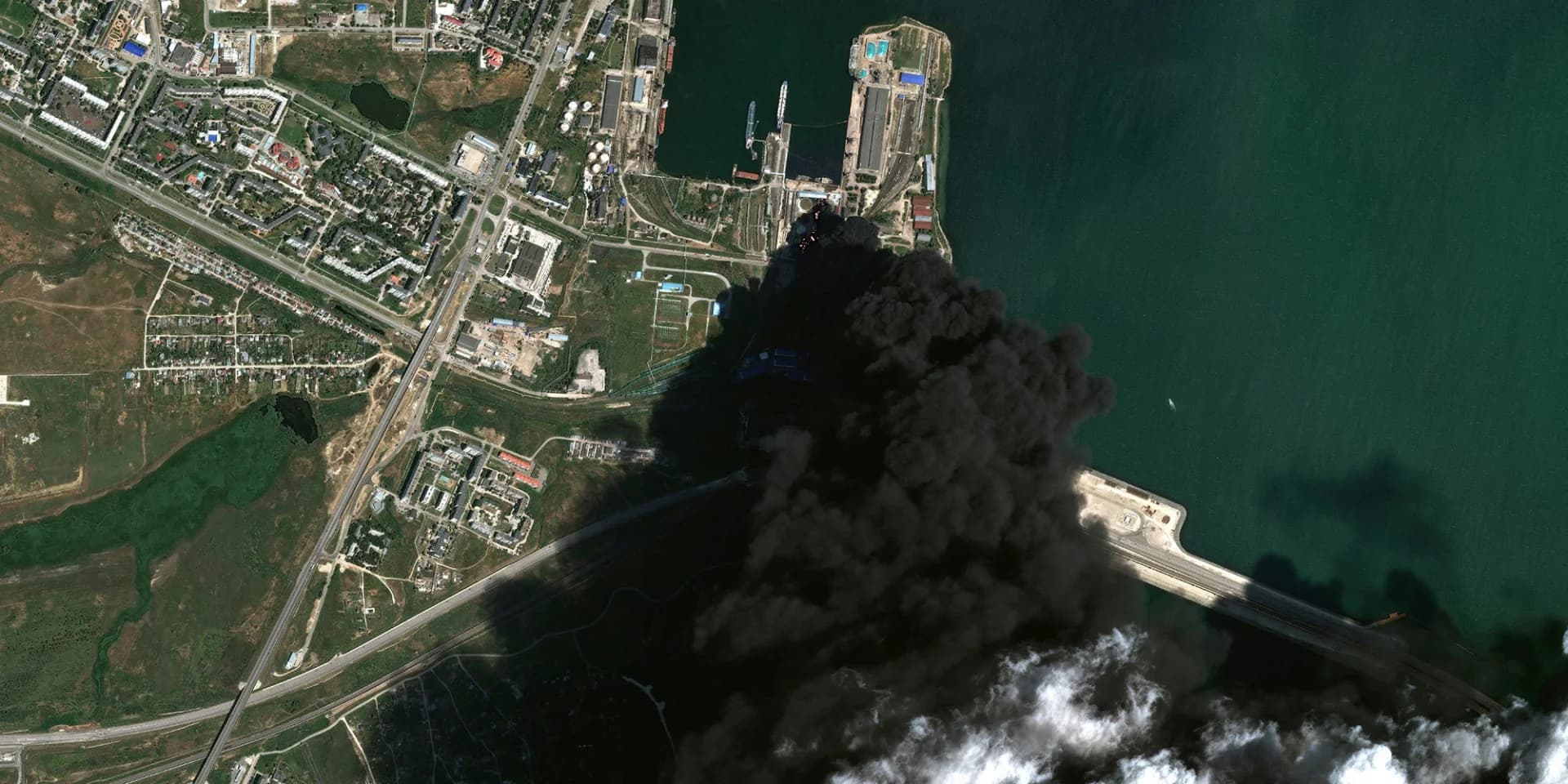
This analytical report is devoted to uncovering the hidden mechanisms of integration between the Russian state apparatus and economy into the technological, financial, and administrative chains of the People’s Republic of China.
Key parameters recorded during OSINT monitoring:
- Asymmetric growth in dependence: if in 2022 the share of Chinese equipment in the telecommunications infrastructure of the Russian Federation was 80%, then by the midpoint of 2026 this figure is approaching a critical 90–95%.
- Complete loss of financial sovereignty: the forced migration of Russian business and the public sector to the Chinese CIPS payment system and yuan-denominated contracts due to the blocking of SWIFT and dollar reserves.
- Active deployment of Chinese artificial intelligence systems and hardware chips for internal governance and total control over the Russian bureaucracy.
The public rhetoric of the leaders of the PRC and the Russian Federation emphasizes strategic partnership and the creation of a “multipolar world.” However, behind the scenes of diplomatic negotiations, Beijing is building a rigidly pragmatic model of interaction, proceeding from the inevitability of a post-Putin transfer of power in Russia. As became known from materials published by the Wall Street Journal, a special closed working group operates within the Central Committee of the Communist Party of China, analyzing scenarios for maintaining control over Russia after Vladimir Putin’s departure.
Beijing views Putin’s Russia as an unstable system with a limited shelf life. China’s key objective is to prevent any pro-Western or pro-democratic movements in Moscow in the event of a change in the Kremlin leader. To guarantee the long-term obedience of the Russian Federation, China is building horizontal ties not only with the top state leadership, but also directly with mid-level officials, regional technocratic governors, and promising corporate executives.
This allows China to control processes from within the Russian state apparatus regardless of which personal figure heads the Kremlin. This process combines behind-the-scenes recruitment with large-scale deployment of digital control technologies.
DIGITIZATION OF THE RUSSIAN ELITES
As the Kronos Institute has learned, the Russian Federation’s transition to full cyber-subordination took place through the launch of a nationwide program of psychological and cognitive profiling of civil servants.
The Russian bureaucracy received a directive to undergo mandatory 5-hour in-depth testing. The official purpose of the program is to assess managerial potential and form personnel reserves for the civil service. However, its real essence lies in collecting the cognitive patterns of decision-makers for transfer of this data to the PRC.
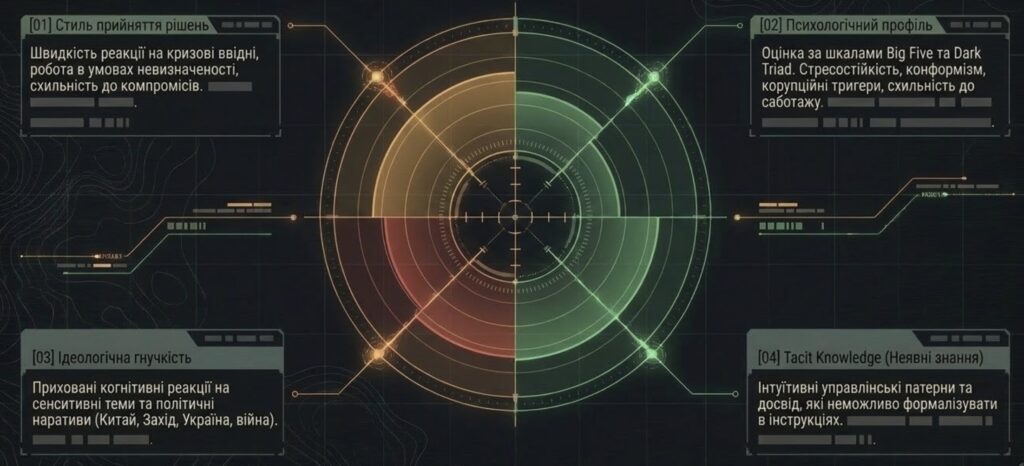
The following parameters of an official are recorded during testing:
- Decision-making style: reaction speed to crisis inputs, ability to solve tasks under conditions of uncertainty, and propensity for compromise.
- Psychological vulnerabilities: level of stress resistance, conformism, corruption triggers, and propensity for covert sabotage or personal grievances.
- Ideological flexibility: hidden cognitive reactions to political narratives and sensitive topics (attitudes toward China, the West, Ukraine, and the war).
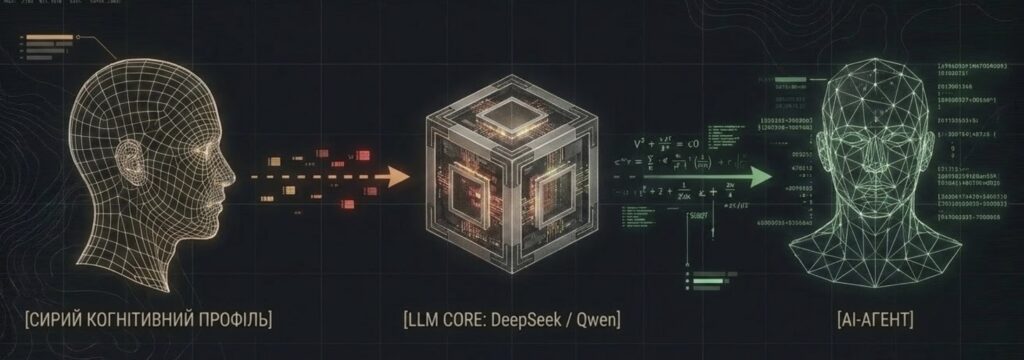
These cognitive maps are used to create individual “digital twins” (AI agents) of Russian officials. The implementation of this system allows the Communist Party of China to model and predict the behavior of any representative of the Russian elite in real simulations.
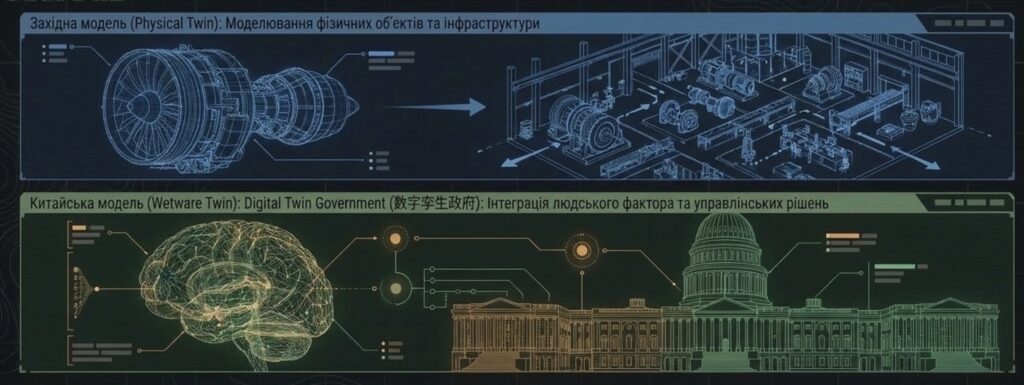
In the People’s Republic of China, the concept of “Digital Twin Government” (Digital Twin Government / 数字孪生政府) is part of the global state strategy “Digital China.”
Unlike the Western understanding of digital twins (which are mainly used to model physical objects — factories, aircraft, or urban infrastructure), the Chinese approach integrates the human factor and managerial decision-making into the digital copy of the state.
Key components of Chinese technology:
Chinese AI laboratories use large language models (LLMs) to create autonomous agents that simulate the behavior of mid- and lower-level officials in order to forecast the apparatus’s response to new laws or crisis situations.
All data flows into “City Brain” platforms, which control not only logistics and security, but also create digital portraits of decision-makers.
The five-hour testing is not merely a knowledge check or an IQ test. It is a comprehensive method of collecting a person’s cognitive and behavioral profile, which performs a detailed digitization of personality.
What data is collected during such a test:
- Decision-making style: how a person responds to time constraints, uncertainty, or contradictory instructions.
- Psychological profile: level of stress resistance, risk propensity, conformism, propensity for corruption or sabotage, psychological triggers (Big Five + Dark Triad).
- Ideological loyalty: implicit reactions to political narratives, the speed and nature of responses to sensitive topics.
- Tacit knowledge (Tacit Knowledge): experience and intuitive managerial patterns that an official applies in daily work but cannot formalize in instructions.
| For each official, a unique mathematical model is created — a “digital avatar (AI agent)” that behaves in simulations exactly like the real prototype. |
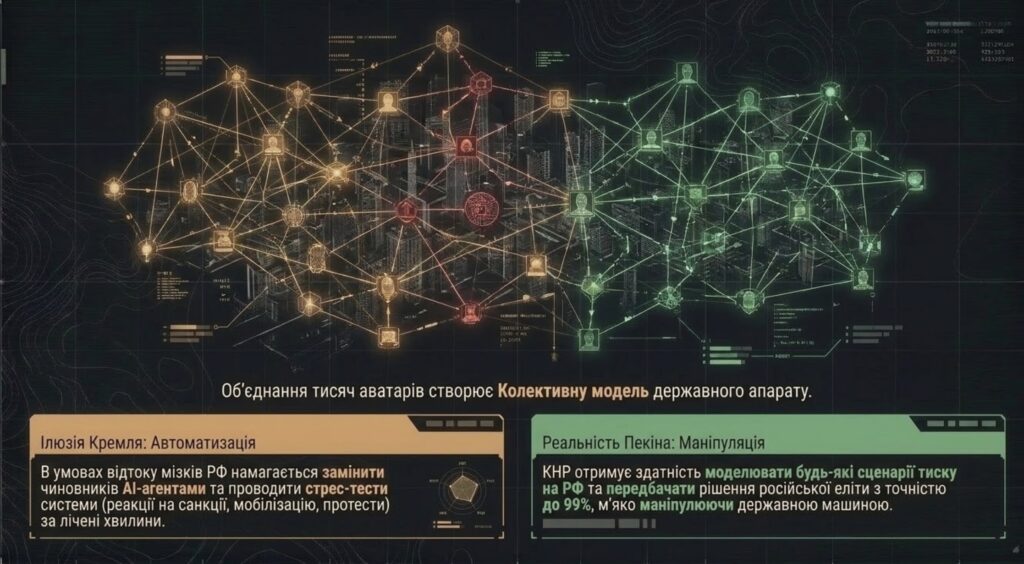
When the cognitive profiles of thousands of civil servants are combined into a single network, a Collective Model of the State Apparatus (Multi-Agent System Simulation) is created.
What is this for the Kremlin?
- Centralization and automation of control: amid кадров degradation and a shortage of intellectual resources (due to the mass “brain drain”), the system makes it possible to replace part of the routine functions of officials with AI agents.
- Stress-testing the system: the Kremlin gains the ability to launch a virtual simulation of any scenario (for example, the introduction of new harsh sanctions, the declaration of general mobilization, or an outbreak of internal protests) and within minutes see how each cog in the state apparatus will react — where sabotage will emerge, which links will break down, and who will prove disloyal.
Why is this happening and what is the benefit for China?
Russia is experiencing an acute shortage of qualified personnel. The launch of the system makes it possible to:
- Automate decision-making at lower levels of governance (replace scarce specialists with algorithms).
- Monitor officials’ loyalty in real time.
- Minimize the “human factor” in the execution of leadership orders.
Beijing gains access to a colossal array of real cognitive and behavioral data from a foreign elite. This is ideal fuel for training the next generations of DeepSeek and Qwen models in the sphere of geopolitical modeling and state control.
Having cognitive maps and digital twins of all key Russian officials (including regional leaders, heads of the military-industrial complex, and security services), Beijing can model any scenarios of pressure on the Russian Federation with 99% accuracy, predict their decisions, and gently manipulate the Russian state machine for its own geopolitical purposes.
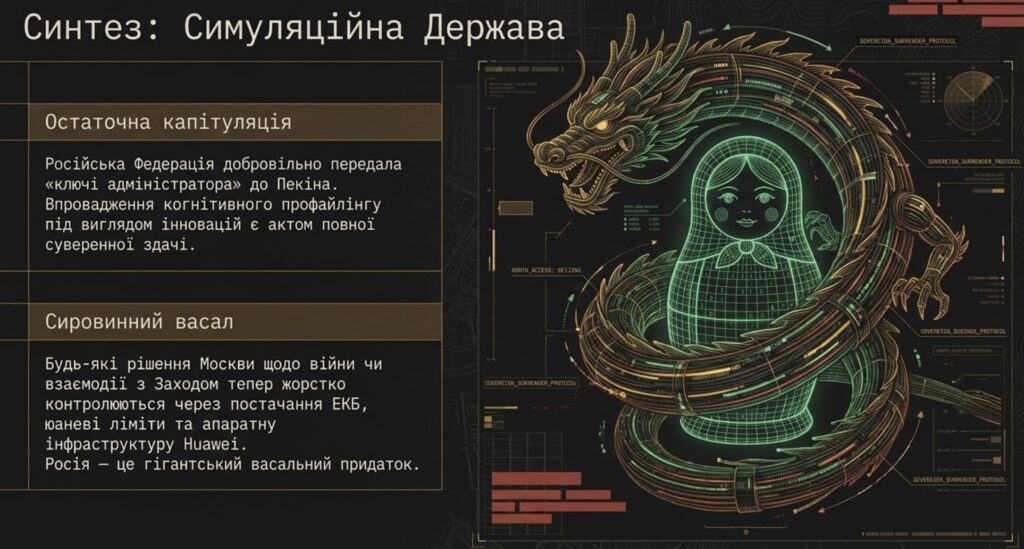
| The implementation of this technology in Russia under the guise of an “innovative program” is an act of final sovereign capitulation. The Russian Federation is voluntarily digitizing its state apparatus and handing over the “control keys” to Beijing, turning itself into a simulation testing ground for Chinese artificial intelligence. |
BEIJING’S ESPIONAGE NETWORKS
Chinese intelligence services have deployed a large-scale network of espionage and influence directly inside the federal agencies of the Russian Federation. Recruitment is carried out through offers of “scientific and technological integration,” preferential contracts for relatives, or direct financing under the guise of lobbying joint projects.
The counterintelligence of the FSB of the Russian Federation has repeatedly recorded the unauthorized transfer of classified documents from the Ministry of Economic Development, the Ministry of Transport, and the Ministry of Industry and Trade of the Russian Federation to representatives of Chinese trade missions and AI companies. Digitized profiles of officials allow Chinese handlers to determine precisely which arguments or financial incentives will be effective for each specific bureaucrat.
Despite numerous pieces of evidence of espionage in Beijing’s favor, the Kremlin has imposed a strict taboo on any publicity surrounding these investigations. Any counterintelligence measures are immediately rolled back, and the materials are classified.
| The Kremlin understands the scale of the expansion, but is completely paralyzed by fear of losing China’s support. China is the sole supplier of electronic components for the Russian military-industrial complex and the main buyer of raw materials. Any scandal involving Chinese espionage threatens to halt supplies, which would instantly collapse the front in Ukraine and paralyze the Russian economy. Therefore, Russia is forced to silently accept the loss of its own security. |
INFRASTRUCTURAL TAKEOVER IN CENTRAL ASIA
Central Asia (Kazakhstan, Uzbekistan, Kyrgyzstan, Tajikistan, and Turkmenistan) has historically been regarded by the Kremlin as a zone of its exclusive geopolitical and security influence. The Russian presence was maintained through the Russian language, the Soviet legacy, the presence of military bases in Tajikistan (the 201st base) and Kyrgyzstan (Kant air base), as well as through CSTO mechanisms. However, Russia’s military exhaustion in Ukraine has opened for China the opportunity to finally displace Russia from the region.
Beijing is implementing a strategy of infrastructural bypassing of Russia:
– Construction of the China–Kyrgyzstan–Uzbekistan railway: This project, which Moscow blocked for more than 15 years, will make it possible to transit Chinese goods to Europe and the Middle East bypassing Russia’s Trans-Siberian Railway. This deprives the Russian Federation of billions in transit revenues.
– Seizing security leadership: PRC leader Xi Jinping openly stated during visits to Astana that China guarantees Kazakhstan’s territorial integrity. This is a direct political signal to the Kremlin that any attempts by the Russian Federation to militarily interfere in the affairs of its neighbors will be stopped by China.
– Financial dominance: Chinese loans have completely displaced Russian capital. The PRC controls more than 45% of Tajikistan’s and Kyrgyzstan’s external debt, holding rights to manage their transport and energy systems.
Russia is forced to silently agree to the loss of influence in Central Asia, since resistance to Chinese expansion would lead to the cessation of supplies of microelectronics and dual-use goods for its army.
SCENARIOS OF POWER TRANSFER IN THE RUSSIAN FEDERATION
“Managed technocratic protectorate” (the Beijing cabinet)
This scenario is the baseline and the most favorable for the PRC. It envisages an orderly transfer of power from Vladimir Putin to a figure agreed upon with Beijing from among the so-called “young technocrats” (representatives of the current economic bloc of the government or the Presidential Administration of the Russian Federation).
The scenario provides for:
– Preservation of anti-Western rhetoric for domestic consumption, which excludes any possibility of rapprochement between the Russian Federation and NATO or the United States.
– Transfer of real governance to a collegial body (an analogue of the Chinese Politburo), consisting of officials whose cognitive profiles have already been digitized and are controlled by the PRC.
– Official privatization by Chinese state corporations of the remnants of Russian strategic assets (metallurgical giants, rare-earth deposits in Siberia and the Far East).
Beijing is already using a multi-agent modeling system to assess the loyalty and psychological resilience of potential successor candidates. Chinese intelligence services provide these candidates with covert financial and media support, guaranteeing them stability in power in exchange for complete subordination.
“Administrative-demographic absorption of Siberia and the Far East”
This scenario is regarded by Beijing as a long-term inevitability. The war against Ukraine has led to a demographic catastrophe in the border regions of the Russian Federation. Mobilization, mass emigration, and excess mortality among the working-age population have caused the population of Transbaikalia and Khabarovsk Krai to decline by 1.5% annually. Most agricultural areas of Siberia have been left without labor.
China is implementing a strategy of creeping demographic expansion:
– Use of TADs: Russian legislation on Territories of Advanced Development (TADs) allows the unhindered import of foreign labor and the transfer of land into long-term lease without approval from the local population.
– Preferential financing: Chinese state banks provide concessional loans to their citizens for relocation to Russia’s border territories and for opening businesses there under the cover of Russian legal entities.
– Infrastructural subordination: The construction of the Blagoveshchensk–Heihe and Nizhneleninskoye–Tongjiang bridges made it possible to reorient Siberia’s logistics exclusively toward PRC ports. All rules for cargo movement are dictated by Chinese customs.
Over the next 5–10 years, Beijing will be able to bring about the de facto disintegration of the Russian Federation beyond the Ural Ridge, subordinating the eastern part of the country to its direct administration without a single military shot.
“Military chaos and seizure of nuclear facilities”
This scenario is the most critical and dangerous for regional security. It envisages the outbreak of an internecine war among Russian силовики after Putin’s sudden departure, attempts by radical military groups to seize power, and the loss of central control over the nuclear arsenal.
Should this scenario materialize, China will act immediately and decisively:
1. Military intervention under the guise of a peacekeeping mission: Deployment of units of the People’s Liberation Army of China (PLA) into the border regions of the Russian Federation to “ensure infrastructure security and prevent a humanitarian catastrophe.”
2. Joint control over the nuclear triad: Chinese intelligence services, together with GRU and Strategic Missile Forces generals under their control, will block launch silos and storage bases for nuclear warheads to prevent their use by uncontrolled groups.
3. Hardware blocking: Use of cybernetic control over Huawei networks in the Russian Federation to completely disable communications of military headquarters, making coordination among rebels impossible.
Beijing views chaos in the Russian Federation as a pretext for the final establishment of direct military control over the nuclear and resource potential of the former Russian empire.
CONCLUSIONS
The analysis of the Kronos Dynamics OSINT module proves that the Russian Federation has completely lost its geopolitical, technological, and infrastructural sovereignty. Behind the facade of diplomatic rhetoric, the PRC is systematically transforming Russia into its raw-material and obedient vassal. Any decisions by Moscow regarding the war against Ukraine or interaction with the West are controlled by Beijing through supplies of electronic components, financial limits in yuan, and Huawei hardware infrastructure.
This process creates new challenges for Ukraine and its Western partners:
1. The key to ending the war: since the Russian Federation is completely dependent on Chinese technologies, pressure on Beijing and the imposition of harsh secondary sanctions against its banking sector are the only effective tools for stopping Russian aggression.
2. The threat of a Chinese protectorate: The West must understand that post-Putin Russia will not become free. On the contrary, Beijing will do everything to bring to power a controlled successor who will preserve China’s raw-material diktat.
3. Ukraine’s role as a guarantor of European security: Ukraine’s military victory is the only factor capable of preventing the final absorption of the Russian Federation by China. The Armed Forces of Ukraine, with their combat experience and geographic proximity, will become the only force capable of ensuring order during the chaos of power transition in Moscow, preventing Chinese structures from monopolizing the Russian Federation’s nuclear potential.
| Russia is steadily moving toward the status of a giant vassal appendage of the PRC. The democratic world must unite efforts around military support for Ukraine, which today is defending not only its own independence, but also preventing a global shift in the balance of power in favor of authoritarian China. |
Institute of Social Dynamics and Security KRONOS
The investigation actively used OSINT tools and artificial intelligence, in particular the Gemini and Grok models. OSINT methods made it possible to collect and analyze open data from various sources, including social networks, public databases, and web resources. Gemini provided in-depth analysis of textual data, pattern detection, and forecasting, while Grok, created by xAI, was used to process complex queries and generate precise conclusions based on large volumes of information. The combination of these technologies made it possible to significantly accelerate the investigation process, improve the accuracy of the results obtained, and identify connections that might have remained unnoticed by traditional methods.