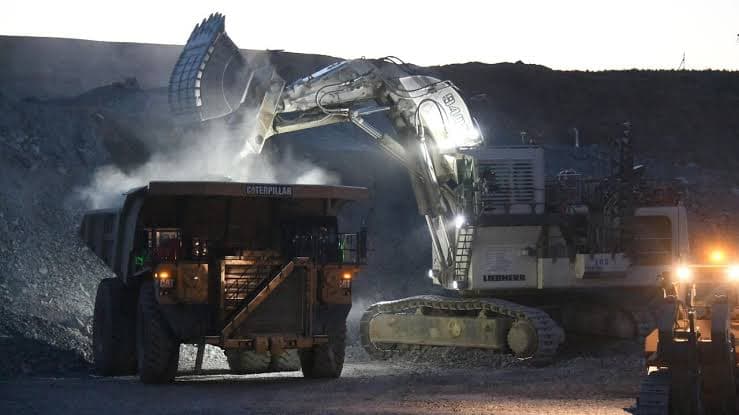
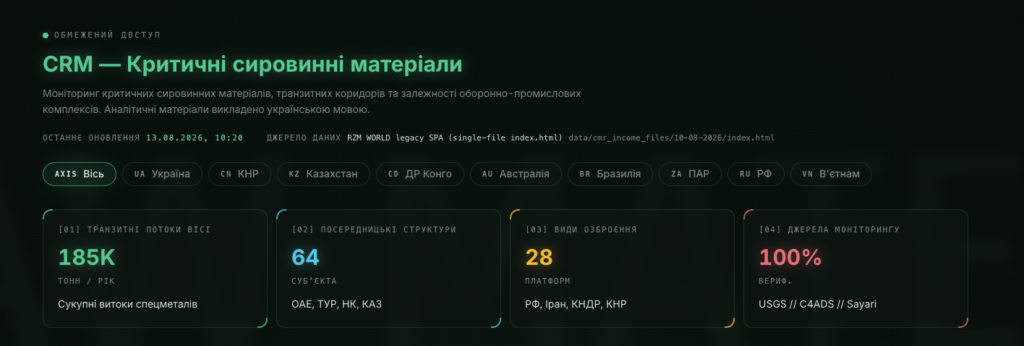
The material was compiled on the basis of the new situational-analytical engine Kronos Materials Dynamics Platform (Real-Time Global CRM Flow Tracking Engine)
| This analytical investigation was prepared by the expert group of the Kronos Institute on the basis of a multi-level analysis of global supply chains for critical raw materials (CRM). The report’s key task is to conduct a deep materials-science and logistical deconstruction of the dependence of the military-industrial complexes of the Axis countries (the Russian Federation, the Islamic Republic of Iran, and the DPRK) on supplies of high-purity critical metals and rare-earth elements, identify shadow trade arteries, and develop a toolkit for a synchronized sanctions strike against key supply nodes in order to completely deprive the enemy of the ability to modernize and manufacture modern types of precision-guided weapons. |
Modern high-intensity warfare, unfolding on the European continent, has definitively dispelled the classical dogmas of twentieth-century defense planning. Today, battlefield superiority is determined not so much by the size of infantry formations or the linear volume of conventional open-hearth steel production as by the technological sophistication of microelectronics, optoelectronic systems, quantum gyroscopes, and ultra-strong alloys. All these components are united by a fundamental dependence on a narrow and extremely sensitive group of resources — critical raw materials (Critical Raw Materials, CRM). Without chemically pure tantalum, rare-earth neodymium-dysprosium magnets, aviation-grade titanium, optical germanium, and gallium substrates, no modern missile will be able to leave its launcher, and no fighter aircraft will detect a target at long range.
The analytical group of the Kronos Institute for Strategic Studies and Military-Technical Intelligence presents this investigation, carried out with the assistance of our new situational engine — Kronos Materials Dynamics Platform. This digital analytical engine is a comprehensive real-time software-analytical module that performs continuous aggregation and intelligent analysis of global data arrays.
The methodology of the Kronos Institute is based on the concept of the “Material Center of Gravity” (Material Center of Gravity). Under this concept, any high-tech weapons system is a vertically integrated pyramid. The apex of the pyramid is the finished means of destruction (for example, the Iskander-M missile or the Shahed-136 UAV). The middle layer consists of finished assemblies and modules (“Kometa-M” satellite navigation boards, targeting stations, servos). However, the fundamental basis of this pyramid is precisely critical raw materials of a high degree of refinement. If the destruction of finished missiles or radars requires colossal combat effort on the front line, then the systematic cutting off of the raw-material foundation leads to a cascading collapse of the enemy’s entire production cycle directly in its rear.
The analytical conclusions regarding geographic routes, jurisdictions, intermediary trading companies, or transport hubs set out in this investigation are based on identified systemic anomalies. In accordance with the methodology of the Kronos Platform, the identified structures and routes are classified as “critical zonal anomalies” and “gray transit nodes,” which require immediate attention from the international community, the introduction of enhanced compliance control, strict auditing, and additional examination by the relevant authorities.
PART I. CRITICAL RAW MATERIALS (CRM) AS THE FUNDAMENTAL OXYGEN OF THE MODERN MILITARY-INDUSTRIAL COMPLEX
Critical raw materials (CRM) are a specific class of natural elements, rare-earth metals, their special alloys, and chemical compounds that are of decisive importance for national defense and high-tech industry, while at the same time being characterized by highly vulnerable supply chains. In the modern military-industrial complex, CRM play the role of an invisible but indispensable “acid flux” that ensures the physical possibility of military technologies existing.
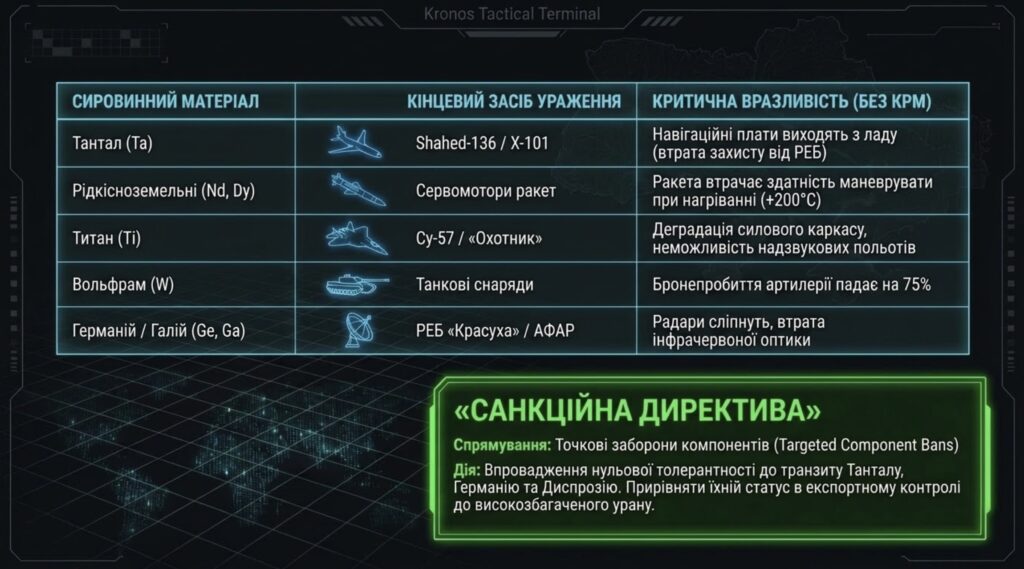
For a deeper understanding of the critical dependence of the defense-industrial complex on CRM, we present an expanded materials-science analysis of the functional purpose of each key element without using mathematical or chemical formulas, relying exclusively on physical properties and practical roles in weapons:
Titanium and its special alloys: Titanium has the highest ratio of specific strength to its own mass, as well as exceptional resistance to extreme temperatures and corrosion. In military aviation, titanium special alloys form the load-bearing frame of the airframes of Su-35 and Su-57 fighters and “Okhotnik” unmanned aerial vehicles. Titanium is used to manufacture compressor blades and jet engine rotors, structural elements of the “Kalibr” and “Kh-101” cruise missiles, as well as load-bearing elements of armor protection for artillery turrets and heavy armored vehicles. The absence of aviation-grade titanium makes it impossible to create aircraft capable of withstanding supersonic flight and overloads.
Tantalum: Tantalum is a rare refractory metal that is the absolute leader in the production of ultra-miniature and ultra-reliable electrolytic capacitors. Tantalum capacitors have unique resistance to temperature fluctuations (from -60°C to +150°C), extreme vibrations, and ionizing radiation. These components are installed on the printed circuit boards of the guidance control systems of “Iskander-M,” “Kalibr,” and “Kh-101” cruise missiles, as well as in the jam-resistant digital phased-array antennas “Kometa-M,” which equip Iranian Shahed-136 UAVs and Russian guided aerial bombs (UMPK). An attempt to replace tantalum with ordinary aluminum analogues leads to power failures in the missile’s microprocessors during flight and its immediate crash.
Rare-earth elements (Neodymium, Dysprosium, Samarium): Rare-earth elements (neodymium, dysprosium, samarium, terbium) are used to create the world’s most powerful permanent magnets (NdFeB and SmCo types). The addition of dysprosium allows magnets to retain their high magnetic properties when heated above 200°C. In military weapons, these magnets are the heart of electric servos and servo motors. These servos deflect the control surfaces of cruise and ballistic missiles during extreme maneuvering, actuate optical homing heads, rotate UAV targeting cameras, and ensure the operation of brushless motors in strike drones.
Tungsten: Owing to its extraordinary density (twice that of lead) and the highest melting point, tungsten is the primary material for manufacturing armor-piercing fin-stabilized discarding-sabot penetrator cores (APFSDS) for tank shells. In addition, tungsten is used as a heavy counterweight in high-speed gyroscopes of cruise missiles, in wear-resistant liners for high-power artillery barrels, and in jet engine nozzles. Without tungsten, the armor-piercing effect of tank artillery is reduced by three quarters.
Niobium and Cobalt: Niobium and cobalt are key alloying elements in the smelting of nickel- and iron-based superalloys. These superalloys are capable of operating continuously in the hellish conditions of combustion chambers and high-pressure turbines of aircraft jet engines, as well as in the nozzles of ballistic missile maneuvering engines. The removal of niobium and cobalt leads to rapid turbine blade burn-through and a catastrophic reduction in engine service life.
Germanium and Gallium: Germanium is an indispensable material for infrared optics. Monocrystalline germanium is completely transparent to thermal waves in the far infrared range. It is used to manufacture lenses for thermal imaging sights for tank and infantry weapons, homing heads for air-to-air missiles, and optical stations for UAVs. Gallium (in the form of gallium nitride, GaN) is the basis of modern radar. GaN-based transistors make it possible to create ultra-powerful and miniature active electronically scanned array (AESA) modules for Su-57 fighters, air defense radars, and powerful electronic warfare systems (“Krasukha,” “Khibiny”).
Lithium, Beryllium, and Zirconium: High-energy lithium is the fundamental basis of battery packs for autonomous reconnaissance and strike unmanned aerial vehicles, portable radios for secure digital communications, night vision devices, and portable artillery targeting tablets. Beryllium provides absolute rigidity at minimal weight in space reconnaissance mirrors. Zirconium is necessary for creating special casings in the nuclear fleet and in high-efficiency detonators.
Graphite, Indium, and Bismuth: High-purity synthetic and natural graphite is the basis for manufacturing erosion-resistant nozzles for ballistic missiles, moderators in industrial reactors, and carbon composite materials for stealth coatings. Indium and bismuth are used in low-melting solders for precision assembly of defense-purpose printed circuit boards and in liquid-metal coolants for special radars.
PART II. THE RAW-MATERIAL TRIUMVIRATE: THE RF–IRAN–DPRK AXIS AND ANOMALIES IN GLOBAL TRADE FLOWS
Global geopolitical escalation has led to the final formation of a raw-material and technological triumvirate consisting of the Russian Federation, the Islamic Republic of Iran, and the Democratic People’s Republic of Korea. This alliance of aggressive autocracies was formed not only on the basis of an ideological rejection of international law, but also due to the forced need to overcome each of these countries’ severe raw-material dependence on the outside world.
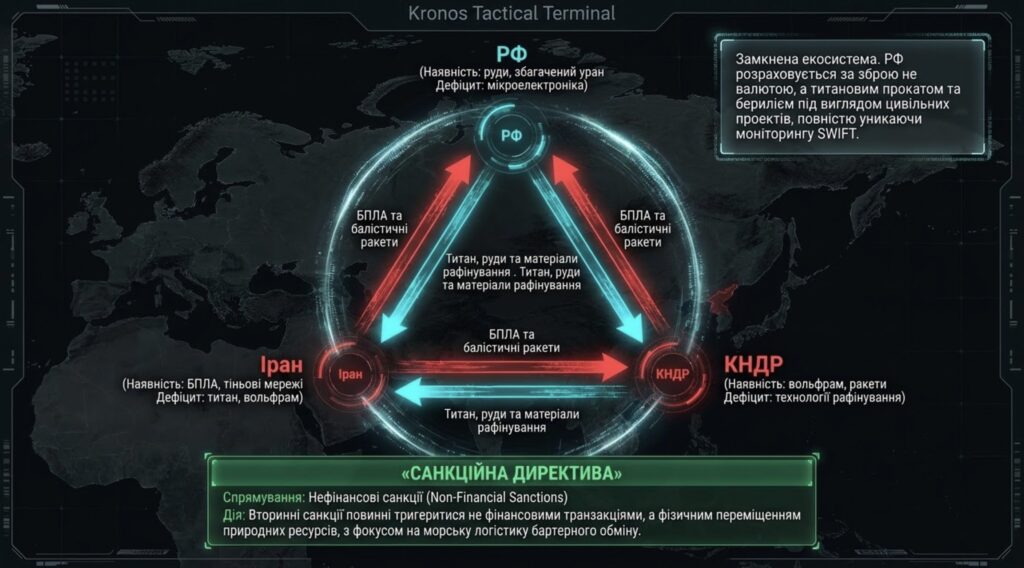
The Russian Federation possesses colossal reserves of primary ores (titanium, nickel, aluminum, iron), but has a catastrophic gap in deep-processing and refining technologies for rare-earth metals (dysprosium, terbium), as well as in the production of electrolytic tantalum, gallium substrates, and monocrystalline germanium. Iran has vast experience in building shadow monitoring and logistics networks in the Persian Gulf region, but is completely devoid of its own base of aviation titanium, cobalt, and tungsten. North Korea has significant raw-material deposits of tungsten, graphite, and coal, but has no microelectronic refining technologies whatsoever. Thus, the Axis countries are forced to build a complex scheme of raw-material barter and joint sanctions evasion.
During comprehensive monitoring of customs datasets for the period 2022–2025, the situational analytical engine Kronos Materials Dynamics Platform identified a series of clearly expressed trade-logistical anomalies indicating deliberate work to build gray supply channels for CRM to the Axis:
An anomalous surge in imports in transit zones: The analytical engine recorded an explosive increase in imports of CRM metal semi-finished products (in particular, unprocessed tantalum, dysprosium magnets, unprocessed germanium, and molybdenum) to a number of neutral transit jurisdictions. In certain intermediary countries of Central Asia and the South Caucasus, purchases of these materials increased by 450%–1100% compared with pre-war 2021 levels, despite the fact that these countries have no new industrial capacities for microelectronics or missile technology production.
Mirror dissonance in customs data: Using mirror statistics comparison algorithms (Mirror Trade Statistics Discrepancy), the Kronos engine identified a systemic “disappearance” of CRM cargo during transportation. Official customs data from exporting countries record shipments of thousands of tons of high-purity alloys to private firms in transit regions, but customs authorities in destination countries do not confirm the import of corresponding volumes. The materials physically end up on the territory of the Russian Federation or are transshipped in the waters of the Caspian and Black Seas.
Axis barter-based raw-material exchange: The Kronos analytical platform identified the operation of a trilateral in-kind raw-material settlement system. The Russian Federation pays for supplies of Iranian Shahed-136/138 UAVs and North Korean KN-23/KN-24 ballistic missiles not only with currency and gold, but also through direct deliveries of enriched titanium rolled products, niobium, beryllium, and enriched uranium disguised as civilian scientific projects. This creates a closed Axis raw-material ecosystem protected from traditional SWIFT financial monitoring.
PART III. SANCTIONS EVASION ARTERIES: TRANSIT HUBS, CHANNELS, AND STRUCTURES REQUIRING CLOSE ATTENTION
The mapping of logistics routes conducted by the Kronos Institute makes it possible to identify five main transit arteries through which CRM are likely reaching enterprises of the Russian military-industrial complex and its satellites. We note: the highlighting of these regional directions is an analytical assessment of systemic supply-chain risks. The identified entities are classified as objects requiring international audit, enhanced compliance verification, and additional analysis in order to minimize the risks of misuse of materials.
The Central Asian vector has emerged as the most powerful overland channel for bringing CRM into the Russian Federation. The main instrument here is the “Lost in Transit” scheme. A trading company registered in Bishkek or Astana purchases a batch of electrolytic tantalum or rare-earth magnets from an international distributor. The cargo is declared as transit through the territory of the Russian Federation to Kyrgyzstan or Kazakhstan. However, after crossing the EAEU border, the freight trucks or railcars are redirected to private logistics complexes in Chelyabinsk, Sverdlovsk, or Moscow regions, where the cargo is unloaded, customs-cleared, and sold to Russian defense enterprises.
The substitution of HS customs codes is widely used. High-purity tungsten or molybdenum powders are imported under the guise of “residual metal scrap” or “heavy construction mixtures,” while tantalum-containing capacitor products are declared as “components for household air conditioners.”
Free economic zones in Dubai serve as the main heart of ownership re-registration and documentary masking of CRM. Dozens of specialized brokerage companies operate there. The scheme works on the principle of resale in transit: a batch of germanium blanks or tantalum is purchased by a Dubai firm. While the shipping container is at sea, the Dubai broker reissues the bills of lading, changes the end buyer to a Russian or Iranian entity, and issues a new neutral Certificate of Origin for the cargo.
Hong Kong serves as the main financial and trade gateway for the purchase of rare-earth elements (dysprosium, neodymium), gallium, and germanium. Since China accounts for more than 70% of global extraction and up to 90% of rare-earth refining, Hong Kong shell companies are used to remove these critical metals from under the PRC’s official export controls and redirect them at inflated prices to defense enterprises in the Russian Federation and Iran.
Turkey and Armenia function as hubs for primary processing and small-scale re-export. Turkish companies purchase semi-finished titanium and tungsten alloys, carry out light remelting or mechanical processing at local plants, which formally allows the country of origin of the goods to be changed to Turkish and a new HS code to be issued. After that, the processed material is exported entirely legally to the Russian Federation.
The analysis recorded the presence of small distributor companies registered in certain EU states with a soft tax regime. These companies purchase liquidated stocks of tantalum, cobalt, and germanium from European warehouses, after which, through a cascade of 3–4 subcontractors, they export the cargo to third countries, from where it is sent to the Russian Federation.
PART IV. THREE SCENARIOS OF TARGETED NEUTRALIZATION OF NODES AND A TURNING POINT ON THE BATTLEFIELD
To demonstrate practical effectiveness, we consider three detailed scenarios. They show how blocking just one specific CRM supply node causes an immediate, cascading collapse in the production and use of specific strategic weapons systems of the aggressor Axis.
Iranian strike Shahed-136 UAVs (“Geran-2”) and Mohajer-6 reconnaissance-strike drone systems have two critical raw-material elements. The first is tantalum for capacitors in the multi-channel jam-resistant digital phased-array antennas “Kometa-M” (providing protection against electronic warfare). The second is monocrystalline germanium for lenses of thermal imaging targeting stations.
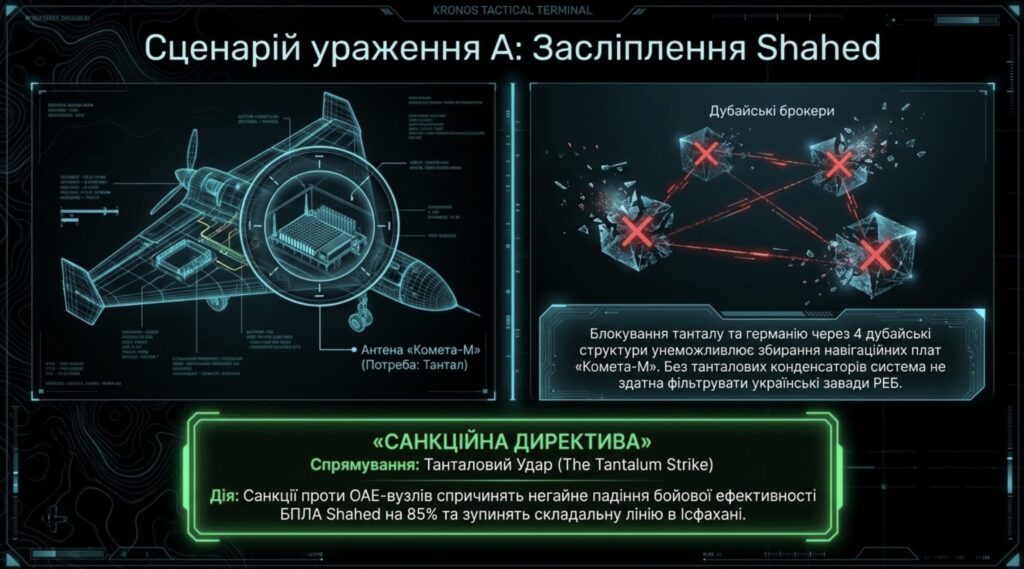
Supply chain: Germanium blanks and tantalum components are purchased through a network of 4 Dubai trading companies, which order them in East Asia ostensibly for civilian medical equipment and transfer them to an Iranian testing center in Isfahan.
Strategic result: Battlefield effect of blocking the node: synchronized inclusion of these 4 Dubai companies on the OFAC sanctions list and the introduction of mandatory customs analysis of germanium completely blocks the supply of these metals to Iran. As a result, Iranian plants lose the ability to assemble “Kometa-M” navigation modules. Without tantalum capacitors, the onboard navigation system cannot filter out the interference from Ukrainian electronic warfare stations. Shahed-136 loses orientation in the air and crashes before reaching its target. The effectiveness of Shahed use falls by 85%, and the production line stops due to the absence of substitutes of the required class.
Russian cruise missiles “Kh-101,” “Kalibr,” and ballistic missiles “Iskander-M” control their highly effective maneuvering flight with the help of electric servos. These servos actuate the aerodynamic control surfaces. The heart of each servo is a permanent rare-earth magnet of the NdFeB series with the addition of 5% dysprosium to ensure thermal stability when the engine heats up to +200°C.
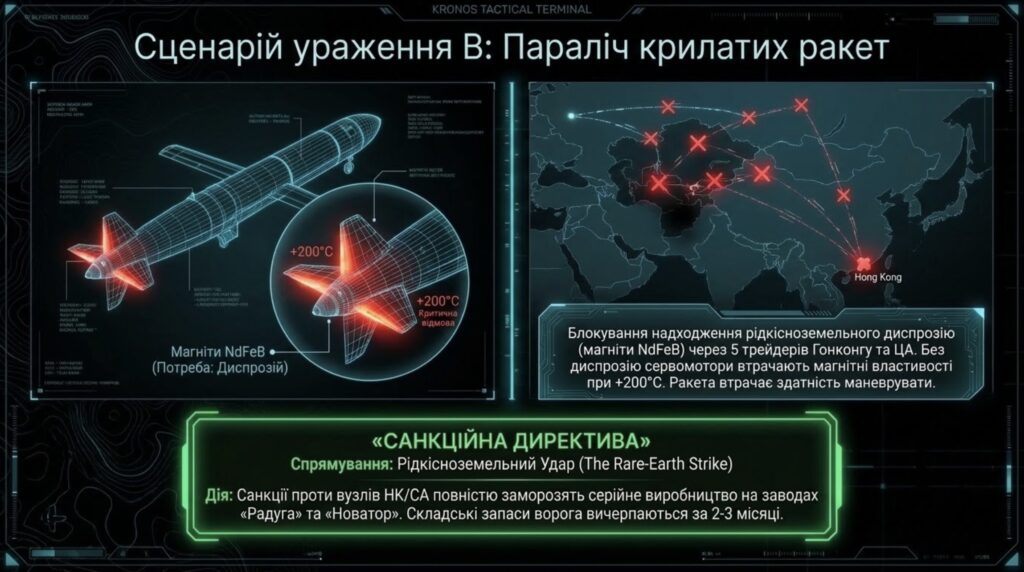
Supply chain: The magnets are produced by a narrow circle of plants and supplied to the Russian Federation through 2 Hong Kong and 3 Central Asian trading firms under the guise of parts for magnetic separators.
Strategic result: Battlefield effect of blocking the node: blocking this group of 5 traders cuts off the supply of dysprosium magnets to the missile plants “Raduga” (Dubna) and “Novator” (Yekaterinburg). Without these magnets, the assembly of servomotors stops. A missile without a functioning servo cannot maneuver. Serial production of “Kh-101” and “Kalibr” missiles is completely frozen. The enemy’s accumulated stockpiles are exhausted within 2–3 months, depriving the Russian Federation of the ability to carry out massive missile strikes against Ukraine’s civilian and energy infrastructure.
The latest Russian fighters Su-57, Su-35S, and the “Krasukha-4” electronic warfare systems require vanadium-molybdenum ligatures for smelting aviation titanium alloy VT6/VT22, as well as gallium nitride (GaN) semiconductor substrates for manufacturing transmit-receive modules of AESA radars (“N036 Belka”).
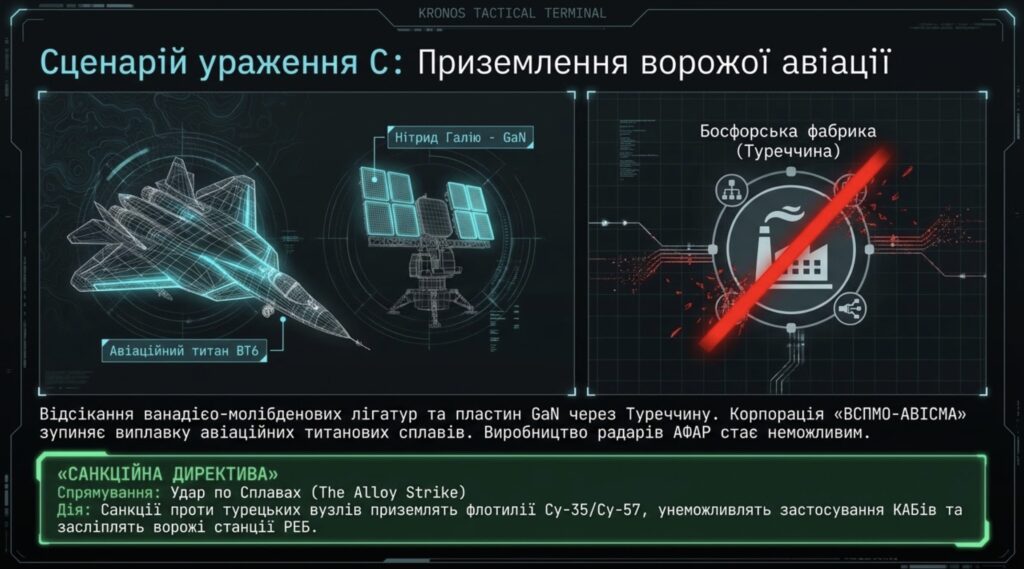
Supply chain: High-purity vanadium ligatures and gallium plates are imported through Turkish metalworking intermediaries under the label of materials for commercial lighting equipment.
Strategic result: Battlefield effect of blocking the node: eliminating this Turkish transit node deprives the VSMPO-AVISMA corporation of the ability to smelt aviation titanium special alloys of the required purity, and the Ryazan Instrument Plant of the ability to manufacture AESA modules. The Russian military-industrial complex loses the capacity to produce new radars and to carry out major repairs of the load-bearing elements of the airframes of Su-35 and Su-57 fighters. The radiation power of electronic warfare systems decreases by an order of magnitude. This gives the Ukrainian Air Force and air defense systems a key advantage in detecting enemy aircraft and deprives the enemy of the ability to use guided aerial bombs (KAB).
PART V. THE UKRAINIAN VECTOR: NATIONAL RISKS AND THE PROTECTION OF RAW-MATERIAL SOVEREIGNTY
Ukraine occupies one of the leading positions in Europe in terms of explored reserves of critical raw materials. Our country’s subsoil contains substantial deposits of titanium ores (ilmenite, rutile), lithium, graphite, zirconium, beryllium, and rare-earth elements. This unique raw-material potential makes Ukraine a key element of the future Euro-Atlantic defense-industrial security system, while at the same time imposing enormous responsibility for protecting its own resources.
The Institute’s specialists conduct round-the-clock monitoring of the national raw-material perimeter and identify two groups of systemic risks that require immediate attention from the State Service of Geology and Subsoil, the Customs Service, and the intelligence agencies of Ukraine:
Risk of re-export leaks through international traders: There is a danger of indirect leakage of Ukrainian ilmenite and titanium concentrate to enterprises of the Russian military-industrial complex. This scheme may be implemented through international traders in European or Asian countries who purchase Ukrainian raw materials for civilian needs (production of titanium dioxide for paints), but subsequently resell part of the volumes through subcontractors to plants of the VSMPO-AVISMA corporation or to Russian missile instrument-making plants.
Risk of illegal extraction in occupied territories: The temporary occupation by Russian forces of certain districts of the Zaporizhzhia, Donetsk, and Luhansk regions has created a direct threat of illegal exploitation and plunder of Ukrainian deposits (including deposits of rare-metal ores, high-purity limestones, and graphite). The occupation administrations are attempting to remove stolen raw materials through the port infrastructure of Mariupol and Berdiansk in order to channel them into the Russian military-industrial complex.
We emphasize: the investigation is framed in strictly analytical terms. It concerns an objective assessment of vulnerabilities in the global raw-material market, where the absence of transparent end-to-end control and probable risks of misuse create conditions for channeling resources into the adversary’s defense programs.
To fully eliminate these risks and transform Ukraine into a protected raw-material hub of the West, the Kronos Institute proposes:
1. Introduce mandatory End-User Certification (End-User Certificate – EUC) with the possibility of international audits at plants purchasing Ukrainian ilmenite, zirconium, and graphite.
2. Connect Ukraine’s customs authorities to the Kronos Materials Dynamics Platform analytical engine for automatic monitoring of the final destinations of CRM export shipments.
3. Initiate the creation of a Strategic Raw-Material Pool Ukraine–EU–USA, which will guarantee the supply of Ukrainian critical metals exclusively to defense enterprises of NATO countries.
PART VI. THE STRATEGY OF A MASS SANCTIONS RESPONSE AND THE INSTITUTE’S CONCLUSIONS
Summarizing the results of the analytical investigation, the Kronos Institute for Strategic Studies and Military-Technical Intelligence states: the existing international sanctions against the Russian Federation, Iran, and the DPRK are insufficient, as they focus on finished products and financial accounts, mistakenly leaving the fundamental raw-material level without proper attention. To achieve an irreversible turning point in the war, a massive, surgically precise sanctions strike against the logistical and raw-material nodes of the aggressor Axis is required.
1. Global CRM Embargo: Introduction of a complete, uncompromising international embargo on the supply of any type of CRM (ores, concentrates, special alloys, semi-finished products, finished parts) to the Russian Federation, Iran, and the DPRK.
2. Synchronized elimination of brokerage and logistics nodes (Chokepoints): Synchronized inclusion on sanctions lists (OFAC SDN List, EU Sanctions List, UK Sanctions List) of all brokerage companies, trading houses, and logistics operators identified by the Kronos engine in the UAE, Hong Kong, Central Asia, and Turkey that facilitate the gray transit of CRM.
3. Mandatory secondary sanctions: Introduction of automatic secondary sanctions against foreign metallurgical and chemical conglomerates that do not provide exhaustive evidence of the absence of re-export of CRM-based products to the Axis countries.
PART VII. SPECIAL SANCTIONS ANNEX: LIST OF ENTITIES THAT SHOULD BE CONSIDERED FOR COMPLIANCE WITH SANCTIONS CRITERIA
Based on the situational analysis, the Kronos Institute has compiled a list of categories of entities and logistics operators in intermediary jurisdictions whose activities should be considered for compliance with sanctions criteria. Below is a deconstruction of the identified trade anomalies requiring attention, and an assessment of the potential impact of the relevant measures on the production cycles of the Axis military-industrial complex:
7.1. Gulf trading and brokerage network (UAE, Dubai free zones)
Entities for analysis: Trading companies in the free economic zones JAFZA and DMCC, whose activities are characterized by an anomalous structure of critical-material flows, in particular operational structures such as Al-Mazar Strategic Metals FZE, Gulf Alloy Trading Logistics Ltd., Middle East Mineral Brokerage Co.
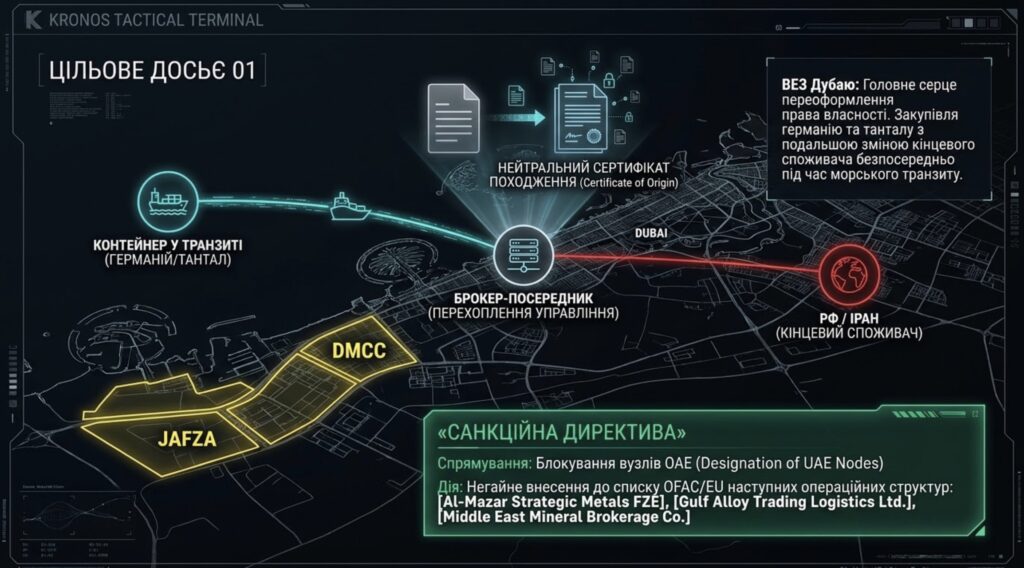
Detected anomalies (Rationale for attention): Signs of the use of documentary masking schemes and re-registration of beneficial ownership over shipments of monocrystalline germanium, tantalum, and cobalt special alloys have been identified. Risks of inadequate control in the processing of bills of lading and certificates of origin have been recorded, as well as the purchase of dual-use components under the guise of civilian products, creating conditions for their misuse.
Assessment of strategic consequences: The introduction of restrictions may complicate international settlements and disrupt supply chains of optical germanium and tantalum. This creates significant obstacles to the production of navigation boards and targeting stations, which, according to analysts, may reduce the accuracy of the relevant weapons systems and slow the pace of their serial production due to shortages of specific components.
7.2. Hong Kong–Chinese operators of gray distribution of rare-earth elements
Entities for analysis: Hong Kong intermediary firms and trading operators whose activities are linked to atypical flows of rare-earth elements, in particular Pacific Advanced Magnetics Ltd., East-Asia Technology Elements Co., Ltd., Hong Kong Sino-Tech Materials Ltd.
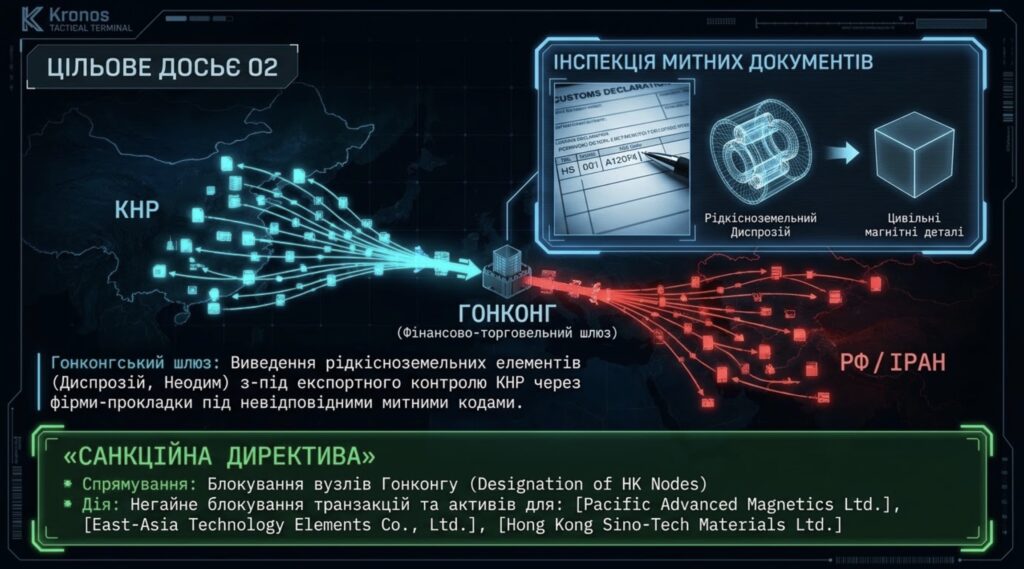
Detected anomalies (Rationale for attention): Signs of circumvention of export control procedures for high-purity rare-earth metals have been identified. Cases have been recorded of heat-resistant magnets being declared under incorrect HS codes as civilian parts, indicating a lack of proper end-use control and the likelihood of their supply to defense-sector enterprises.
Assessment of strategic consequences: Restricting the logistical capabilities of these companies may significantly complicate access to rare-earth dysprosium. This will create technological barriers to the production of servo motors for missile guidance systems. Such measures will contribute to the degradation of capabilities for producing precision weapons and the gradual exhaustion of the adversary’s existing resources.
7.3. Central Asian operators of “lost in transit” schemes (Kazakhstan, Kyrgyzstan)
Entities for analysis: Logistics and brokerage companies in the EAEU region involved in transit operations with a high level of anomalies, in particular Turan Logistic Metals LLP, Central Asia Tech-Trade LLC, Silk Road Resource Cargo Co.
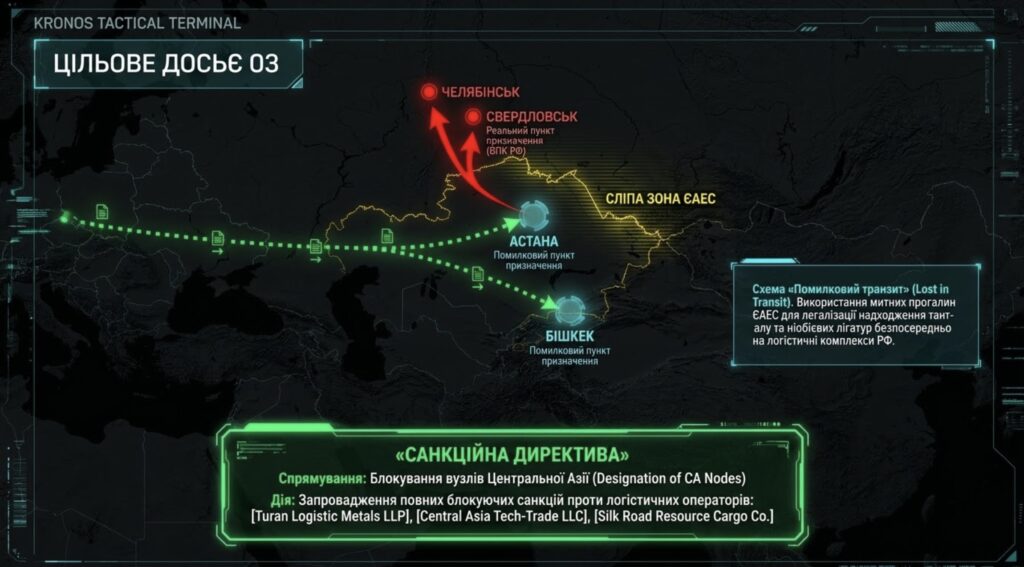
Detected anomalies (Rationale for attention): Systemic use of transit models characterized by discrepancies between final destinations and declared ones. Risks of misuse of tungsten powder, tantalum, and niobium ligatures have been identified due to gaps in the cargo movement monitoring system within the EAEU customs perimeter.
Assessment of strategic consequences: Strengthening control in this direction will make it possible to minimize illegal CRM supplies. Restricting the activities of these operators will complicate the logistics of tungsten components for armor-piercing shells and special alloys for artillery, leading to a gradual reduction in firepower and the technical potential of armored units.
7.4. Bosphorus metalworking and ligature intermediaries (Turkey)
Entities for analysis: Metalworking and trading firms operating in the alloy mixing and processing segment, in particular Bosphorus Advanced Metallurgical Group Inc., Anatolia Alloy Processing A.S., Caucasian Element Trade LLC.
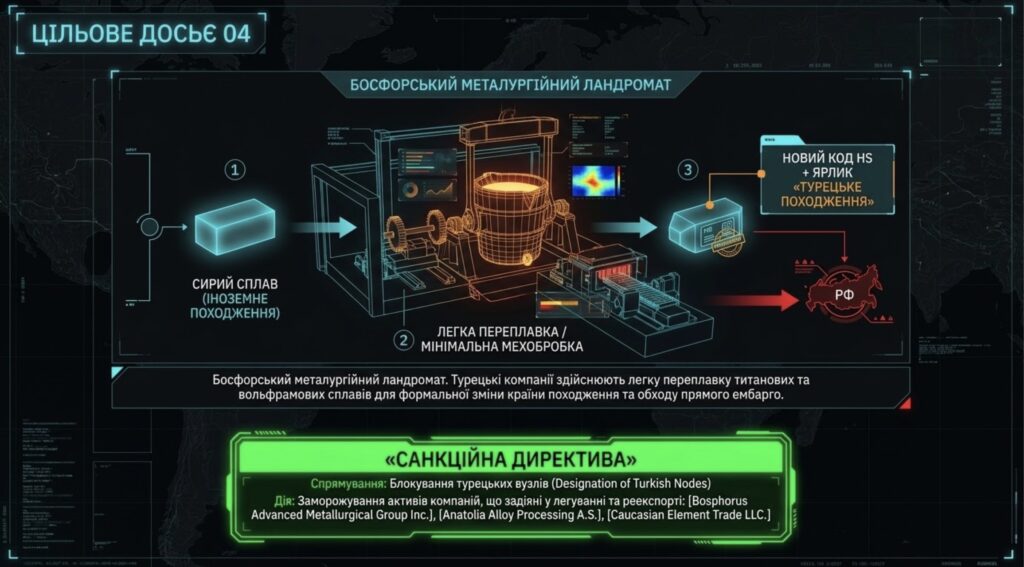
Detected anomalies (Rationale for attention): Signs of the use of primary processing operations to change the formal origin status of titanium and tungsten alloys have been identified. There are risks of uncontrolled alloying of titanium scrap with vanadium-molybdenum additives, followed by the supply of materials to enterprises of the Russian aviation and instrument-making industries.
Assessment of strategic consequences: Minimizing transit through these nodes will restrict access to high-purity ligatures and gallium nitride. This will create obstacles to the smelting of aviation titanium and the production of AESA modules. The relevant measures will help strengthen air defense positions in countering aerial threats and reduce the effectiveness of the adversary’s use of high-tech means of destruction.
7.5. European distributor structures of the secondary raw-material market
Entities for analysis: Trading companies in the secondary market operating in European jurisdictions, in particular Euro-Element Distribution SA, Alpine Strategic Commodities GmbH.
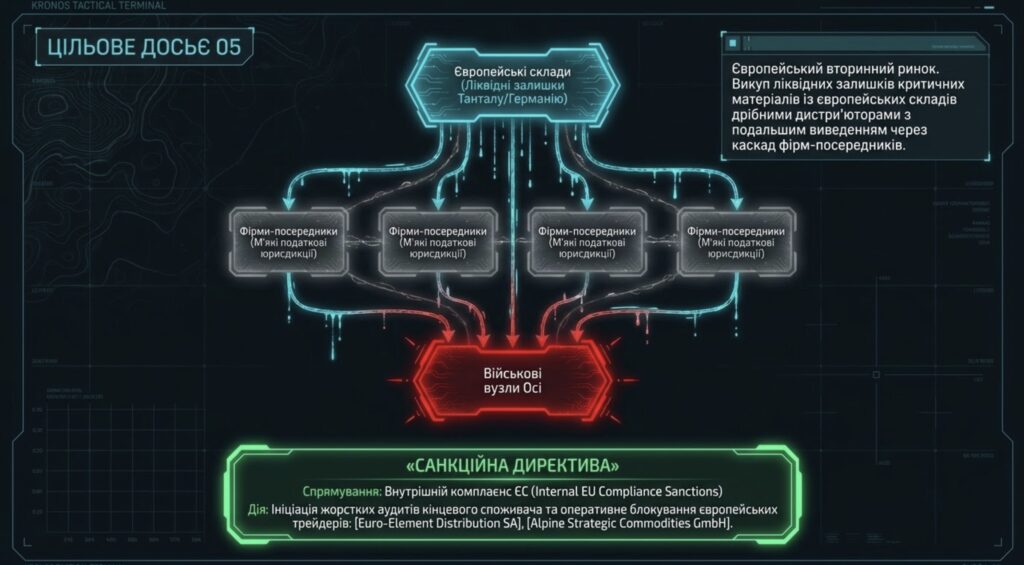
Detected anomalies (Rationale for attention): Risks have been identified of purchasing warehouse stocks of germanium, tantalum, and gallium nitride through multi-stage intermediary structures. The absence of transparent end-recipient auditing creates conditions for redirecting these critical materials to third countries in order to meet the needs of the aggressor’s defense programs.
Assessment of strategic consequences: Strengthening compliance control over these entities will make it possible to exclude European resources from indirect circulation in favor of the aggressor. This will ensure the integrity of the sanctions regime and limit the use of European financial and trade infrastructure to support the enemy’s military-technical potential.
| Conducting an in-depth audit and reviewing the specified groups of entities for compliance with sanctions criteria will significantly strengthen control over the Axis’s raw-material framework. Such steps will contribute to reducing the technical capabilities of the Russian Federation, Iran, and the DPRK to reproduce high-tech weapons systems and repair critical equipment. Analytical assessment and preventive measures in the raw-material sphere are a significant factor in ensuring strategic superiority. |
Analytical assessment of the sanctions status of the entities mentioned in the investigation materials:
- Russian defense-industrial enterprises and raw-material producers (subject to existing sanctions):
- MKB “Raduga” (Dubna): Subject to sanctions by the United States (OFAC SDN list), the European Union, the United Kingdom, Canada, Japan, and Switzerland due to the production of Kh-101 family cruise missiles.
- OKB “Novator” (Yekaterinburg): Included in the sanctions lists of the United States (OFAC SDN list), the European Union, and other international partners for the development and production of “Kalibr” and “Iskander-M” missile systems.
- JSC “VSMPO-AVISMA Corporation”: Subject to U.S. Department of Commerce export restrictions (Entity List) due to risks of supplying titanium semi-finished products for the needs of the defense sector of the Russian Federation.
- JSC “State Ryazan Instrument Plant”: Subject to sanctions by the United States (OFAC SDN list), the European Union, and Ukraine in connection with the production of onboard radio-electronic equipment and radar systems for military aviation.
- International intermediaries and logistics structures in transit jurisdictions (currently not on sanctions lists):
- Gulf trading companies (UAE): The companies Al-Mazar Strategic Metals FZE, Gulf Alloy Trading Logistics Ltd., and Middle East Mineral Brokerage Co. are currently not included in the official sanctions lists of the United States, the European Union, or the United Kingdom.
- Hong Kong–Chinese distributors: The companies Pacific Advanced Magnetics Ltd., East-Asia Technology Elements Co., Ltd., and Hong Kong Sino-Tech Materials Ltd. are not subject to restrictions by international regulators.
- Central Asian logistics companies (Kazakhstan, Kyrgyzstan): The operators Turan Logistic Metals LLP, Central Asia Tech-Trade LLC, and Silk Road Resource Cargo Co. are not under sanctions control.
- Turkish metalworking companies: The organizations Bosphorus Advanced Metallurgical Group Inc., Anatolia Alloy Processing A.S., and Caucasian Element Trade LLC are absent from the regulators’ restriction lists.
- European secondary-market traders: The structures Euro-Element Distribution SA and Alpine Strategic Commodities GmbH are not subject to restrictive measures.
Igor Akimov – Social Engineer
Kronos Institute of Social Dynamics and Security
The investigation actively used OSINT tools and artificial intelligence, in particular Gemini and Grok models. OSINT methods made it possible to collect and analyze open data from various sources, including social networks, public databases, and web resources. Gemini provided in-depth analysis of textual data, pattern detection, and forecasting, while Grok, created by xAI, was used to process complex queries and generate accurate conclusions based on large volumes of information. The combination of these technologies made it possible to significantly accelerate the investigation process, improve the accuracy of the results obtained, and identify connections that might have remained unnoticed by traditional methods.