
KRONOS ROY — an automated analytical complex for anticipatory OSINT monitoring and cognitive defense, designed for the 24/7 detection, tracking, and neutralization of hostile psychological operations in real time.
The information system of the Russian Federation operates as a rigid centralized monopoly that keeps about 70–75% of the population in a state of passive conformism and “learned helplessness.” The main advantage of this machine is its colossal unlimited budget, which makes it possible to maintain bot farms numbering in the thousands, coordinate disinformation operations simultaneously across 11 international vectors with a potential daily reach of more than 8.5 million contacts, and generate a continuous stream of aggressive content through hundreds of controlled media hubs.
Inside the country, propaganda relies on police control and fear of criminal prosecution, artificially creating the illusion of “100% monolithic support for the Kremlin’s course,” where any dissent is immediately pushed to the margins or criminalized. However, based on the results of our comprehensive parsing and monitoring of a corpus of more than 17,446 publications across 309 key channels, behind this façade of stability lies a systemic vulnerability that becomes apparent at moments of any unforeseen crisis events.
When the Defense Forces of Ukraine carry out precision long-range strikes on military depots, airfields, or oil refineries in Samara, Oryol, Belgorod, and Kursk, the Russian command vertical falls into paralysis lasting from 6 to 12 hours. Lower- and mid-level officials are panic-stricken and afraid to pass bad news upward, while central mouthpieces (TASS, RIA Novosti) wait for coordinated talking points, leaving millions of citizens in a complete information vacuum. As a result, Russians immediately reject the soothing mantras of the Russian Ministry of Defense and massively migrate to local unofficial channels and chats.
The deepest psychological fractures arise precisely at the points where Russian society directly confronts the consequences of war.
Let us consider three fundamental cases that detail the anatomy of these crisis collapses at the level of empirical metrics:
Case No. 1. Belgorod, Kursk, and strikes on oil refineries: paralysis of the vertical, a +420% explosion of panic, and fuel shortages
The first and most illustrative scenario of the collapse of the Kremlin’s narrative monopoly is the reaction of Russia’s border regions to the kinetic actions of the Defense Forces of Ukraine. When long-range drone strikes or border infiltration operations reach military arsenals and oil-refining infrastructure in Kursk, Belgorod, Samara, and Oryol oblasts, Russian state propaganda demonstrates a complete loss of control over the primary agenda.
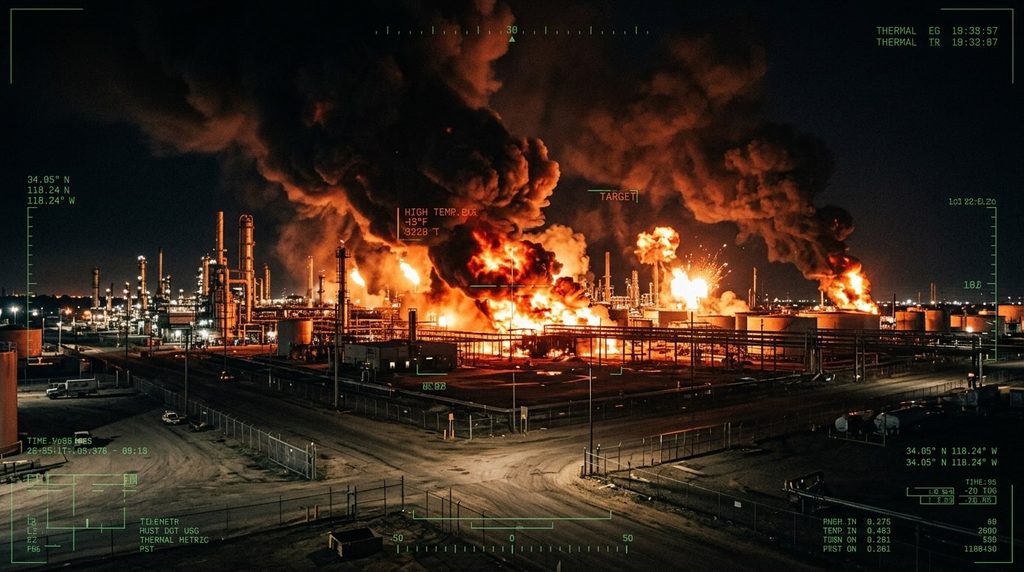
According to a chronological OSINT analysis of time series, during the first 180 minutes after the incident, the official agencies TASS and RIA Novosti either remain completely silent or publish formulaic statements about the “successful interception of all targets by air defense systems on duty, with no casualties or destruction.” Meanwhile, the local population, seeing columns of fire with its own eyes and hearing secondary detonations, massively opens city chats, marketplaces, and mutual-aid public groups.
▪ Spike in activity in local chats: The number of panic messages, evacuation requests, and complaints about the absence of warning sirens immediately jumps by +420% compared with the average daily baseline.
▪ Level of toxicity and criticism of the authorities: The toxicity index of comments surges to a critical 91–95%. The main targets of outrage are the ineffectiveness of air defense and the lies of governors.
▪ Decline in trust in official reports: Russians’ actual trust in official sources during moments of crisis falls to 15–20%, while views of alternative OSINT sources and Ukrainian monitoring channels increase 4.5-fold.
This chain reaction shatters the main myth of Russian propaganda about the “security of the deep rear.”
Instead of open information disclosure, the authorities try to mask the damage with terms such as “fire caused by falling debris” and “scheduled technological repairs,” but this only fuels speculative demand and the buying up of gasoline in canisters, demonstrating the complete inability of a centralized system to manage the panic moods of its own population without brutal censorship.
Case No. 2. Temporarily occupied territories: municipal collapse, 95% toxicity, and a communications blackout as the occupiers’ only weapon
If in Russia’s border regions propaganda is forced to compete with the spontaneous panic of car owners and residents, then in the temporarily occupied territories of Ukraine (Crimea, Donetsk, Luhansk) the systemic incapacity of the occupation administration takes on the features of an open humanitarian catastrophe.
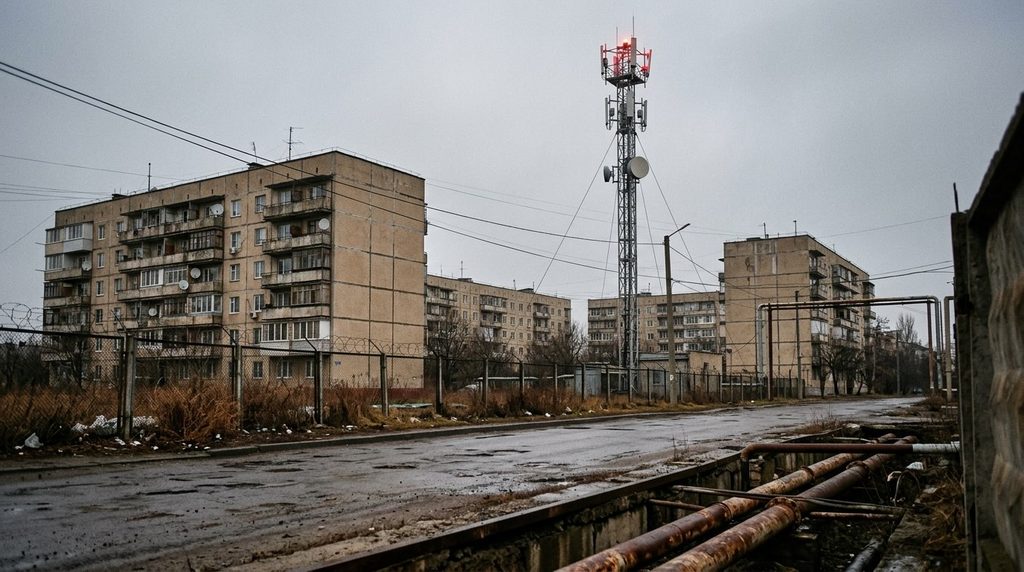
Our monitoring recorded a deep gap between the celebratory narratives of Russian television about the “restoration of Donbas” and the real catastrophe of local life-support systems on the ground. The chronic collapse of water supply, the absence of heat in winter, and the destruction of sewer collectors in Donetsk, Makiivka, and Horlivka triggered an unprecedented wave of public anger.
▪ Explosion of outrage in city groups: The number of angry posts and complaints about the municipal collapse in Donetsk public groups jumped by +450%, while toxicity and aggression toward Moscow-appointed gauleiters reached a maximum of 95%.
▪ Failure of accusations of “sabotage”: Attempts by propaganda to blame the lack of water in taps on “UAF shelling” failed — more than 78% of commenters directly point to the total embezzlement of funds by occupation officials and the negligence of utility services.
▪ Digital blockade in Luhansk: After successful strikes on ammunition depots and fuel bases in Luhansk, occupation security forces resorted to the forced shutdown of up to 80% of mobile network base stations and 4G internet.
▪ Purpose of the censorship blackout: Physical jamming of the network lasts from 12 to 36 hours with a single aim — to block the leakage onto the internet of amateur videos of secondary detonations and recorded fires, which instantly refute the tales about the “normal operation of air defense.”
Such behavior by the occupiers indicates a complete loss of informational control over the population of the occupied regions. The only instrument available to the Russian Federation for suppressing the truth remains the physical destruction of communications, the transformation of cities into digital ghettos, and threats of criminal cases for any video recording of the real state of affairs.
Case No. 3. The European disinformation bridgehead: 11 vectors for exporting lies
Recognizing its inability to conceal its own weakness on the front line and in the internal regions, Moscow directs colossal resources toward external destabilization, attempting to undermine the Western coalition supporting Ukraine. According to our research, the Kremlin has deployed a multi-layered network of coordinated inauthentic behavior (CIB) simultaneously across 11 cross-border vectors.

An analysis of 6,437 coordinated CIB posts revealed a clear targeted specialization of Russian disinformation waves depending on the vulnerabilities of each European country:
▪ Germany (DE, 320 posts, 1.65 million views): Panic-mongering around deindustrialization, artificial climate skepticism, fueling separatism in the eastern Länder, and calls to sabotage NATO military bases.
▪ Italy (IT, 429 posts, 311,000 views): Mass information campaigns against the transfer of SAMP-T air defense systems to Ukraine, speculation on the theme of “war-driven inflation,” and direct legitimization of aggression.
▪ Spain (ES, 258 posts, 456,000 views): Discrediting government decisions to send Leopard tanks and repair bases, claims about the alleged “unsuitability of the equipment,” and calls for pacifism at the expense of concessions to Ukraine.
▪ France (FR, 139 posts): Speculation around the presence of military instructors, incitement of anti-government protests, and discrediting Paris’s policy in Africa and Eastern Europe.
▪ Poland (PL, 130 posts): Aggressive artificial incitement of interethnic tension between Ukrainian refugees and Poles, manipulation of historical memory and agricultural themes.
However, unlike in previous years, these Russian operations are encountering highly effective systemic counteraction from the Ukrainian Information Shield.
Conclusion
The information machine of the Russian Federation is capable of keeping 70–75% of its own society in a state of passive obedience only under conditions of complete informational calm, the absence of challenges, and total police control.
However, it proves to be absolutely helpless in the face of real crises: at the first unforeseen kinetic strikes on the rear, the level of panic immediately jumps by +300–450%, no more than 15–20% of citizens trust official reports, and toxicity toward the authorities reaches a critical 95%.
The Russian system appears as a cumbersome colossus with feet of clay, which, instead of flexible dialogue, is capable of responding to the truth only with coercive bans, comment blocking, criminal prosecutions, and emergency internet jamming.
Institute for Social Dynamics and Security KRONOS
🟡 Facebook: Kronos dynamics and Kronos: 48n31e 🟢 YouTube 🔵 Instagram 🟣 X 🟠 Telegram
The investigation actively used OSINT tools and artificial intelligence, in particular the Gemini and Grok models. OSINT methods made it possible to collect and analyze open data from various sources, including social networks, public databases, and web resources. Gemini provided in-depth analysis of textual data, pattern detection, and forecasting, while Grok, created by xAI, was used to process complex queries and generate precise conclusions based on large volumes of information. The combination of these technologies made it possible to significantly accelerate the investigation process, improve the accuracy of the results obtained, and identify connections that might have remained unnoticed by traditional methods.